


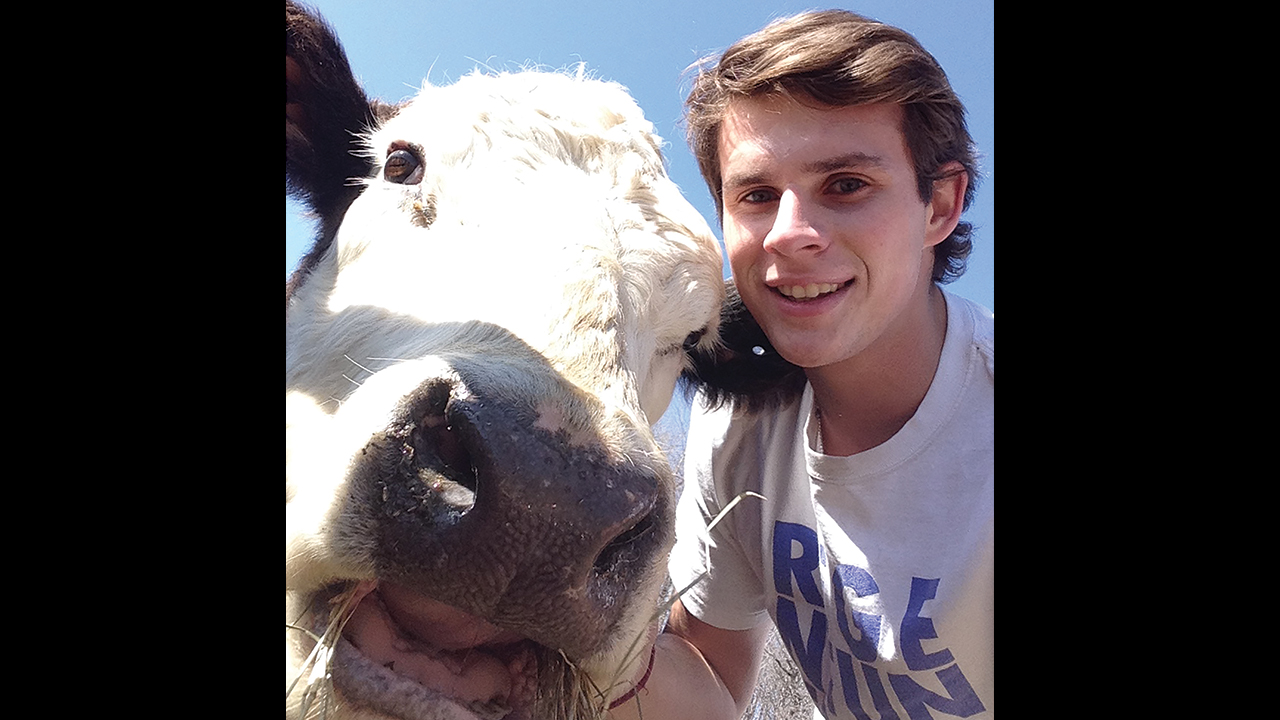
Growing up on a hobby farm in eastern Ontario meant eating meat at least twice a day, three times if we were lucky enough to wake up to the scent of Dad frying bacon. But I haven’t eaten pig flesh in over five years now, nor that of birds, cows, sheep or other mammals.
Why? Because I’m trying to embrace and usher in the nonviolent kingdom of God on Earth as it was in the Garden of Eden and will be on the new Earth.
But let me back up a few steps.
My parents never made any money from the farm, but alongside their regular jobs and our childhood endeavors we made maple syrup and raised animals. Sometimes we had geese, sometimes pigs, but more frequently we had chickens — and, for my teenage years, always cattle. I have memories of chasing the graceful beasts down our one-mile gravel road, golf club in hand as a gentle prod for any cows hesitant to trek to their new grazing area.
There are plenty more memories of us “processing” (killing and butchering) our chickens on the lawn. I was usually on the defeathering part of things, except for the time I asked to take the knife to perform the fatal slice. There was indeed blood, but unfortunately from my brother’s finger, leading to a trip to the hospital.
We were gentle with our animals, and they reciprocated, some of the cows becoming tame enough to hug. When a local cattleman delivered smacks to the backs of our bovine beauties when he came by to transport them to the sale barn, I realized not everyone took this approach.
Following the lead of the regenerative farming movement, we rotationally grazed every kind of animal we owned, so the creatures always felt the sun above and grass beneath. We were taught to disdain feedlots, a style of farming where hundreds or thousands of cows are fed grain in a small space for the sake of efficiency.
This and other factory-farming (or, in the industry parlance, “concentrated animal-feeding operation”) practices seemed wrong compared to the happy lives we gave our animals.
But I didn’t really think about where my meat came from until I was about 22. That was the year my wife became pregnant with our firstborn. Plagued with hyperemesis gravadarum, she was unable to eat, much less cook, any meaty dishes.
After bearing our son, she never got a taste for flesh again. She connected the dots between the creature and the freezer. Being a subpar and lazy cook, I became a meat minimalist, only eating animals if we were visiting other people or eating out.
And I survived. Over time I remembered my childhood warnings about factory farming and learned that over 99% of North America’s birds and pigs and 75% of cattle experience these unnatural operations before making their way to a grocery store.
With these stats in my mind, I took an Introduction to Moral Theology class at a Jesuit college as part of my master’s degree. When I asked the professor, John Berkman (a student of Stanley Hauerwas), about something he’d said about animals, he sent me an article he’d written — “Are We Addicted to the Suffering of Animals?” — in which he decried our addiction to “low-cost industrial meat.” I decided to give up eating birds and land mammals for a year. That was over five years ago.
As I studied scripture with animals on my mind, I discovered that despite the assumption that the natural world is but a backdrop for our salvation, God cares deeply for all his creatures. God only allowed us humans to eat other animals — long after the Fall — when the floodwaters receded (Genesis 9). At this time, God made a covenant not only with humans but with “every living creature” and “all flesh.”
I saw the legal protections God put into the Torah for animals, showing that God cares about our fellow creatures beyond what they can do or provide for us. I read psalms that described all creatures praising God, indicating that animals are capable of relationship with their Creator. I saw that Jesus recognized the value of even the most worthless — economically speaking — bird.
I was especially struck by the prophetic passages that describe a new (or, if you will, very old) way of animal relationships: the prey lying around comfortably with their predators. This is the Creator’s aim: a sinless creation where shalom, not violent predation, reigns.
Christians are people of the future. We are inspired by and living toward the restoration of all things, God’s new heaven and new Earth. Considering this, it makes sense for us to give up predation against our fellow creatures.
But it’s not easy. And, I admit, I fall short. If I truly lived up to my convictions in our world of factory-farmed eggs and dairy production, I’d be a full-fledged vegan. But I’m not. Despite my children’s protestations, I still occasionally eat fish, which technically makes me a pescatarian.
While I hold my convictions firmly, you won’t catch me making diet a requirement in my personal church book of discipline. I agree with New Testament scholar Richard Young that “the Bible neither commands nor condemns vegetarianism.” I also agree with Young that eating a plant-based diet is the best way to witness to God’s ultimate peaceful purposes for his creatures.
I think changing one’s diet is the easiest way to minimize the suffering of our fellow creatures and to prevent a host of environmental problems industrial agriculture contributes to. You may disagree — as my chicken-processing family members do — and I respect that.
In a world where animals are treated like raw materials or protein units, not eating land animals is the best way I can agree with God’s declaration that my fellow creatures are intrinsically good (Genesis 1), regardless of what they can do for me.
Jonathan Tysick studies the Gospels and Christ-centered animal ethics in a Ph.D. program at Stellenbosch University and the Free University of Amsterdam. He once worked at a Mennonite Brethren church in Toronto and now lives in Cape Town, South Africa, with his wife and two sons. He hosts a podcast and YouTube channel, “Bespectacled & Curious.”


Have a comment on this story? Write to the editors. Include your full name, city and state. Selected comments will be edited for publication in print or online.