


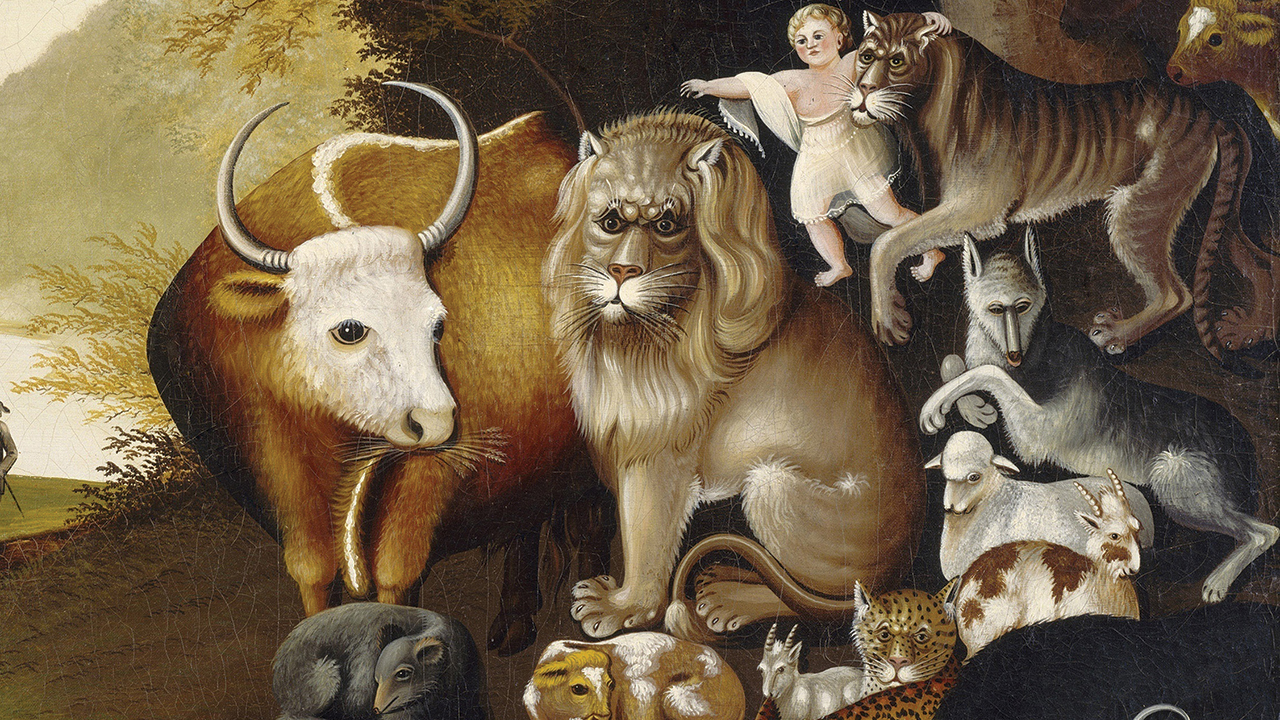
But ask the animals, and they will teach you; the birds of the air, and they will tell you; . . . Who among all these does not know that the hand of the Lord has done this? — Job 12:7, 9
What do the animals teach? Ironic as it sounds, they might show us how to be human.
Before we consider how they do this, we need to think about what it means to become fully human.
In Leaving Church (HarperOne, 2007), Barbara Brown Taylor says becoming fully human “is not the same as the job of being human, which came with my birth certificate. To become fully human is something extra, a conscious choice that not everyone makes. . . . Because I am a Christian, I do it by imitating Christ.”
Imitation of Jesus — the Son of Man, the model human — involves both thought and action. On the thinking side, becoming fully human might mean emptying oneself, renouncing ego and pride, finding contentment in one’s identity as a beloved child of God.
Brown Taylor links the search for the essence of humanness to Jesus’ paradoxical promise that one who loses one’s life for Jesus’ sake will find it again (Matthew 16:25).
“You only need to lose track of who you are, or who you thought you were supposed to be, so that you end up lying flat on the dirt-floor basement of your heart,” she writes. “Do this, Jesus says, and you will live.”
Jesus doesn’t beckon every disciple to the same journey. The quest of self-emptying will resonate with some. Others will choose a more action-oriented, less introspective path.
What does all of this have to do with learning from animals? In sum: The greatest truths are found in the simplest ways of being.
Starting with the lowliest people: Jesus said one must become like a child to enter the kingdom of heaven. A child’s trust and innocence reveal a humble, ingenuous heart that shames adult cynicism and guile.
Similarly admirable are the animals. Look at the birds, Jesus said. God cares for them; they do not worry. Their lives are simple, as ours could be if we decluttered (literally and figuratively).
But do the animals “know . . . the hand of the Lord,” as Job said? Perhaps not literally, but God’s creatures still “declare their Maker’s praise,” as a hymn proclaims. This echoes Psalm 148’s inclusion of “wild animals and all cattle, creeping things and flying birds” among the chorus of entities, both living and inanimate, that praise God.
The fourth-century bishop St. Basil of Caesarea prayed that God would “enlarge within us the sense of fellowship with all living things,” whom he saw as kin, “our little brothers.” He perceived that “they live not for us alone but for themselves and for Thee” and asserted that they “serve better in their place than we in ours.”
We might protest that this is not a fair comparison. Animals, knowing neither virtue nor vice, innocently obey instinct or training. Humans, endowed with free will, must contend with a sinful nature.
Yet we get Basil’s point: How much sweeter life would be (animals “love the sweetness of life even as we,” Basil said) if humans fulfilled God’s purposes for our existence as diligently as animals accomplish theirs.
As Psalm 148 suggests, animals sing but one stanza of Creation’s praise song. Answering AW’s call for submissions for the April issue, Keith Lyndaker Schlabach wrote: “The ancient sages describe two sets of scriptures for human understanding of God: the Bible and Creation. Interpretations may vary, but most of us can read the Bible. Yet we are woefully illiterate when it comes to reading the Book of Creation. In a society that is increasingly computer-generated, fragmented, materialistic, violent and fast-paced, the Earth’s creatures have much to teach those who are willing to be in conversation with them.”
For our illiteracy, we pay a high price in environmental damage and species extinction. David Clough writes in A Faith Embracing All Creatures (Cascade, 2012): “Especially at a time when the major problems confronting humans, other animals and the Earth itself have arisen from the consequences of human activity, it is crucial to recognize God’s creative intention that human beings exist alongside other creatures, rather than that all else exists to serve [our] interests.”
The second-century bishop St. Irenaeus of Lyon said “the glory of God is a human being fully alive.” True enough, and even more so, a fully human being who takes lessons from God’s sacred creatures.


Have a comment on this story? Write to the editors. Include your full name, city and state. Selected comments will be edited for publication in print or online.