



The higher education institutions affiliated with Mennonite Church USA, Mennonite Church Canada and the Mennonite Brethren denominations in the U.S. and Canada have released fall enrollment statistics.
Canadian Mennonite University grew with its largest incoming class. The addition of 221 new students increased enrollment from 700 to 775, bolstered by the new bachelor of education after-degree program.
The number of incoming students in residence more than tripled after the university announced first-year students can live in dorms for free through a gift from a CMU supporter. About 28% of incoming students are first-generation, and 19% identify as First Nations, Métis or Inuit.
Graduate enrollment is stable. Enrollment in CMU’s Menno Simons College program at the University of Winnipeg is down slightly.
Hesston College grew for a third straight year with a total headcount of 407, up from 394 a year ago and above 400 for the first time since 2018. The 362 students living on campus increased by 24, the most since 1989, with 45 commuting.
The number of students returning jumped significantly, with the retention rate climbing 13% over last year.

“As part of our shift from a two-year to four-year model, we anticipated some early challenges with retention as we narrowed our academic focus to four-year professional degree programs and shifted athletics” from the two-year to the four-year model, said President Mark Landes. “Entering our second year with clarity in our model and more investments in the four-year student experience, we are excited to see this retention improvement.”
International enrollment dropped from 64 to 54 last year due primarily to federal visa approval delays, but rebounded to 62 students from 28 countries this year.
The college entered a dual-credit agreement with Hesston High School this semester, with 45 dual-credit students taking math courses this fall. Those students are not included in the total headcount.
Conrad Grebel University College grew for the second year in a row, with 231 students connecting with its residence program, up from 215 last year. Enrollment for courses Grebel teaches at the University of Waterloo is down slightly, reflecting decreases in some of the larger music courses. The master of theological studies program welcomed 10 new students and grew to 43 total students, up slightly from last year, while the master of peace and conflict studies declined from 32 to 26.
Goshen College undergraduate enrollment increased from 718 to 743, with the largest incoming class (205) since 2017. This offset declines in adult and graduate enrollment, keeping total enrollment almost the same as last year, up two students to 849.
Stephen J. Wolma, vice president for enrollment management, said the proportion of Mennonite students in the incoming class matches the overall percentage at about 12%.
“We are down 1% in incoming international students, indicating that international student recruitment held up fairly well against the headwinds resulting from changes in the visa process,” he said (see “Private Colleges Adjust to Rapidly Shifting Government Landscape,” AW, September). “Our incoming Hispanic student numbers were strong at 35%, up 8% from the previous year.”
Bethel College enrollment rose slightly to 451 students. The count of 443 full-time students is equal to last year’s total enrollment. There are 174 first-time freshmen, one of the largest first-year classes in three decades.
International enrollment declined to 28 students from 18 countries, after having 35 from 23 countries last year. Those figures do not include two German students participating in Bethel’s exchange program with the University of Wuppertal, which celebrates its 75th anniversary this year as possibly the world’s longest continuous collegiate exchange partnership.
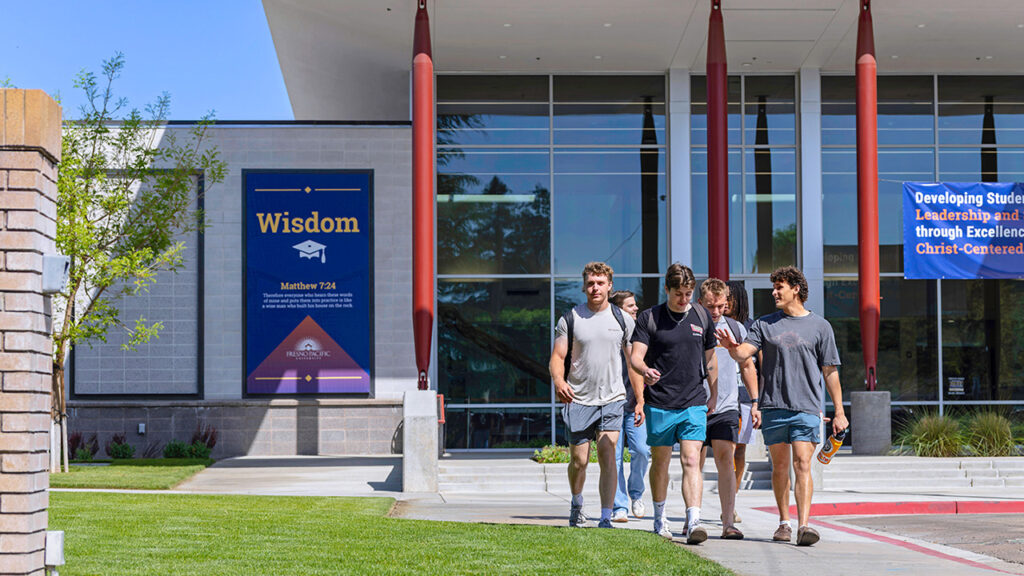
Fresno Pacific University total enrollment dropped from 2,944 to 2,877 students, though students are enrolled in more credit hours than a year ago. Undergraduate enrollment increased 5.5%, with declines in graduate and bachelor’s degree completion.
Tabor College’s record-setting increases in freshmen and graduate or online students a year ago were followed by slight declines this fall, with undergraduates on campus down from 567 to 559 and graduate and online students down from 116 to 113. Students come from 41 U.S. states.
There are 76 international students from more than 30 countries, down a bit from 80 last year. Tabor communications specialist Adam Suderman reported the decline had more to do with coaching changes than governmental impacts on visas.
Anabaptist Mennonite Biblical Seminary enrollment declined, in part due to the end of a six-year partnership with Meserete Kristos Seminary in Ethiopia and U.S. government denial of student visas for all international students who had been admitted to study on campus in Elkhart, Ind. Total enrollment of 169 is lower than last year’s 20-year high of 200 students.
Graduate-level enrollment is down from 162 to 150 students, which the seminary reports is the second-highest amount since 2009. The online master of arts in theology and global Anabaptism was the only graduate program to decrease, dropping from 49 to 30 students, largely because of the end of the MKS partnership.
“Our overall student body remains robust, anchored by new growth here on campus and in local students,” said President David Boshart. “The conclusion of our Ethiopian master of arts program was painful, and it represents part of this semester’s shift in numbers, but most of our Ethiopian students chose to finish their studies as independent students at a distance. As we continue to receive requests for theological training from partners across Africa, Latin America and Asia, we remain deeply committed to our mission both locally and globally.”
Students from the U.S. increased by six to 92, and the 78 from Mennonite Church USA are the most in 12 years. Four graduate students come from Mennonite Church Canada, down two from last year. The proportion of graduate students belonging to Anabaptist groups decreased from 81% to 79%, as the 31 students from other faith traditions is the same number as last fall.
Eastern Mennonite University’s incoming class of 216 students — the largest in six years — built on improvement in last year’s incoming class, but it wasn’t enough to make up for declines at higher levels. Total enrollment declined from 1,211 to 1,140 students. Undergraduates are up slightly from 730 to 736, and graduate students are down from 358 to 318.
For the first time, more than half (53%) of first-year students identify as first-generation college students. First-year students of color increased to 52%, the second-highest percentage in school history, and 44% are student-athletes.
“We remain committed to reaching first-generation college students and expanding access through programs like the EMU Promise Grant,” said Braydon Hoover, vice president of enrollment and marketing. “I’m especially proud that more than half of our incoming class will be the first in their families to earn a college degree.”
Fifty-nine incoming students were awarded Promise Grants, which cover the full cost of tuition for eligible Virginia students whose families earn $75,000 or less. EMU counts 113 students who receive the grants.
Eastern Mennonite Seminary has 63 students, seven more than last year, with growth in both full-time (14) and part-time (48) students.
Bluffton University enrollment declined to 524 after totals of 553 and 641 in the previous two years. First-time freshman enrollment increased, and the 20 incoming transfer students are the most in six years. The incoming class of 168 comes from nine states, and 11 of those students have a parent, sibling or grandparent who is an alum.
Cara Echols, director of public relations, said the increase in transfers is the result of several factors.
“During the spring, we worked to build partnerships with institutions that were closing or discontinuing programs, offering those students an opportunity to continue their education at Bluffton,” she said. “While that outreach contributed to our increase in transfers, it was not the sole reason for the growth.”



Have a comment on this story? Write to the editors. Include your full name, city and state. Selected comments will be edited for publication in print or online.