



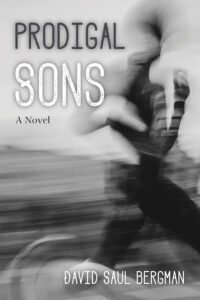
 Mennonite pastor and only slightly reluctant amateur detective John Reimer returns in Prodigal Sons (Resource Publications), the sequel novel to 2021’s Unpardonable Sins by David Saul Bergman, the pen name for the collaboration of Daniel Born and Dale Suderman. Reimer gets a sabbatical in the mid-1990s from his pastorate in Chicago, where he was nearly killed, so he hopes to find rest and renewal in the fictional community of Marion Hills, Kan., tucked precipitously between Hillsboro’s verdant cropland and the Flint Hills’ rugged ranchland. But before Reimer even gets to town he finds himself caught up once again in deadly intrigue, wealthy-family squabbles, cocaine smuggling, a little bit of sex, Sunday sermons that move the plot along and a stampede of goats at the Kansas Mennonite Relief Sale. Born carries on the collaboration after the 2020 death of Suderman and conveys a familiarity with a corner of south central Kansas not often depicted in Mennonite literature. — Tim Huber
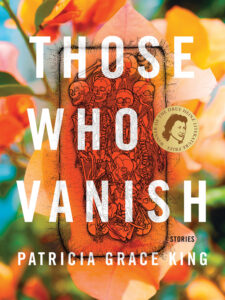 Winner of the Drue Heinz Literature Prize, Those Who Vanish (University of Pittsburgh Press) is the first book by Patricia Grace King. She grew up Mennonite, graduated from Eastern Mennonite University, served with Mennonite Voluntary Service and Mennonite Central Committee and regards herself as ethnically and culturally Mennonite. Most of the book’s eight stories relate in some way with Guatemala. Hovering in the background as an ever-present menace, if not addressed directly, is the 1960-1996 conflict there, in which over 200,000 Guatemalan civilians were killed or disappeared and 1.5 million more were displaced as refugees. It’s tricky to write about such a context without straying into didactic rants, but King ably does so by focusing on characters and addressing other conflicts, such as the clash of cultures as she adeptly looks at American life through the eyes of poor Guatemalans. And she writes beautifully: “the sun skids down the sky like it’s greased” or describing one character as “aggressively fit.” Without space to comment on every story, I especially enjoyed the last two, “Adiós and Adiós” and “Day of All Saints,” which are linked by the relationship between Martín, a Guatemalan whose family was murdered by the Guatemalan army, and Abby, an American who comes to Guatemala to study Spanish. I hope King develops these into a novel. — Gordon Houser
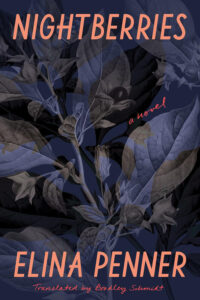 Four years after its original release in German, Elina Penner’s debut novel Nightberries is available in English through CMU Press (Canadian Mennonite University). The darkly comic and slightly morbid novel follows members of the Neufeld family through a tumultuous weekend in which tight-knit connections grow tighter still. The German-speaking Aussiedler immigrants from Russia don’t quite belong in their return to a “homeland” that was never theirs to begin with. Generational trauma seasoned with Plautdietsch (Low German) builds to a breaking point as well-stocked stores and pantries never quite outrun memories of need in Soviet times. Church offers community but not connection. And after Nelli Neufeld loses her beloved anchoring grandmother, she falls inward as a shocking discovery in the basement freezer pulls distant siblings closer than any number of whiskey-soaked Sunday afternoon faspas. Translation of Nachtberren (Aufbau, 2022) was completed by Bradley Schmidt, originally from the Goessel, Kan., area, who works as a translator and teaches writing and translation classes at Leipzig University in Germany. — Tim Huber
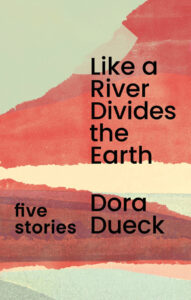 Canadian writer Dora Dueck takes readers into her characters’ lives with psychological precision and a lyrical grace in Like a River Divides the Earth (Freehand). These five stories address suffering and the struggle to understand it. Like the peerless Alice Munro, Dueck often covers a novel’s worth in a short story.
In “Mask,” a 14-year-old girl sees her father’s face for the first time. He is a World War I vet whose face was wounded, and he wears a mask to cover it. Dueck’s description is vivid: “Holes instead of a nose. Dark holes in a pink crater of pulled-tight skin running from cheekbone to cheekbone, though the tip had been spared and stood there by itself, pale and hideous, as if too stubborn or stupid to quit when abandoned.”
In “Blue,” a group of women finds community living together in a house. Then a tragic event disrupts their lives and their harmony.

Two of the stories, “Her Own Self” and the title story, deal with Mennonites escaping from Russia. In the former, a woman whose baby boy has just died must leave in a hurry and carry that loss with her. In the latter, a man now living in Germany recounts the events of a village next to his crossing the Russian border into China without waiting for his village to join them, as had been promised. That hurt is compounded by losing the girl he loved from that village.
“The Regatta” is told in first person by a woman counseling a woman who has lost her son. But the counselor receives insight from the grieving woman.
All these fine stories deal with great suffering yet end on a hopeful note. They are well worth reading. — Gordon Houser
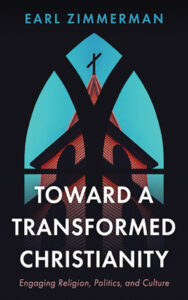 The Old Order Mennonite church of Earl Zimmerman’s youth held an ironclad belief that higher education was unnecessary and dangerous. His questing mind couldn’t accept that, and readers of Toward a Transformed Christianity: Engaging Religion, Politics and Culture (Wipf & Stock) will be grateful. Combining memoir, theology, biblical reflection and social commentary, Zimmerman applies his pastoral and scholarly experience to a wide-ranging analysis of how Christians can faithfully engage a changing religious terrain. Teaching in the Bible and religion department at Eastern Mennonite University left “emotional and spiritual scars” from controversies over biblical interpretation, yet he draws lessons from the experience, as he does from many others, including mission encounters in the Philippines and India. He wrestles with questions like the one from a woman who asked if she could follow Jesus as a Hindu. His prescriptions for revitalizing the church address concerns like “what happens to us when our formerly separated communities morph into community churches that are largely at home in American culture.” With discussion questions for each chapter, the book would suit small groups seeking to reflect on Anabaptism’s past and present, engage with current issues and shape a faithful future. — Paul Schrag
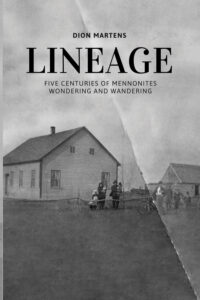 Canadian writer Dion Martens tells the story of his ancestors in novel form in Lineage: Five Centuries of Mennonites Wondering and Wandering (Pandora). The advantage of such an approach is that it helps bring alive characters usually only found in history books and often magnified as martyrs. As Martens writes, “These were not saints in stained glass. No, they were human beings: complex, flawed, courageous.” The disadvantage is that the account raises the questions: What is historical? What is fiction? Martens combines stories of individual ancestors with occasional chapters called “Mennonite History Class,” in which a fictional professor, a stand-in for the author, engages a class to talk about each ancestor. Here he sometimes answers a student’s question about which part of the story is true. As fiction, the novel is weak, with much more telling than showing, though he likes to throw in details of smell. And despite the professor’s claim that history is “a story of tension,” there is less dramatic tension in the telling than one would expect. In his acknowledgments, Martens writes, “Working with historical material presents many challenges: conflicting records, divergent interpretations and layers of prior analysis that require careful navigation.” True. Martens has tried to make this history more accessible and interesting to the average reader, and in that he succeeds. — Gordon Houser
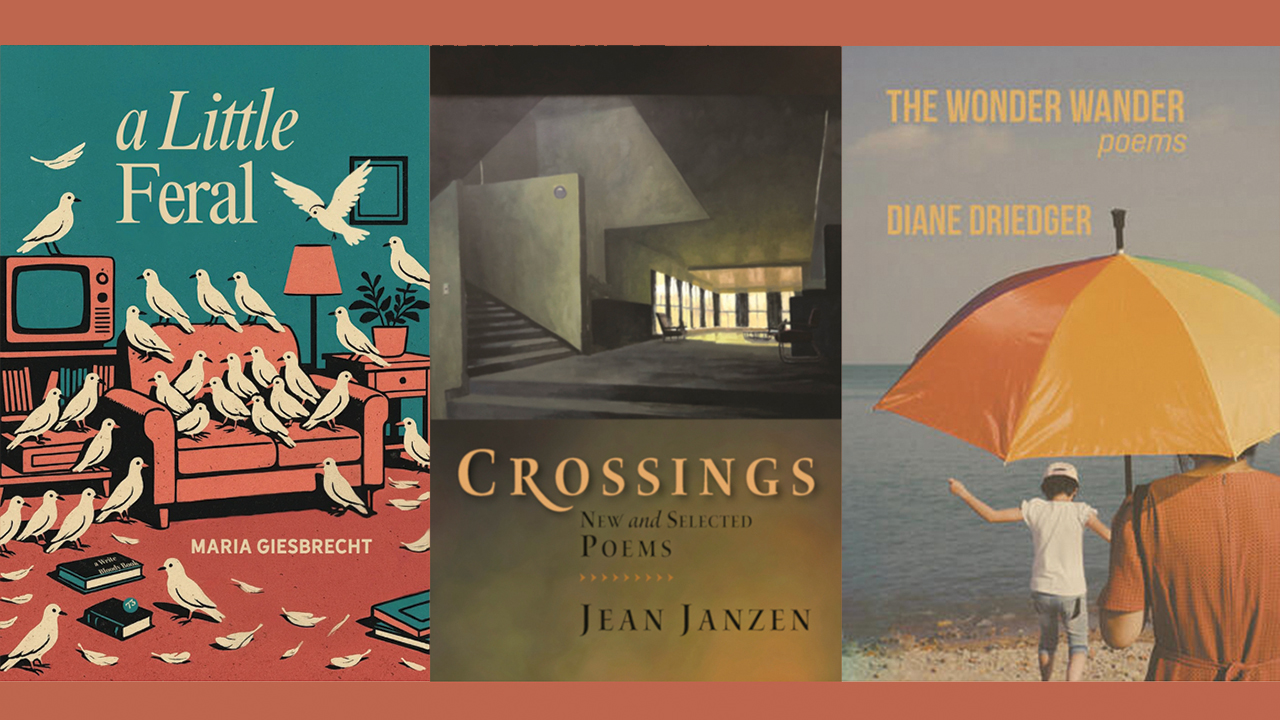
Poetic explorations, grounded in the body
New books of poetry by Mennonite-related authors cover much ground. This is literal, with immigration, ancestral journeys and world travel. Yet these volumes also cover wide terrain with explorations of memory, transgression, art and disability, all while grounded in the body.
Maria Giesbrecht’s debut collection A Little Feral (Write Bloody Publishing) was written in the aftermath of leaving her Old Colony Mennonite community as a young woman, having immigrated to Canada from Mexico as a child. Her poems look unflinchingly at an abusive father and at women’s survival: “Father leads marriage counselling/in our living room every Friday night./ . . . . Mother wore long sleeves.” Several poems engage transgression and sexual liberation, reminiscent of work by Canadian poets Di Brandt and Audrey Poetker.
The body appears often in Crossings (DreamSeeker/Cascadia), a collection of new and selected poems by Jean Janzen, who began publishing poetry in her 50s. Now in her 90s, she considers St. Mark penning his Gospel in “Falling Asleep Beside the Bones,” aware of her “breathing in and out” and her hands, “opening, letting go.” Throughout her career, Janzen frequently uses flowers, plants, art, biblical references and music as beginning points for meditations that move from the concrete to the spiritual. Her work is also marked by family memory of suffering and flight from Russia.
In The Wonder Wander (Caitlin), Diane Driedger considers the body as the site of pain and exhaustion. In poems that describe weakness from fibromyalgia (“ankles weak/lurching along”) and difficulty, Driedger uses rhyme and sound to tell a story. In “On Missing a Step,” the narrator recounts falling in a series of words: “careen/steam/gleam/beaned/keen/lean.” The poet shares a journey to becoming a disability activist, also while describing a Mennonite upbringing that took her to Kansas, Winnipeg, California and Europe. These poems delight in sound and simplicity. — Eileen Kinch
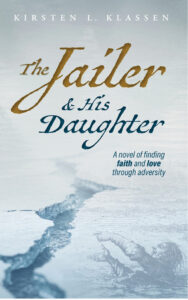 Kirsten Klassen’s The Jailer & His Daughter (Masthof) is a historical novel with surprise, heart and spiritual depth. Many readers know the story of Dirk Willems, the Dutch Anabaptist who escaped prison across thin ice in 1569. When his pursuer fell through the ice, Willems turned back and rescued him, sacrificing his chance at freedom. Klassen begins where that famous account ends, imagining how the jailer and his family were affected by this extraordinary act. At the center of the novel is Pieter, the jailer whose life changes forever after encountering Willems. Accustomed to following orders, obeying rules and avoiding difficult questions, Pieter is forced to reconsider everything he believes. Willems’s act of mercy becomes the catalyst for a journey marked by faith, doubt and discovery. Readers also meet Fenna, Pieter’s daughter, who comes of age during a period of religious conflict and uncertainty. As father and daughter explore Anabaptist beliefs, they begin a search for truth, identity and purpose. Their growth feels authentic, making their struggles and victories both engaging and meaningful. Klassen skillfully blends historical fact with imaginative storytelling. Her characters are richly developed, the setting is vividly realized and the narrative remains compelling. More than historical fiction, the novel encourages reflection on faith, forgiveness, courage and the ways God works through ordinary people to transform lives. The Jailer and His Daughter asks important questions about choices, faith and sacrifice, while showing how acts of mercy can influence people long after the moment has passed. — Lisa Williams
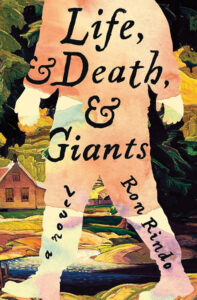 Paul Bunyan came from Minnesota forests, but Gabriel Fisher came from Wisconsin Amish country. Life, & Death, & Giants by Ron Rindo (St. Martin’s Press) spins the larger-than-life tale of a very big Amish boy who grew into a very big man blessed with an uncanny connection to animals. A fantastical journey through youth baseball, college football and even professional wrestling is still grounded in tender tellings of love, loss and evolving relationships among family and friends, especially when Amish rigid discipline and generous forgiveness are tested. Rindo taught English and creative writing at the University of Wisconsin in Oshkosh and uses a creative approach in which the novel’s narrative is presented in each chapter by rotating characters. This allows the story to come from viewpoints as diverse as a pious Amish grandmother, an agnostic veterinarian who heals everyone but himself and a rough-hewn recovering alcoholic who owns a tavern. — Tim Huber
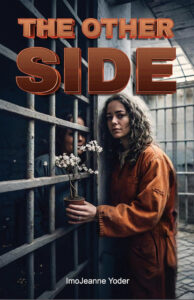 A self-published memoir, The Other Side by ImoJeanne Yoder (available on Amazon) presents itself on its cover and description as an account of experiencing jail and learning to adapt to its difficulties, and it does that in its first four (of 10) chapters. The circumstances of her confinement are not always clearly described (the book could have used an editor) but she shows the injustices of our healthcare and legal institutions. She was arrested for neglecting her husband’s bed sores and removing him from a nursing home, but an appendix (“Letter from My Husband to the Court”) shows that she didn’t know about the bed sores on his back, which he refused to let her wash, and that it was his wish to not go to either the hospital or the nursing home. He later died, and the unfairness of her arrest adds to her grief for her husband’s death. The memoir jumps between her experiences growing up in a conservative Mennonite context and her career as a social worker to more didactic comments about such subjects as Mennonite history, the challenges of being a single Mennonite woman, patient rights and grief. I resonated with her comment that “anticipatory grief helps, but it doesn’t take away the sting of death.” Throughout her experiences she draws upon her faith in God. — Gordon Houser
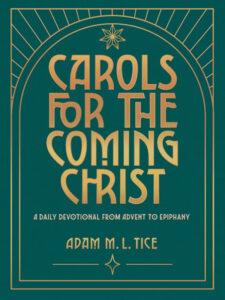 In a season of noise, Adam M.L. Tice invites readers to read, reflect and respond in new ways. Each entry in Carols for the Coming Christ: A Daily Devotional from Advent to Epiphany (Herald) is grounded in an Advent, Christmas or Epiphany carol and connected to a scripture passage. Carols range from the familiar (“Silent Night”) to new ones by Tice (“Jesus Entered Egypt”). He invites us to read the text of each carol before singing or listening to appreciate the poetry, language and meaning. Reflections and response actions strike a balance of individual and communal concerns — from personal faith to collective social justice and what it means to hold these in tension for a well-rounded and well-grounded faith. The reflections are concise (a single paragraph to a full page), written to help adults engage and grow while being accessible to younger readers or listeners. Reflection activities range from writing to physical movement, from art to research on cultural images. Readers will find responses that speak to them and some that stretch them to new experiences of God and the season. Each carol can be found in the Voices Together hymnal, offering a wonderful opportunity to become more familiar with newer or lesser-known carols. Hymn numbers are listed for Voices Together as well as a few other common hymnals. The author includes ideas for using the book in worship, small-group study or individual devotions. I look forward to using it with my family, including my 9-year-old. — Jennie Wintermote
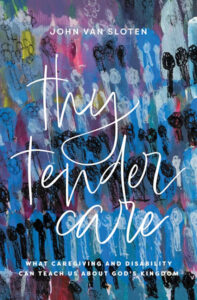 Thy Tender Care: What Caregiving and Disability Can Teach Us About the Kingdom of God (Herald) is a love letter to a son. Author, pastor, husband and father John Van Sloten writes of the birth of his son Edward, born with Down syndrome, and maps out the profound impact Edward has made on his life and faith. I think the best summary is on the dedication page: “For my son Edward, who has taught me the deepest truths about God.” Each chapter delves deeper into the many ways Edward reflects the image and spirit of God. Van Sloten emphasizes the transformative power of caretaking and understands his own transformation. He admits that when Edward was born, he was distraught — in contrast to his wife, whose reaction was, “Is that all?” This difference feels important to me, because it exemplifies who I think would most benefit from this book. I see it especially for someone who never expected or wanted to take on a caretaking or parenting role but had it thrust upon them. Or maybe it’s simply for a parent who underestimated the demands of childrearing. In all those cases and more, Thy Tender Care offers an example of a father coming to terms with the mismatch between his expectations and reality while drawing nearer to God on the journey. — Danielle Klotz


Have a comment on this story? Write to the editors. Include your full name, city and state. Selected comments will be edited for publication in print or online.