


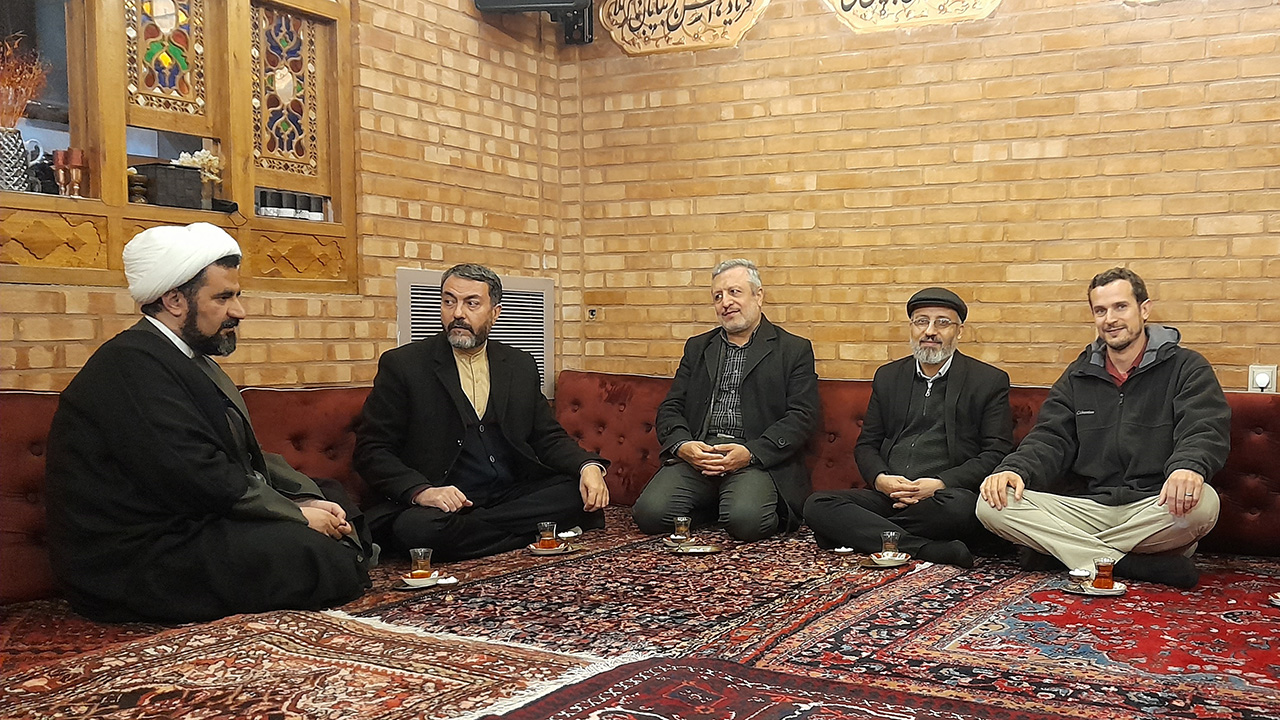
Talking on the phone with a friend in Iran, in the middle of a U.S. bombing campaign, my intention was to offer condolences. But to my surprise, the main thing he wanted to say to me was, “You need to come back. Let me know what I can do to make this happen.”
What my friend is communicating, even as his country is being bombed, is that there is only one way out of this mess: deeper attachment to one another — as Christians and Muslims, as Iranians and Americans.
The U.S.-Israeli war on Iran has elicited all kinds of reactions. Some focus on the human toll — the number of lives lost, disrupted or displaced. Some highlight the economics of it — the staggering cost of war, its economic impact.
Others draw attention to the rationale, theology or eschatology behind it, still others the security implications for the region and beyond.
What is often missing is perhaps the most fundamental to understanding how something like this could happen and how to find our way out of it: the power of dignity.
The violation of dignity
Donna Hicks describes dignity as the glue that holds all of our relationships together. It’s the desire to be understood, heard and treated fairly. It’s the need to feel safe in the world.
Dignity violation, on the other hand, is the hijacking of those basic needs. Our brains are wired to be super sensitive to dignity violations, because they represent a threat to us. Dignity violations can be physical, emotional or even symbolic.
The assassination of the supreme leader of Iran at the outset of the war was a basic and symbolic dignity violation. Even Iranians or other Shia Muslims who are critical of the country’s authoritarian government experienced the killing of a clerical leader as an attack on their identity.
This sort of response is universal for us as humans. When our family moved to Somaliland, we arrived on the very day that members of al-Qaeda attacked the office of the French satirical newspaper Charlie Hebdo. The murders were in response to the magazine’s publication of cartoons of the Prophet Muhammad, including a caricature on its cover. All over the city of Hargeisa I observed bumper stickers reading, “We love the Prophet more than we love ourselves.”
What was the sentiment behind these messages? From the perspective of dignity, what was going on? The message was obvious: My identity is wrapped up in the Prophet. What I aspire to be as a Muslim is shaped by him. When you insult him, you insult me and everything I believe in.
The difference between dignity and respect is important. Honoring dignity does not validate the actions of the other, or label them respectable. J. Daryl Byler demonstrates this well in “A Better Way Than War” (AW, March 9): There is no need to defend the oppressive Iranian regime in order to affirm the dignity of Iranian people.
War is dignity violation at its extreme. This is why violence can never lead to lasting positive change, only to shifts in power that leave resentments bubbling under the surface.
The power of dignity
The alternative to the dignity violation of war is personal engagement. Mennonites have been part of initiatives in Iran for decades, and these exchanges have borne remarkable fruit. One piece of this legacy is an organization called Luke 10, which is focused on building friendships with Iranians.
In the buildup to the current war, Luke 10 released the statement “A Time for Peace,” with original signatories in both Iran and U.S. In the weeks since, hundreds of people around the world have signed the statement, with the largest number adding their names from Iran.
People are hungry for dignity — not only to be offered it, but also for a chance to extend it to others in concrete ways. Iranian-American Reza Aslan says cultural exchange is the way lasting positive change happens. The doors that open around dignity are surprising and can break out of our paradigms of what is possible.
Dignity is so powerful it can transcend even religious identities or boundaries.
One of the most honored champions of democracy in Iran is a young American missionary named Howard Baskerville, who was killed in a democratic uprising in Iran in 1909. To this day he is honored as a martyr in Iran. Aslan writes: “Baskerville did not arrive with a mandate from Washington. He did not offer ultimatums or airstrikes. He chose solidarity over leverage. ‘The only difference between me and these people is the place of my birth,’ he said shortly before his death, ‘and that is not a big difference’ ” (“The Iranian Dream of an American Savior,” New York Times International Edition, March 9, 2026).
Imagine it: Iranians honor the memory of an American who went to Iran to teach English and to preach the gospel. A gospel that is freed from nationalist trappings and from the threat of dominance is good news indeed and can be received as such.
In Iran I observed the honor for Jesus Christ at every turn — in mosques, museums and homes. This reverence is an authentic part of Shia spirituality. But I believe it goes beyond religious conviction. Iranian Muslims have recognized the power of extending dignity to Christians, for whom Jesus Christ is the center of our faith.
My friend is not alone in extending the invitation to mingle our lives, as Iranians and Americans, as Muslims and Christians. This sentiment is widespread. Cultural exchange is the only way to peace, because it is the path of dignity.
If our concern is for Iranian Christians, then dignity is the only way. When a closed society begins to open up to the outside world, it also creates more space for diversity within. Furthermore, the church in the wider region will be given more space to flourish.
If our concern is for the security of the region and the world, then dignity is the only way. Dialogue and negotiations, though slow and imperfect, make a difference and bring us closer to peace and security.
And if our concern is to become better disciples of Jesus, then the Samaritan dignity that he offers his hearers in Luke 10 is the only way.



Have a comment on this story? Write to the editors. Include your full name, city and state. Selected comments will be edited for publication in print or online.