


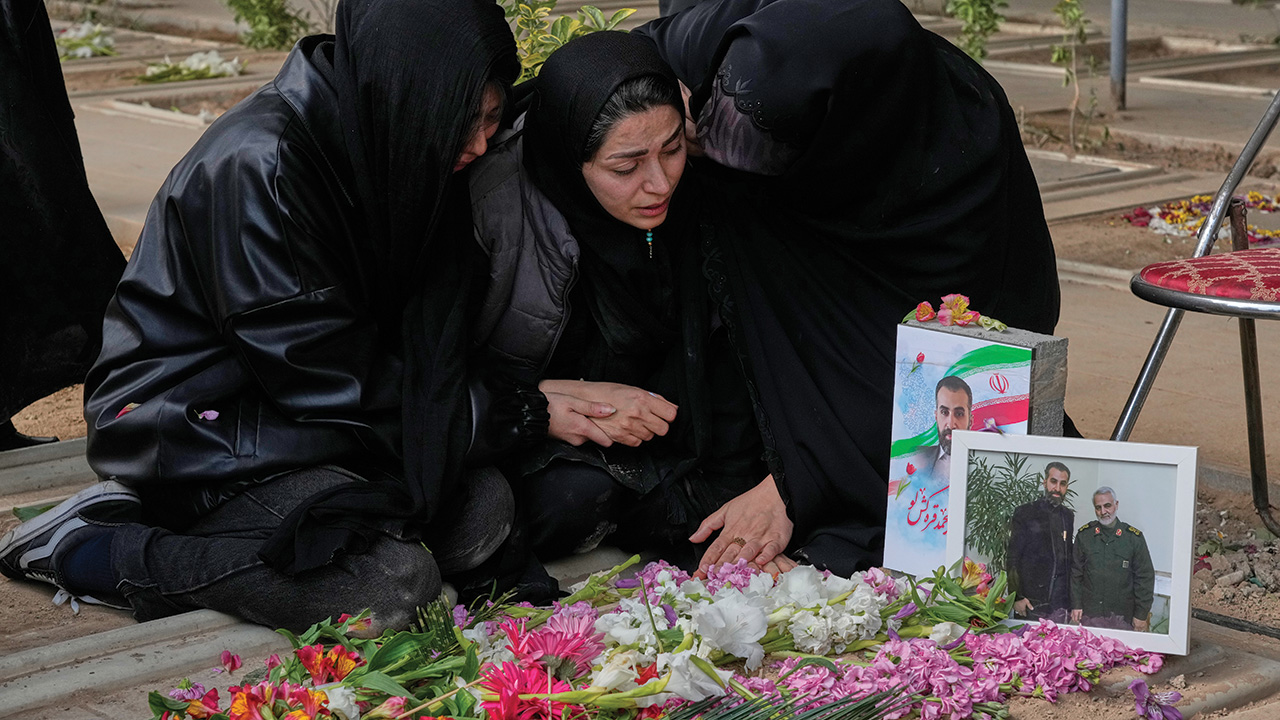
When the president who promised to end wars started one, atrocity followed swiftly. The U.S. and Israel had scarcely begun their assault on Iran when a Tomahawk missile struck a girls’ elementary school in the city of Minab, killing at least 175 people, most of them children. All evidence indicated it was a U.S. missile.
The architects of this war call it “Epic Fury.” Those with a right to be angry are the parents and grandparents of the dead children.
As the war’s toll rises, outrage and grief multiply, all the more so because none of this had to happen. Neither international law nor religious just-war theory supports aggression when there’s no imminent threat. Seizing an opportunity to crush a weakened adversary doesn’t measure up to any ethical code.
As usual, predictions of an easy win proved wrong. Powerful nations, time and again, fall for the allure of quick wars. In 1914, the European armies that fired the guns of August expected to be home by Christmas. In the 2000s, failed attempts at nation-building in Iraq and Afghanistan turned Americans against “forever wars.” President Trump promised not to repeat his predecessors’ mistakes but succumbed to the usual illusion.
Anabaptists, who espouse nonviolence because Jesus taught and lived it, are making common cause with diverse people of faith to denounce the war. Pacifist and nonpacifist Christians alike are raising voices of protest and lament against the Iran war specifically and state-led violence generally.
“We affirm that war is incompatible with God’s very nature and will for humanity and against our fundamental Christian principles,” says an ecumenical statement signed by Mennonite World Conference, the World Council of Churches and six other entities. “. . . [W]e lament the absence of morality and legality, the prevailing arrogance and ideologies of power, and the replacement of conscience with political utility.”
“Prevailing arrogance” describes the demeanor of U.S. Defense Secretary Pete Hegseth, who has boasted of raining “death and destruction from the sky all day long.” His bellicose posturing disgusts not only opponents of the war but also supporters who consider it unseemly to crow and swagger while people die. Cultivating an identity as a Christian warrior, he has disparaged restrictions that aim to reduce civilian casualties, vowing not to be constrained by “stupid rules of engagement.”
Beyond the widening war in the Middle East, Christian peacemakers view with grave concern the Trump administration’s aggressive actions and threats elsewhere. Community Peacemaker Teams, which has Anabaptist roots, cites its opposition to U.S. imperialism in Latin America — recently demonstrated by the capturing of Venezuela’s president and the tightening of economic pressure on Cuba with the goal of regime change.
“We oppose all military intervention and exercises of hegemonic control by one country over another,” CPT says. “We reject the revival of the Monroe Doctrine, which asserts the United States government’s unilateral right to intervene in the domestic affairs of other states in order to maintain hemispheric and global dominance.”
Mennonite Central Committee warns of other threats to peace: “We grow increasingly concerned by U.S. aggression globally, including the support for genocide in Gaza and the attacks on Venezuela and Nigeria. In this critical moment, we at MCC . . . will continue to engage with members of the U.S. Congress to 1) pass war-
powers resolutions that oppose further military actions; 2) speak out against the illegal U.S. military campaign against Iran; and 3) shift funding from the military to human needs programs such as health care and humanitarian assistance.”
While rejecting righteous warmaking, Christian peacemakers need humility when faced with questions like how we would propose to deliver Iranians from a repressive regime or drive Russian invaders from Ukraine. Former Washington Post columnist Colman McCarthy, a stalwart voice for peace who died Feb. 27 at age 87, once said: “There are no guarantees that nonviolence will always work, any more than there are that violence will always work. Both systems have failed; which failure do you want to align yourself with?”
We’ll choose the one that doesn’t bomb children.
An appeal for peace grounded in faith begins with prayer. Lorraine Stutzman Amstutz, Mennonite Church USA’s denominational minister for peace and justice, offered “A Prayer for Peace in Response to the Iran War” in MC USA’s PeaceMail: “We . . . pray for wisdom for leaders, protection for the innocent, comfort for those who grieve and restraint that prevents further bloodshed. May God’s justice and mercy guide all nations toward lasting peace. Holy Spirit, bring comfort where there is fear, courage where there is despair and hope where darkness feels overwhelming.”



Have a comment on this story? Write to the editors. Include your full name, city and state. Selected comments will be edited for publication in print or online.