


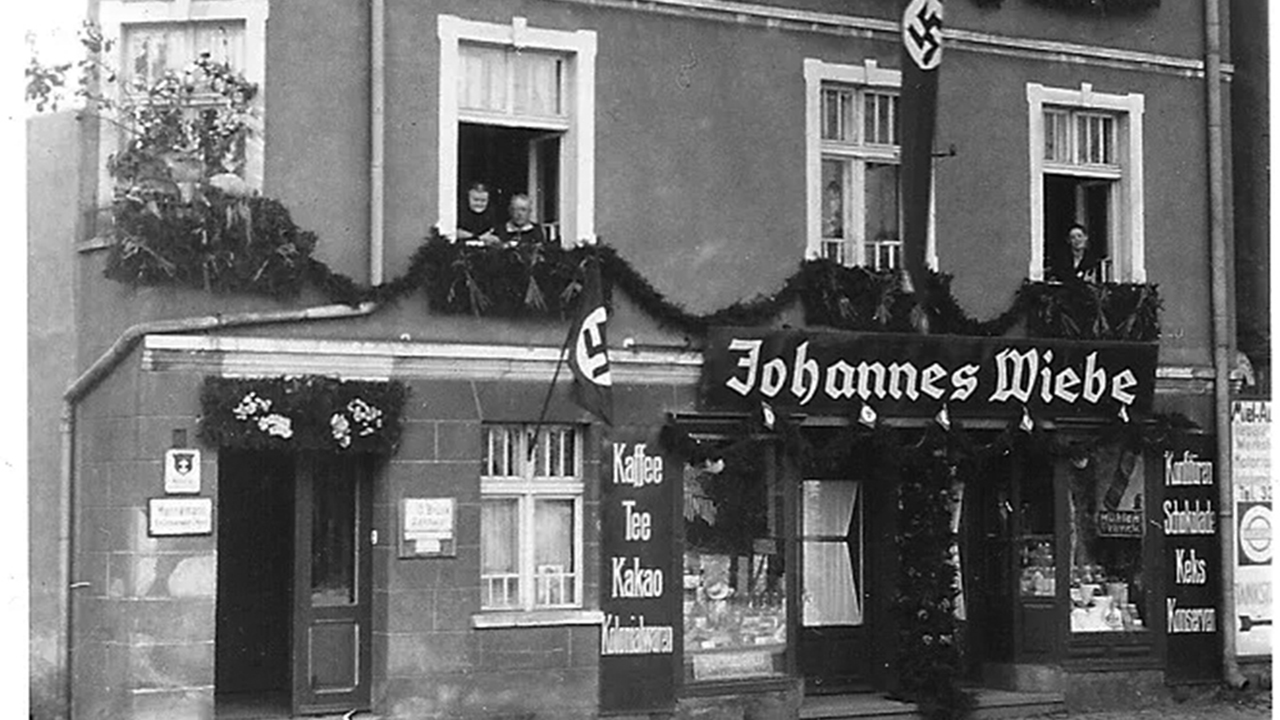
The digitization and online release of records of millions of Germans who joined the Nazi Party will make research on Mennonite involvement in the Third Reich more accessible for researchers.
The U.S. National Archives released almost 11 million membership records in March for public access through its website.
Bethel College history professor Mark Jantzen published research on some of the clearest examples of Mennonite membership in the National Socialist German Workers’ Party (NSDAP) in the 2020 book he edited with Bethel colleague John Thiesen, European Mennonites and the Holocaust. He published additional findings in a 2024 article in Mennonite Historical Journal (Mennonitische Geschichtsblätter) published by the German Mennonite Historical Association.
Jantzen outlined high rates of Nazi Party membership among Mennonites in the Vistula Delta region near Danzig, which held the densest concentration of Mennonites in Germany. A third of area Mennonite church leaders are documented in Nazi membership files. At one time, five of the churches’ seven bishops/elders in Vistula Delta county were Nazi Party members. By comparison, about a tenth of the German population joined the party by the end of the Third Reich.
“Some of this information has been published in German-language research going back to the 1970s, but to English-language readers it feels particularly new,” Jantzen said. “Getting the basic facts systematically documented by working with party membership files is an important first step. Understanding why and how many Mennonites participated in Nazi racist and nationalistic projects remains an ongoing task.”
Ben Goossen, assistant professor of international history at Boston University and author of Chosen Nation: Mennonites and Germany in a Global Era, said the files have been available in Washington, D.C., and Berlin, Germany for many decades, but digging through the physical files required significant time and travel.
While the digitized microfilm is searchable, the process is cumbersome to locate specific information.
“That said, historians can do a lot of work with these Nazi membership cards,” Goossen said. “Two key basic questions that remain to be researched are the extent of Nazi Party membership among Mennonite leaders beyond the Danzig area — for example in northwestern Germany and southern Germany — and the extent of Nazi Party membership among general church members and their families in all congregations.”
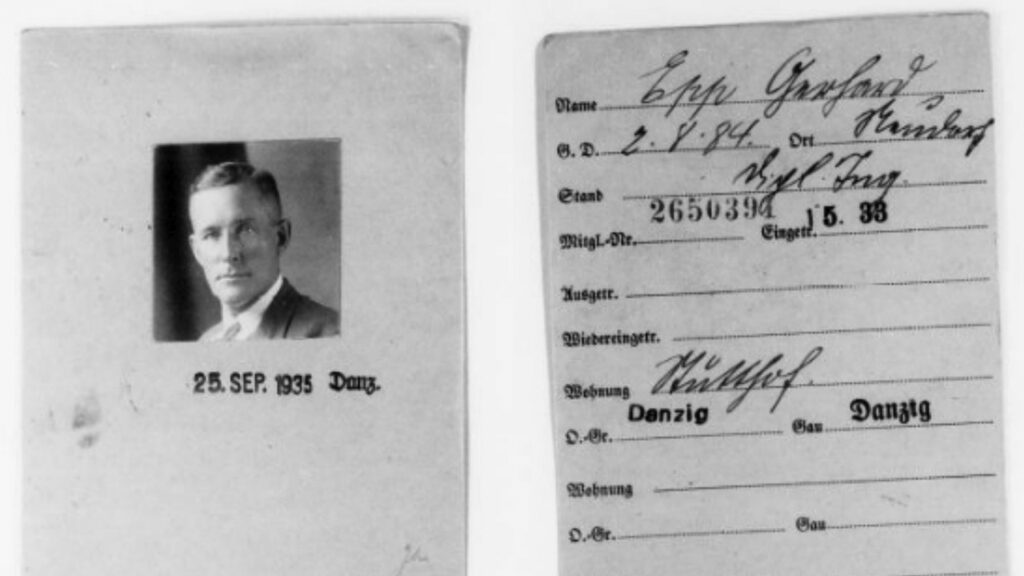
Goossen noted research remains to be done on demographic patterns that would flesh out Nazi membership among Mennonites, which in turn could be compared to the general German population and other religious groups.
John Thiesen, author of Mennonite & Nazi? Attitudes Among Mennonite Colonists in Latin America 1933-1945 and archivist at the Mennonite Library and Archives at Bethel College, has used the membership files since 1990. He said documenting Mennonite connections requires careful research because they list only names, birth date and place of residence, not religious affiliation.
“Just because you find a Neff or Horsch or Neufeld or Penner doesn’t mean the person was a Mennonite or even had any Mennonite ancestors,” he said. “People too easily fall into the ‘Mennonite names’ trap. There are no uniquely Mennonite names. Many ‘Mennonite names’ are common German surnames.
“The ‘Mennonite names’ mythology subtly aligns with Nazi ideology. Do a person’s ethical or theological obligations depend on their biological ancestry? That’s what the Nazis said, and it’s what the idea of ‘Mennonite names’ also implies.”
Astrid von Schlachta, director of the Mennonitischer Forschungsstelle (Mennonite Research Center) in Weierhof, Germany, said the membership cards are still helpful. There has been ongoing research on these materials in recent years, especially in establishing a clearer picture of Mennonites’ party association in smaller towns.
“In the future it will be an ongoing important task to tell the story of Mennonites in the Third Reich besides ‘numbers of party membership,’ ” said von Schlachta. “The [Mennonite Research Center] had an online forum last year in which we invited people who grew up in the 1930s or 1940s to tell their story. Topics included contact with Jews and euthanasia. The picture of the times of National Socialism became very colorful — and the gray areas became visible.”
Goossen noted that research continues to paint a clearer picture of how Nazi ideology spread far more extensively than previously understood among Mennonites in the 1930s and 1940s. And not just in Germany, but in the Netherlands, Poland, Brazil, Paraguay, Canada, the United States and Ukraine.
“While most Mennonites who encountered Nazi ideology in one form or another during these years lived outside of the Third Reich or territories that it occupied during World War II, Mennonites in Germany and the Free City of Danzig had the opportunity to join the Nazi Party, and many did so,” he said. “These records make that history more accessible to researchers than ever before, and they hold the potential to deepen our understanding of the complicated and concerning history of Mennonites and Nazism.”



Have a comment on this story? Write to the editors. Include your full name, city and state. Selected comments will be edited for publication in print or online.