


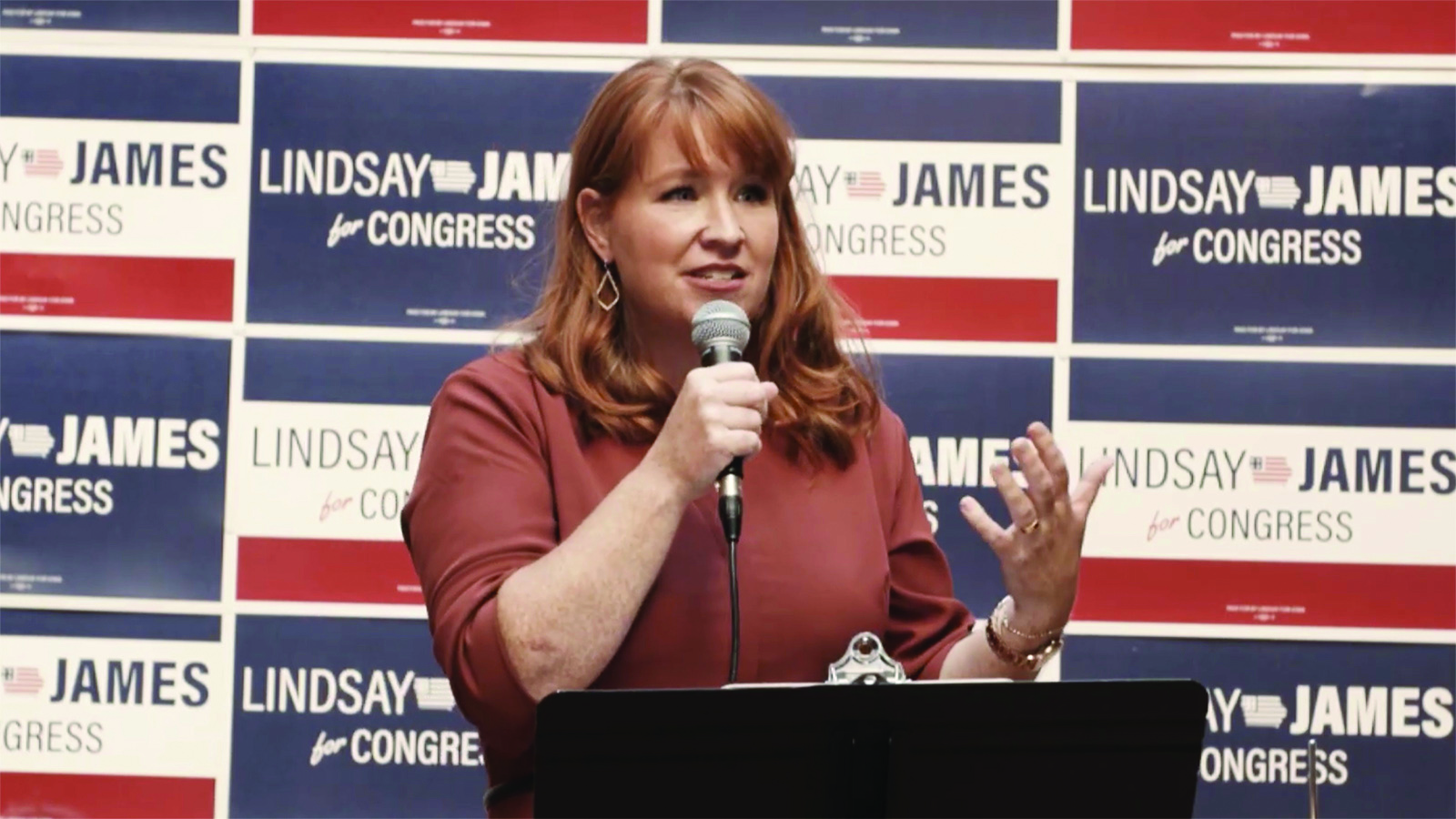
Mainline Protestant clergy running for political office as Democrats are getting pushback. At the Family Leadership Summit in Des Moines, Iowa, in July, Joe Mitchell, a Republican running against Lindsay James in the second congressional district, said James “calls herself a pastor.”
He then coined a term to apply to candidates such as James and other progressive clergy candidates in other states. “I call them PINOs,” he said — “Pastors in Name Only,” a variation of an acronym used by Republicans for other Republicans who do not share the hard conservative agenda of their leader: RINO for “Republican in Name Only.”
Clergy have been running for office and serving as public officials for a long time. Methodist pastor Peter Cartwright ran against Abraham Lincoln for Congress from Illinois in 1846. This pattern has been common among Black pastors — notably current Georgia U.S. Sen. Raphael Warnock, a Baptist pastor, and Missouri U.S. Rep. Emanuel Cleaver II, a United Methodist pastor.
But something is different this year. More clergy are running for office, and many of them are mainline Protestant. Iowa is a good example, where State Rep. Lindsay James, a Presbyterian Church (USA) pastor, and State Sen. Sarah Trone Garriott, an ordained minister in the Evangelical Lutheran Church in America, are running for Congress.
But notice the reason the Republican candidate gave for calling them “not real pastors.” It had nothing to do with their serving in the legislature or having been chaplains. He said they are not real pastors because “they don’t profess the true gospel of Jesus Christ.”
This is not a peculiar thought by an isolated politician. For several years, those on the far right have suggested that only they represent the true gospel of Jesus Christ. Here, then, some take the further step to declare that those following long-standing strains of the Christian tradition do not draw witness to the gospel of Christ at all.

Similar labels are used for other clergy candidates by their opponents. James Talarico, the Democratic nominee for the U.S. Senate in Texas and a recent Presbyterian Church (USA) seminary graduate, has been accused of blasphemy. Adam Hamilton, the Democratic nominee for U.S. Senate in Kansas and pastor of the largest United Methodist church in the United States, has been deemed a “heretic.”
The discussion of political issues from a mainline Protestant perspective may seem strange to the public after decades of dominance by those who associate Christianity with only one side of political options, the most conservative, including those advocating Christian nationalism. That was not always the case. For much of the 20th century, the voice of religion on public matters tended to be from mainline Protestant denominations and their leaders, generally in a moderate to liberal direction. As public issues became more polarized, those mainline groups and leaders appeared at times as partisan as today’s conservatives.
Conservative evangelicals in the mid-20th century came to identify politically with a conservative political agenda far different from that of many 19th-century and early 20th-century evangelicals in their social attitudes and aspirations. It was the evangelical tradition in this earlier period that often exemplified the progressive goals of abolition, women’s suffrage, prison reform, public education and concern for the poor. Even prohibition was understood among evangelicals as a progressive cause at the time, as part of a concern for alcohol’s impact on families, poverty and crime.
But the public did not make the connection between white evangelicals and a narrowing political agenda for many years after the 1940s, since activism was not encouraged among White evangelicals except on a few select issues, such as liquor and pornography. All of that changed in the 1970s with the emergence of the Religious Right as a political force. Not only has the Religious Right been the loudest voice in bringing religious language to public issue debates, but they have also used “Christian” as synonymous with their narrow and minority interpretation of Christianity.
So, some people may not associate Christianity with the priorities of Jesus toward the poor, strangers, justice and peace, and including sensitivity and advocacy on matters of racial equity. This does not mean that mainline denominations and leaders have not stayed in the conversation, but such voices no longer are amplified by the media, as once was the case.
What these new mainline Protestant candidates do is what Black clergy political figures, as well as many Black lay politicians, do so well. They are not only comfortable in talking about their faith motivations, but their purpose is to serve the common good, especially those on the margins.
Another candidate for Congress this year is a third-generation pastor, Frederick Douglass Haynes III, pastor of Friendship-West Baptist Church in Dallas. He is the Democratic nominee for the 30th district in Texas. He told Religion News Service that he sees the success of Democratic clergy at the polls this year as a testament to their “track record of community service” and “fighting for the people.”
Any religious person, clergy or lay, must always remember that the goal of all public service is the common good. With so little talk about the welfare of the whole community, and especially the most vulnerable, these candidates are offering a fresh and different message.


Have a comment on this story? Write to the editors. Include your full name, city and state. Selected comments will be edited for publication in print or online.