


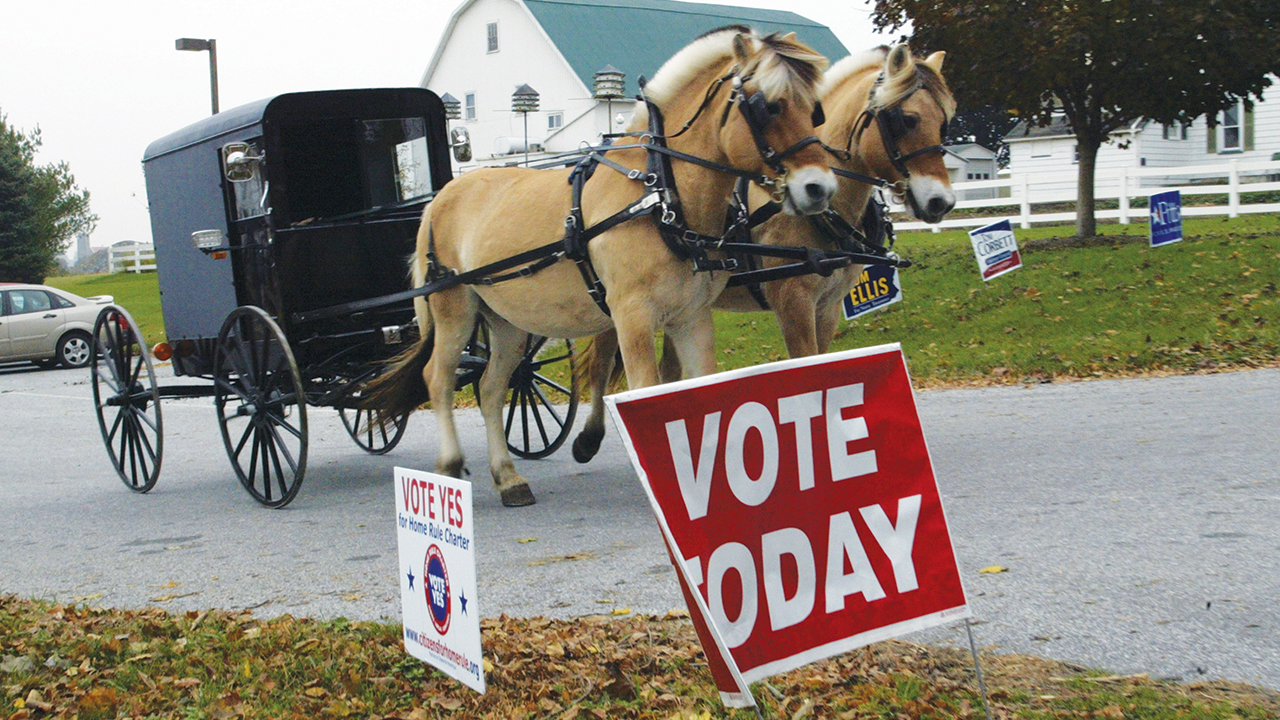
Do the Amish vote? I get this question a lot, especially as voter mobilization efforts targeting Amish communities draw national attention. In an era of political polarization and Donald Trump, the question is often framed as a puzzle: Why would the Amish vote?
Considering all Amish communities and subgroups, the answer is no, the vast majority of Amish don’t vote and never have. And yet we know from written and oral sources that in some places Amish voting stretches back a century and a half or more.
Drawing on traditional Anabaptist teaching in the 1632 Dordrecht Confession and other sources, the Amish emphasize that Christians should pray for government officials and be respectful when interacting with them. Church members should obey all laws that do not conflict with conscience.
Embracing a strict notion of the separation of church and state, one Amish publication presents the church’s standard objection to voting: “If we don’t want the government to tell us how to conduct our church affairs, we had better not tell them how to run the government.”
Behind that statement lies an assumption that government is not “us.” Indeed, for the small number of Amish who do vote, a two-kingdoms theology (keeping God’s and the world’s realms separate) may motivate support for policies that minimize government’s scope and intervention.
Americans like to think of voting in terms of a “rational actor” model in which individuals review their values, study the candidates’ platforms and then vote for those who align most closely with their beliefs. But voter behavior is more complex than that and often involves a basic sense of identity with (or alienation from) one’s neighbors, coworkers or family heritage.
In some places, Amish people are well integrated into their local neighborhoods, serving as the backbone of rural volunteer fire companies, for example. For them, voting can be an extension of community life and reflects local sensibilities. In most rural parts of the northern U.S., those sensibilities have been Republican for generations.
About nine in 10 registered Amish voters identify with the GOP. Almost all the rest say they are independent.
In places with a tradition of Amish voting, Republican organizations have long worked to mobilize Amish voters. In 2004, party leaders in Holmes County, Ohio, and Lancaster County, Pa., mounted aggressive outreach efforts and arranged for President George W. Bush to meet Amish people, as his father, President George H.W. Bush, had done in 1991.
In 2016, political operatives in Arlington, Va., including one with family ties to Nappanee, Ind., launched Amish PAC. The initial focus was Dr. Ben Carson’s short-lived presidential campaign, because Carson’s book Gifted Hands had been a popular read in Amish circles.
It was Donald Trump, not Carson, who got the Republican nomination 2016, and Amish PAC moved into Trump’s orbit. Amish PAC ads emphasized that Trump was a businessman, political outsider and teetotaler. Critics pointed to his multiple divorces, vulgar language and the fact that his business experience involved running gambling casinos and wondered how he could attract Amish votes.
Trump’s presence at the top of the ticket seems not to have been decisive for Amish voting. Taking Lancaster County as an example, the percentage of Amish who voted has fluctuated, dropping in 2016, rising in 2020 and falling again in 2024. That year, 14% of eligible Amish voters went to the polls, roughly the same as in 2004. Evidence suggests the increase in Amish voting in 2020 reflected frustration with state-level pandemic policies rather than affection for Trump.
The impact of Trump’s policies on the Amish has been uneven. No doubt, some Amish business owners appreciate elements of his tax and trade policies. At the same time, the administration has made it harder for Canadian Amish to visit the United States, sought to cut Amtrak service on which many Amish rely and opposes regenerative agriculture, an approach to soil health Amish farmers have pioneered.
Like many Americans who inhabit partisan echo chambers, civic-minded Amish tend to get political information from a narrow range of sources. Non-Amish neighbors, coworkers and customers are key conduits. In settlements where it’s common for Amish people to hire non-Amish drivers, those drivers and the talk radio they tune in to can also be sources of opinion.
Amish entrepreneurs who are members of the National Federation of Independent Businesses receive the NFIB voter guide, which tends to take positions aligned with Republican economic priorities.
In the past, Amish families often subscribed to local, nonpartisan newspapers. But those media sources are in retreat or shutting down.
Yet partisan political content doesn’t come with a guaranteed line of interpretation. Even the echo chambers exist within a larger system of meaning-making that can reframe new information to reinforce older identities.
This summer, a columnist in an Amish periodical shared assertions about birthright citizenship that seemingly came from a non-Amish neighbor promoting the president’s effort to overturn constitutional precedent. Yet rather than stirring support for the president’s agenda, as the neighbor likely intended, the conclusion the Amish writer drew from the provocative statements was that “true Christians cannot vote” and must not “take up the sword” against others.
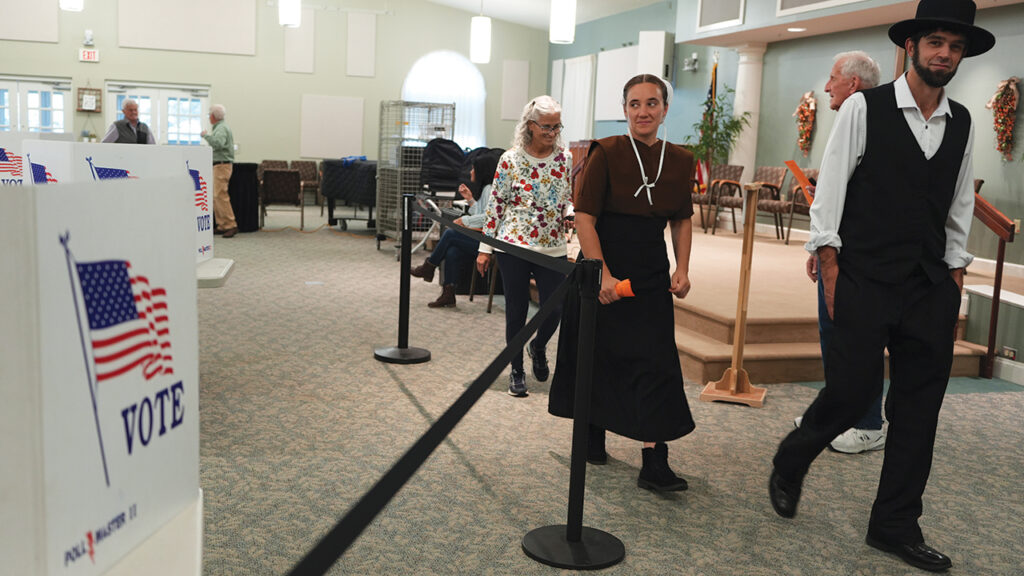
Media attention around Amish voting during the past several election cycles has sparked Amish conversation. Some church leaders offer new articulations of two-kingdoms theology that make previously implicit opposition to voting more explicit.
A writer in Geauga County, Ohio, cited 2 Corinthians 5:20 and its metaphor of being an ambassador for Christ. “An ambassador does not vote in the country where he lives,” the writer declared. Even if voting would be proper, it would be impossible to do so with a clear conscience since “both Republicans and Democrats” promote “violence and destruction,” and candidates who claim “family values and Christians values” engage in “name calling and mudslinging.”
Among the relatively small number of Amish who vote, political affiliation remains primarily local and connectional. Republican officials who show up at rural events, like ribbon-cuttings for a new fire station or a health clinic, signal that they are available to help constituents with their problems, which Amish voters appreciate.
Given Amish population growth — the number of church members has been doubling about every 20 years — are Amish voters destined to become ever more important? On the one hand, deepening economic integration may come to normalize a sense of civic obligation in some places. Yet, it is the most traditional segments of the Amish world — the affiliations with no inclination at all toward voting — that are growing most rapidly.
As is so often the case, Amish life is both a lens and a mirror, focusing and reflecting Americans’ hopes and anxieties. Rather than either celebrating or decrying the fact that some Amish voted for Donald Trump, mainstream Anabaptists might consider the shape of our own community involvement and whether we are facing or evading the question, “Who is my neighbor?”
Steven M. Nolt is professor of history and Anabaptist studies and director of the Young Center for Anabaptist and Pietist Studies at Elizabethtown College in Pennsylvania.


Have a comment on this story? Write to the editors. Include your full name, city and state. Selected comments will be edited for publication in print or online.