


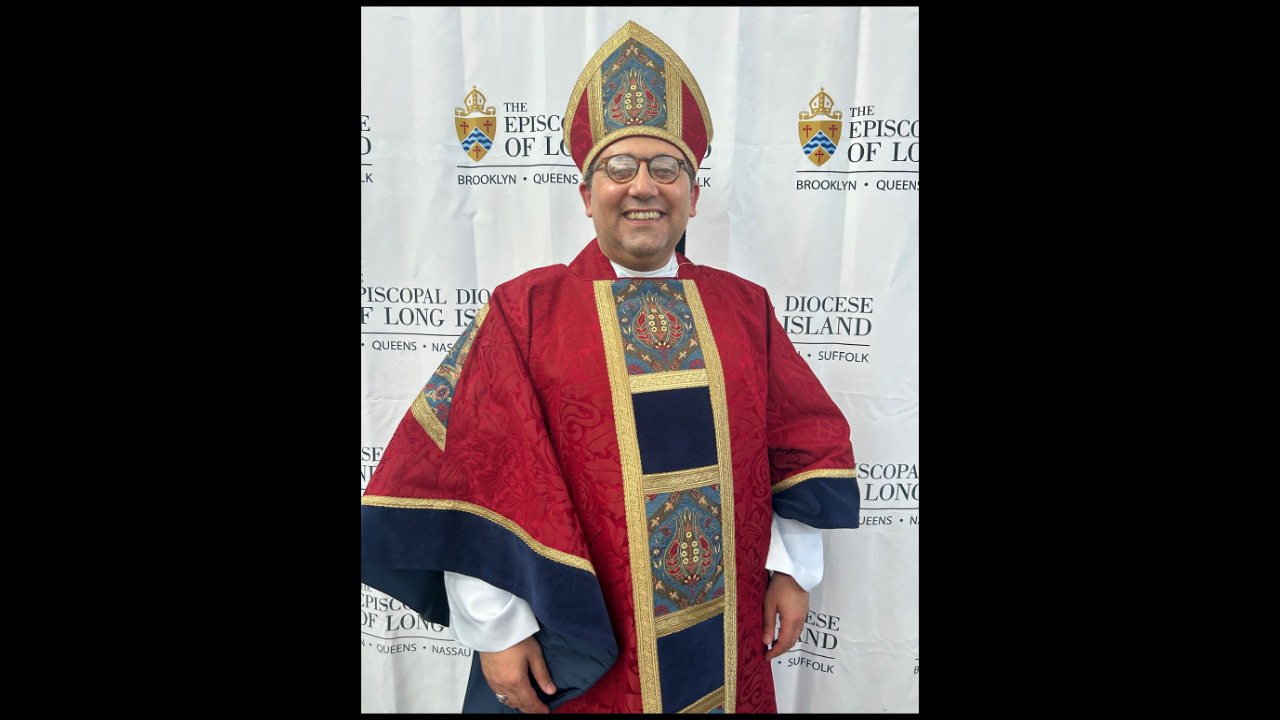
When Adam J. Shoemaker became the first bishop of Arab and North African descent in the Episcopal Church’s 237-year history, many of his colleagues saw it as a glass-ceiling smashing.
Donning vestments with a Turkish blue tulip and North African pattern, Shoemaker greeted families, clergy and laypeople alike after his ordination and consecration as the ninth bishop of the Episcopal Diocese of Long Island on Sept. 19. Nearly 2,000 people attended the ceremony at Tilles Center for the Performing Arts in Brookville, New York. The line to meet him stretched for more than 90 minutes.
“He embodies what it means to be the church in the world, and in particular, in New York City and the suburbs,” said Lindsay Lunnum, rector of Zion Episcopal Church in Queens, which is part of Shoemaker’s diocese alongside Brooklyn.
Shoemaker, 47, told RNS he sees himself as an “imperfect vessel” for serving the church. But his background is almost tailor-made for leading one of the Episcopal Church’s most ethnically diverse dioceses: he was baptized in the diocese; he’s lived in Latin America and speaks advanced Portuguese and basic Spanish; and he is the son of a Muslim Egyptian and a New Yorker with Jewish roots. His background covers the trifecta of the Abrahamic faiths.
But accepting his heritage hasn’t always come easily for him, he said.
Shoemaker, born Adam James Haggagi, was raised in New York, where his parents moved just before he was born. They had met at a train station in Luxor, Egypt, while his mother — a New York native, secular Jew and Egyptologist — was on vacation. His father struck up a conversation, and romance ensued. His mother didn’t come back from that vacation until just before he was born, he said.
While he was still a young child, his parents separated, and his father returned to Egypt. Shoemaker would see him only periodically when he had business trips to New York. Upon advice from the State Department, his mother never allowed him to travel to Egypt to visit his father’s family.
Eventually, his mother remarried, and he was enrolled in school with his stepfather’s name, Shoemaker.
Without much contact with other Arabs, Shoemaker described internalizing a sense of racism around his heritage growing up.
“There were times in my life when I would blame everything I didn’t like about myself on my Arabness,” he said. “It had a really corrosive effect on my personhood.”
By the time he was 18, he legally changed his name to Shoemaker. He estranged himself from his father after his mother died a few years later, he said.
The 9/11 terrorist attacks, which happened during his senior year of college, began to change things for him, however. “I remember 9/12, 9/13, 9/14 very differently because of my background,” he said.
While he said he was largely shielded from racism because of his lighter skin tone, he saw the accelerating racism toward Southwest Asian and North African Americans and Muslims in the U.S. He remembered seeing Arabs and Muslims pinning American flags to their clothes, in efforts to shield themselves from a pervasive feeling of retribution.
Between seeking therapy and serving as a missionary in his early 20s in Brazil — where his mixed ethnic background was both normal and celebrated — he began learning to cherish his ethnic identity, he said. At the same time, he had begun discerning a call to the priesthood in the Episcopal Church, in which he was raised.
He was ordained as a deacon in 2007, and as a priest in 2008.
Around that time, in his mid to late 20s, he reconciled with his father in Egypt. When he visited in 2020, just before the COVID-19 pandemic, he wasn’t sure if his Muslim family would accept their half-American relative who was a Christian priest.
But when one of his aunts saw him for the first time, she approached him with tears in her eyes and immediately embraced him “the way you hug something that’s been lost for so long, and you’ve found it,” he recalled. His father drove him around Luxor honking and exclaiming to neighbors that his long lost son had returned. It was a deeply meaningful experience for the bishop.
“The journey that I’ve been on my whole life to reconcile the disparate parts of my personhood and certainly my Arabness … it’s been liberating,” he said. “It’s helped me to become more fully the beloved child of God that I believe I’ve been called to be, and the priest and hopefully the bishop that I’ve been called to be.”
He hopes to use his new role to help elevate the voices and experiences of SWANA (Southwest Asian and Northern African) peoples within the Episcopal Church, he added.
Julie Hoplamazian, the Armenian-American rector of St. Michael’s Episcopal Church on the Upper West Side of Manhattan, said Shoemaker is the perfect person to help bring that perspective.
“The perspective of folks who live in that region of the world is a perspective that the church has conventionally tried to colonize,” she said. “And now we have a person from that part of the world who is a voice and a leader in the church to remind us and be a voice for the people who are the original Christians, the oldest Christians.”
Shoemaker also said he sees his leadership as an opportunity for change within the church, including in its relationship to the realities of violence in Israel and the Palestinian territories.
“I would hope to find ways to share my (Arab-American) perspective in Christian love, not only as bishop of the diocese, but as a bishop writ large in the wider church, and to be compassionate for the suffering that goes on in Gaza, in the West Bank,” he said.
As bishop, he believes part of his job is to serve as a public theologian. This compels him “to speak for fundamental Christian values, baptismal covenant values — dignity, respect, the inherent dignity and worth of all,” he said.
Donna Landers-George, a parishioner at Church of the Advent, an Episcopal church in Westbury, New York, said the overwhelming feeling across the diocese is one of excitement. “He’s the bishop for what is yet to come, a bishop for the future,” she said.


Have a comment on this story? Write to the editors. Include your full name, city and state. Selected comments will be edited for publication in print or online.