


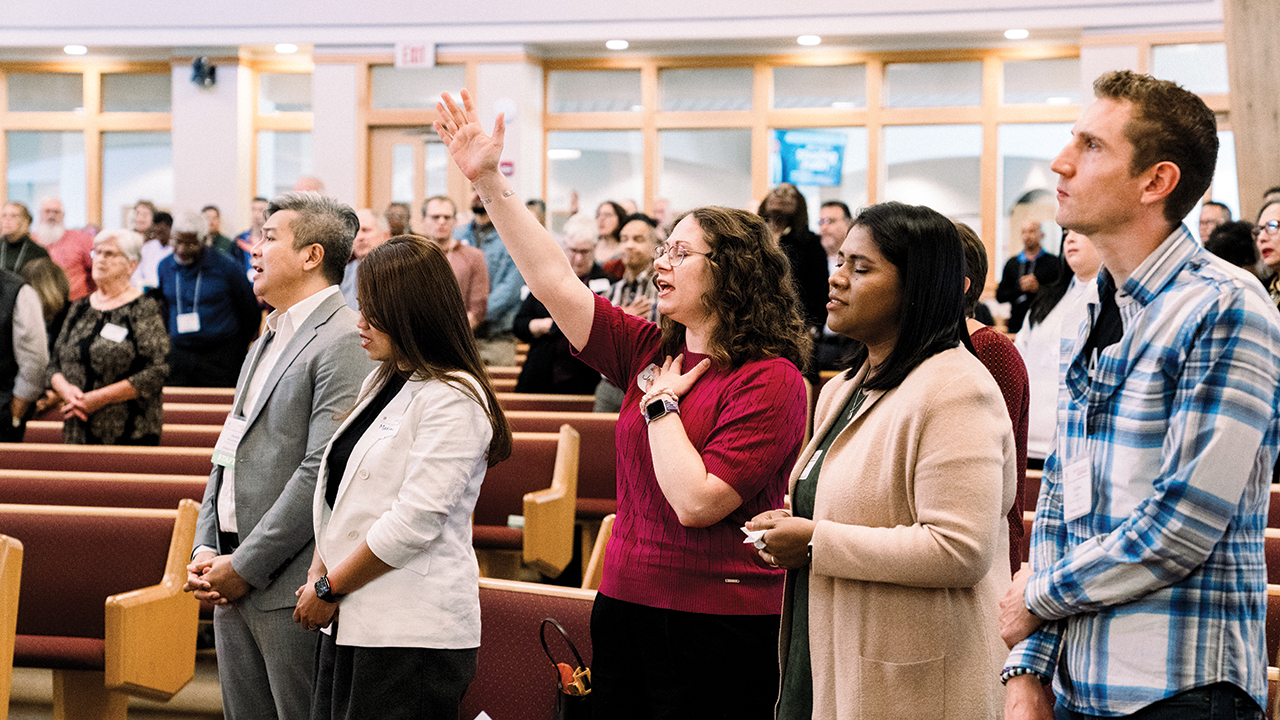
Stepping into autonomy, Mosaic Mennonite Conference is celebrating its intercultural diversity and defining its identity as a place where “high expectations and gracious hospitality meet.”
One year after delegates voted to end their affiliation with Mennonite Church USA, about 250 people gathered at Souderton Mennonite Church and Zion Mennonite Church in Souderton, Pa., for Mosaic’s annual assembly Nov. 6-7.
With the theme, “We Love the Lord,” based on Psalm 116:1-2, they talked about how to stay centered on Jesus while making space for different cultures, beliefs and practices.
For inspiration, they drew on the passionate preaching of a West Coast pastor who embodies Mosaic’s intercultural character and expansion far beyond its historic heartland in Bucks and Montgomery counties north of Philadelphia.
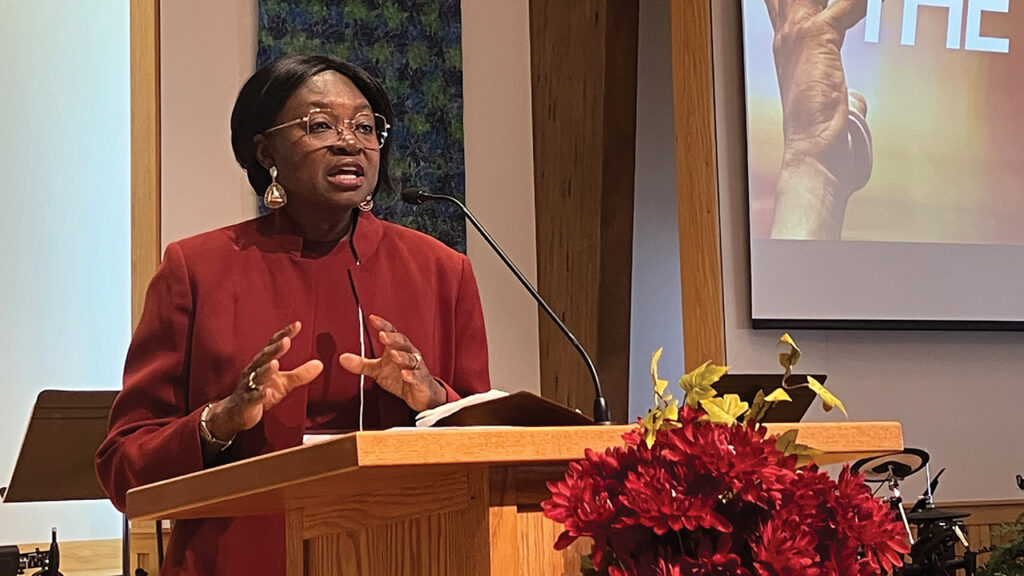
“I’m here today to tell you our God is a dynamic God, because when you cry out to him, he listens to you,” said Grace Pam of Los Angeles Faith Chapel. Calling people forward for prayer and anointing, she proclaimed, “Mosaic Mennonite Conference, I want you to agree that the dawn of your morning is here!”
Originally from Nigeria, Pam belongs to one of the immigrant groups that anchor Mosaic’s membership, of which nearly half are people of color.
Though its roots reach back 300 years as Franconia Mennonite Conference, Mosaic’s emerging identity stems from both a merger and a split — the reconciliation of Franconia and Eastern District conferences in 2020 and the departure from MC USA a year ago.
Based in Lansdale, Pa., Mosaic counts 56 congregations — 43 in Pennsylvania, nine in Florida, six in California and others in New Jersey, New York, Vermont and Texas — with an estimated membership of 7,500. Delegates welcomed two new congregations in Garcia, Mexico, and Temicula, Calif.
“Years ago, one of the goals of Franconia Conference was to become more diverse, and that vision from the past has been coming to fruition,” moderator Janet Panning said in an interview. “It’s a joy to be part of it and to learn from our brothers and sisters around the world and to broaden our vision of who God is.”
In Mosaic’s first year of autonomy, people were ready to set aside deliberations about affiliation and focus on strengthening their congregations, Panning said.
“It is very sad that we are separated from Mennonite Church USA, and I don’t think anyone is happy about the split,” she said. “My personal hope is that there will come a day in the not-too-distant future when that rift will be healed.”
With the disaffiliation decision behind them (the recommendation to leave MC USA passed with 74% support last November), delegates turned their attention to topics like how to support immigrant congregations and how to decide whether an 11-year-old document on sexuality still suits the conference today.
Two breakout groups talked about creating opportunities to study scripture together and “going to the margins” by welcoming cultural differences. Another focused on intercultural worship and prayer.
In the group that discussed challenges for immigrant communities, it was reported that about 10% of Mosaic pastors are vulnerable to immigration enforcement actions.
“Numerous members of our communities have already been detained or deported,” Mosaic leaders wrote in a pastoral letter. “Some members and leaders of Mosaic have self-deported, or plan to do so, rather than face the uncertainty and violence of current immigration enforcement. . . .
“We commit to ongoing support of recent immigrant communities within Mosaic as we struggle together through this time. We commit ourselves to lives of conscience that honor the humanity of all people, regardless of documentation status.”
Another group discussed conference policy regarding LGBTQ+ people and LGBTQ-affirming congregations. Currently, a 2015 document, “Grace and Truth,” prohibits pastors from performing same-sex covenant ceremonies and mandates a review of their credentials if they do.
A new document, “Clarifying Our Center,” approved by the conference board in 2025, urges acceptance of differences “with grace and humility” — implicitly casting a new light on previous restrictions and punitive responses.
The “Clarifying Our Center” statement defines Mosaic as a place where “high expectations and gracious hospitality meet.” It advises “prioritizing understanding over judgment” and “honor[ing] each other’s pursuit of faithfulness and movement toward our common center,” which is Jesus.
To the question of whether the 2015 statement “still represents who we are as a conference,” responses ranged from support to opposition. The document affirms denominational resolutions from the 1980s that define same-sex relations as sin. Several delegates called the 2015 statement outdated or said they felt they had to apologize for it.
Board member Michael Howes said a strategic planning process next year will include revisiting the “Grace and Truth” statement.
Differing views on sexuality and scripture were among the reasons some Mosaic members wanted to leave MC USA. Mosaic’s acceptance of LGBTQ-affirming congregations and allowance of local discernment have drawn some congregations in and led others to leave.
Those who departed went in different directions. Among the five congregations that left Mosaic in the past year, new affiliations included LMC (a more traditional/conservative direction) and MC USA (a more progressive/liberal direction).
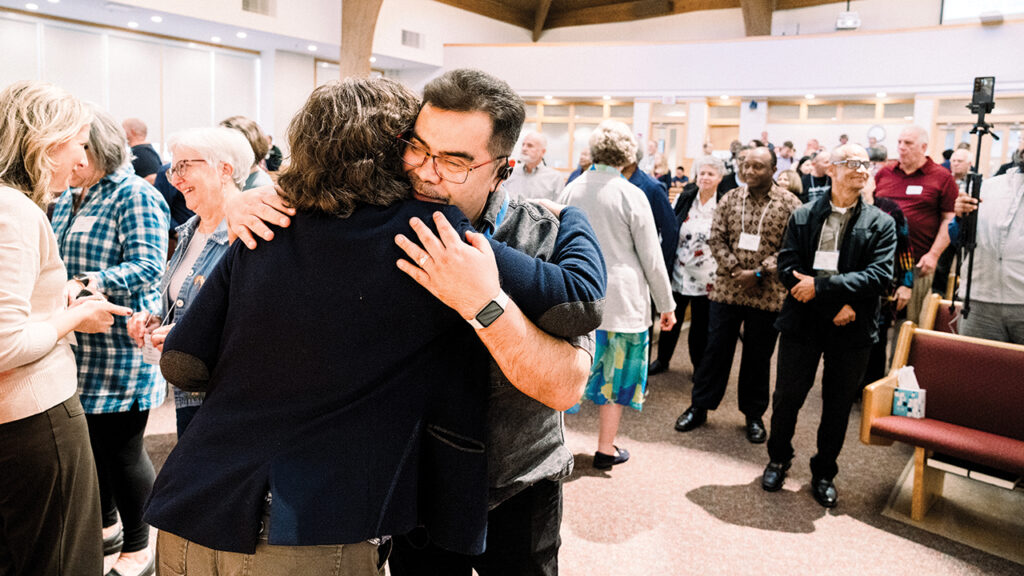
Earlier this year, to build Mosaic’s identity, the conference board held a series of listening sessions to hear people’s thoughts about relationships, both internal and external. Internally, concerns included the challenge of making room for theological diversity.
Some listening sessions focused on building resilience among immigrant congregations, including financial support. Others centered on Mosaic’s commitment to cultivate healthy partnerships with MC USA, Mennonite World Conference and other Anabaptist communities.
Executive minister Stephen Kriss said Mosaic wants to give and receive counsel and to share resources and experiences.
“Mosaic doesn’t intend to be an island of Anabaptist identity and witness unto itself,” he told AW. “I’m grateful for our delegates’ commitment to continue to build on existing relationships while exploring new opportunities for shared witness and ministry.”
Mosaic encourages its members to continue to support Mennonite Mission Network, the mission agency of MC USA; and to use resources from MennoMedia, the publishing agency of MC USA and Mennonite Church Canada. Mosaic has a partnership with MC USA for Hispanic ministry leadership training. It has ongoing relationships with MC USA-affiliated colleges, universities and seminaries, including Mosaic members serving on boards.
“There’s tremendous value in our relationships, and they’re even more important since we are autonomous now,” said Ken Burkholder, pastoral team leader at Souderton Mennonite Church, in an interview.
Burkholder sees Mosaic forging a distinct identity by building unity based on the three commitments in the “Clarifying Our Center” document: becoming like Jesus, loving like Jesus and living like Jesus.
“I see Mosaic seeking to live into its three priorities, not just as something on paper,” he said. “I think we’re getting the flavor of that today.”
He believes autonomy gives the conference more “flexibility in following the Holy Spirit’s leading” and opens the way for “growing in a variety of ways, not only nationally but globally.”
Mosaic has partnerships with ministries in India, Honduras, Mexico, Indonesia and Uganda and supports new churches in Mexico, Colombia and England.
Saturday morning speakers, in addition to Grace Pam, were Brent Camilieri of Deep Run East Mennonite Church in Perkasie, Pa., and Marco Güete, Mosaic leadership minister from Resplandece Mennonite Church in Pembroke Pines, Fla.
For Randy Nataliano, a delegate from Homestead Mennonite Church in Florida, Mosaic’s diverse and welcoming culture flows from a Christ-centered foundation.
“Jesus is the culture, and they emphasize that in Mosaic,” he said. “This is the first group beyond the local church that I’ve been interested in being a part of. I’m proud of being a part of these people.”


Have a comment on this story? Write to the editors. Include your full name, city and state. Selected comments will be edited for publication in print or online.