


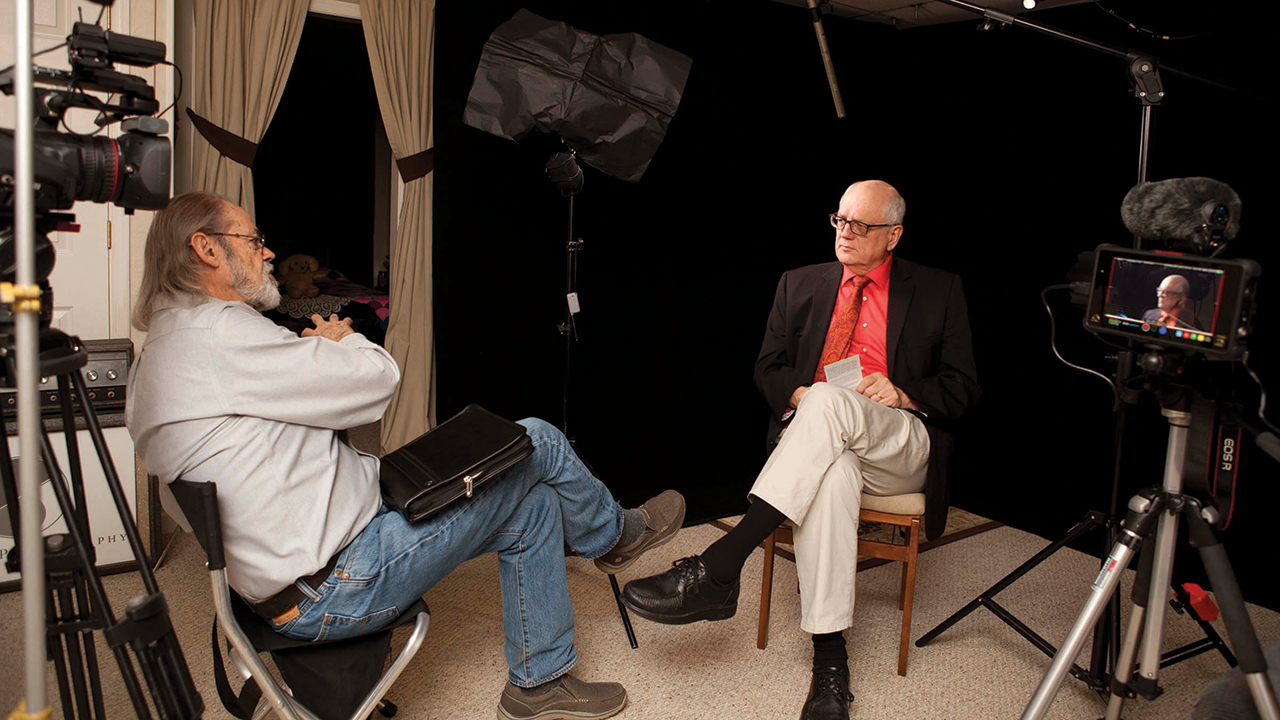
A new documentary that seeks to explain Mennonites to non-Mennonites is premiering in November on Pennsylvania public television.
Being Mennonite in America was developed by filmmakers Burton and Mary Buller of Harrisonburg, Va., after conversations with local retired professors a decade ago grew into a yearslong project investigating the history of Mennonite identity across the United States.
“The broader culture has no understanding of Anabaptism,” said Burton Buller. “… I was always kind of interested in what [people from other denominations] thought about Mennonites and their preconceived ideas. There was always this appreciation, but deep misunderstandings and assumptions, so I wanted to make a film, a primer for non-Mennonites.”
The film broadcasts on public television stations first at 2 p.m. Nov. 22 and 9 p.m. Nov. 23 on WITF Harrisburg in Pennsylvania, with online streaming and airtimes in other locations to be announced locally in the coming months.
The Bullers set out initially to create a film about Mennonite identity across all of North America but pulled back from attempting to cover too much. The final product takes a mostly historical approach to addressing how Mennonite faith and relationships to society and the government were impacted by U.S. wars, with a conclusion moving into the present about how groups have “institutionalized peacebuilding” through organizations like Mennonite Central Committee and Mennonite Disaster Service.
Buller said one of the biggest challenges was keeping the film focused.

“Cutting out stuff was difficult, especially World War I content was problematic because it’s such a watershed moment in Mennonite pacifist history,” he said. “Those experiences created the avenue to acculturation in ways that were just unheard of prior.”
He acknowledged the film is limited to Mennonites of European ancestry in the U.S., and hopes someone does a film that can focus on the experiences of non-White Mennonites.
“I did interview Leslie Francisco, and that’s interesting in so many ways,” he said of the African American leader and pastor in Virginia. “We tried to give a nod to the broader community who were also nonresistant during the wars. Mennonites tend to be most creative in the response to violence of war. Those are the times for Mennonites to make major decisions and get most behind nonviolence — otherwise we kind of let things slide, which is why World War I caught Mennonites off guard. …
“My hope is that if there is a time when we start to be required to really make decisions involving our nonresistance, maybe this film will give some history and context to that. There’s lots of resources about Mennonite history, but there are very few that take the cultural context into account.”
The 90-minute film has been screened once already, during Mennonite World Conference’s celebration of 500 years of Anabaptism in the summer of 2025 in Zurich, Switzerland.
“One European Mennonite who watched it made a comment to me that these ‘Pax boys’ came and built houses after World War II,” Buller recalled. “This person said, ‘We thought that was easy. We had no idea that it was difficult being a pacifist in America and what you had to go through.’ … So even in the European community there’s a bit of a blind spot when it comes to what it means to be nonresistant over the years, both in terms of relationships to the government and broader society.”
As independent producers, the Bullers are distributing Being Mennonite in America to public television stations through the National Education Telecommunications Association. NETA supplies content for each station to select and schedule on an individual basis.
“NETA is doing promotion to stations now, and those stations will have the material at the end of this month and will choose when they run it,” Buller said, encouraging people to keep an eye on online broadcast schedules of their local station. “… There will be another streaming option that will be free that people can watch online. We’re talking with one right now, and we’ll know in a month about that option.”



Have a comment on this story? Write to the editors. Include your full name, city and state. Selected comments will be edited for publication in print or online.