


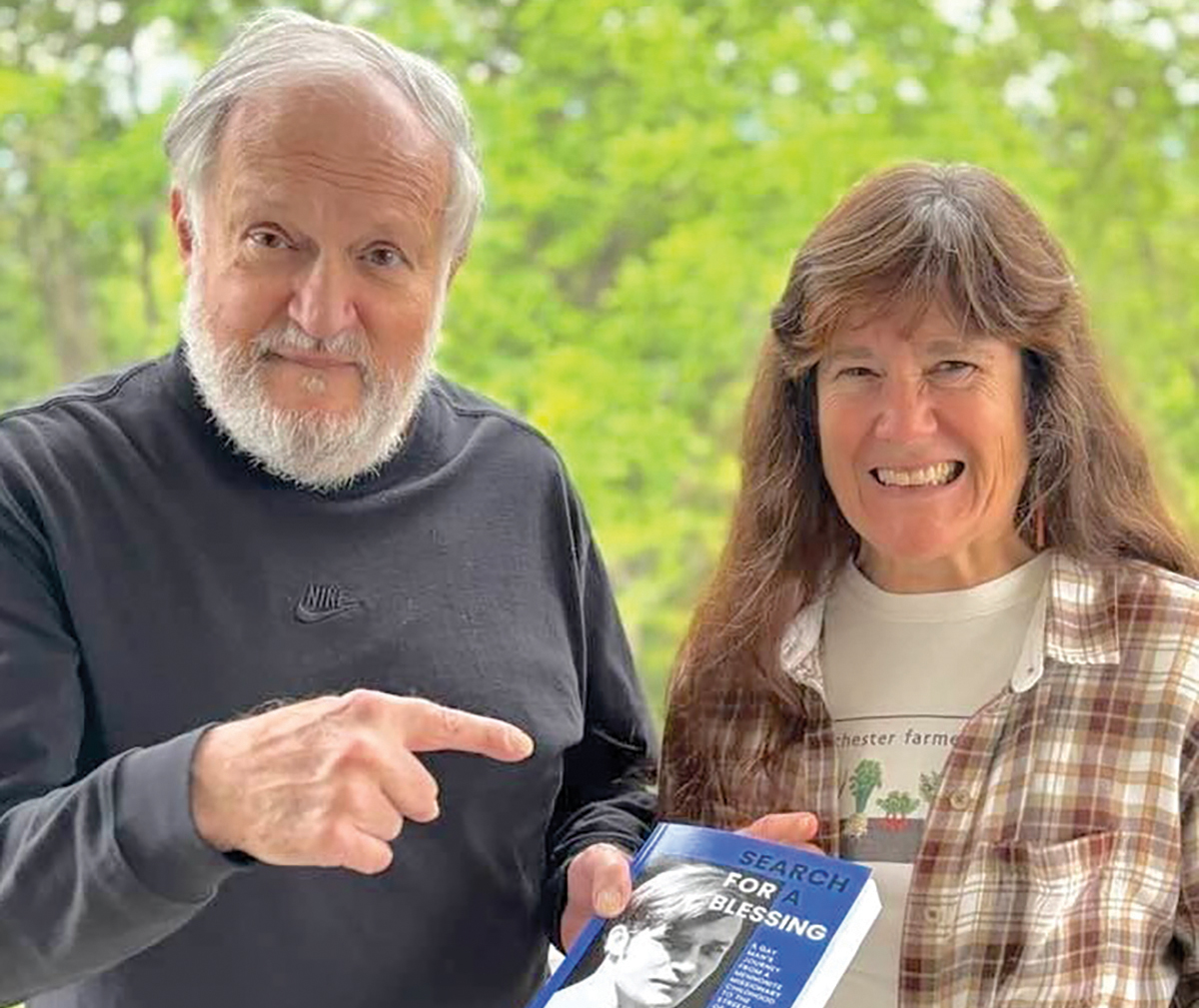
I’m standing in my office, talking on the phone with my Uncle Joe, tears welling up. I think of Uncle Joe as an establishment Mennonite, part of the “in” crowd. He was, after all, the president of a Mennonite university. He is reading me an apology he wrote to the LGBTQ+ community, lines he’s scribing for a book review blurb for Search for a Blessing: A Gay Man’s Journey from a Mennonite Missionary Childhood to the Streets of AIDS Activism (Pandora).
The memoir is by another uncle, Daniel Shenk, who had to leave the Mennonites in the 1970s so that he could live an authentic life as an out gay man. As a fellow writer, I’ve been helping Uncle Dan and his co-author Joyce Maxwell, his niece, with various aspects of publishing.
I tell Uncle Joe about what he’s read to me: “Yes, please send that!” His blurb is now inside the book’s front cover.
The church’s exclusion of Dan and other LGBTQ+ loved ones was one of the main reasons I left the Mennonites after college, experiencing what I now know as “moral injury.” That, and the church’s position at the time that women could not be ministers. I’ve known Uncle Dan since dating and then marrying his nephew, Jonathan, in the late ’80s, when Dan was navigating New York City’s AIDS crisis as a chaplain.
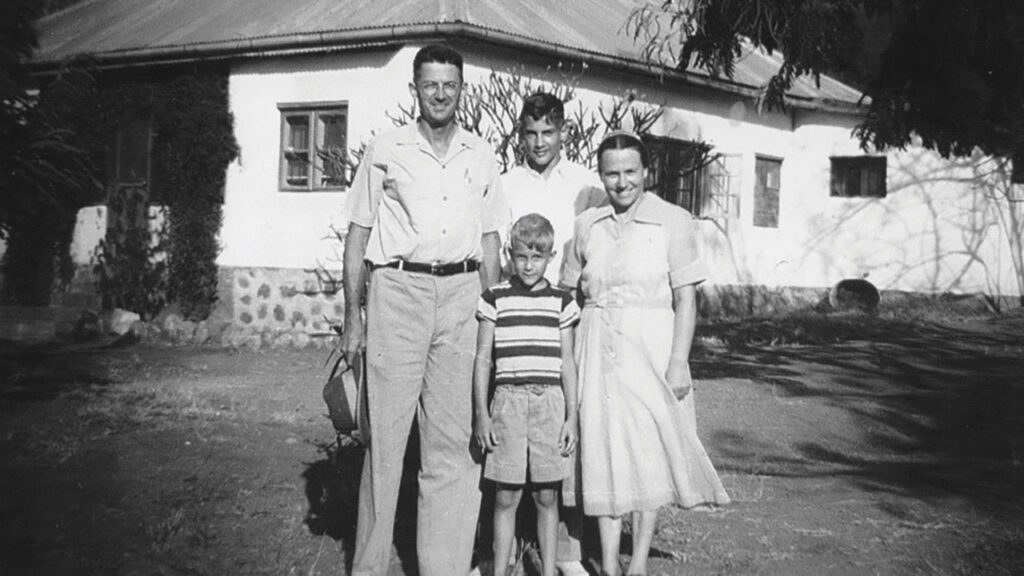
Moral injury happens when one’s sense of the moral universe is damaged by offenses one has either experienced or witnessed. Like Uncle Dan, I left a church in which my parents were torchbearers. They sacrificed much in their leadership roles. Uncle Dan’s father built churches in East Africa; his mother served lepers. In Search for a Blessing, Dan compares his early childhood at boarding school to the difficult childhood of David Copperfield by Charles Dickens.
My own father could’ve become a teacher, earning a living wage. Instead, he led a small “planted” church in Levittown, Pa., where we lived in the manse that also served as the church sanctuary until an addition was built. Sometimes, families in crisis would live with us for weeks, my mother caring and cooking for them. While we got a lot of meats and produce from my farmer-grandfather, money was scarce.

As Dan notes, others were seen as more important than he was, and I could relate to this stance toward the world, which we had been taught and which still impacts me at times. It’s a perspective rooted in Philippians 2:3: “Do nothing from selfish ambition or conceit, but in humility regard others as better than yourselves.”
All this sacrifice in service to others. Our community also loved the stories of Jesus sitting with the outcasts. But when it came to the loving, Christian uncle, the cousin, the best friend who happens to be gay and out? Where was the Jesus-like sitting together? From church leadership, especially, there was only the stone being thrown, only the casting out.
My father, Ray, was among the conference ministers who supported the removal of Germantown — the historic Mennonite church in Philadelphia that dates back to the late 1600s — from membership over this issue in the 1990s. The decisive vote to “excommunicate” the church was one that my father and I argued about. He softened later in his views and attended a welcoming congregation late in his life, which moved me greatly. But for the people of Germantown, and other churches who’ve faced this kind of ostracizing, the injury can’t be overstated. I spoke to one Germantown congregant recently who used a term to describe her experience of that time that feels on point: “We were dis-membered.”
As I’ve read Dan’s chapters about how he came through all this to accept himself and open himself to grace, my heart has been finding some healing. Uncle Dan survived isolation, sexual assault, judgment from his church and family, and still retains his faith. He has been a lifelong chaplain, bringing care and love to people with AIDS. That is some incredible resilience.
When I was going through the marital separation and mental health crisis that became the subject of my own memoir, Crazy Quilt: Pieces of a Mennonite Life, I found an inner compass I hadn’t discovered before. Perhaps that is the human silver lining for strife. Holding some outlandishly awful lemons, you press out some sweet (yet still slightly bitter) drink for yourself. You know yourself better.
I never would have expected the healing words of apology coming from my Uncle Joe, who is president emeritus of Eastern Mennonite University. It was a big deal for me to hear his words. Nor did I expect reading Dan’s narrative — which is rife with raw stories of alienation that he pairs with stories of grace — to challenge me to look for grace as he does.
In Dan’s book, he experiences isolation as a child sent to boarding school at age 6, only to experience isolation as an adult from the very church his parents sacrificed their lives for as missionaries in East Africa. Even the ultimate sacrifice: His mother was buried on that continent after dying in a plane crash.
Dan reads existential theologians to help him accept who he is as a gay man. He becomes an ordained chaplain, finding a sense of belonging in serving those society pushed to the margins.
Reading his story, I review my own explorations that have helped me heal the rifts in my psyche and live a spiritual life, albeit one outside any organized religion. I’ve sat with the Quakers, meditated with Hindu gurus and Buddhist monks, looking for a language that made sense to me.
Ultimately, I have found a spirituality of inclusion — that we are all one as beloved children of God, for all of eternity. It’s a counterbalance to the separation and despair I felt as a teen who worried about her non-Christian friends going to hell, as well as the fate of her gay and lesbian friends.
I recognize that the church is changing. Not fast enough, but pockets of inclusion give me hope at a time when the larger society has become louder in its intolerance of and inhumanity toward LGBTQ+ people. At times like these, the church should be a place of comfort and belonging. A place of sitting-with. The hen covering her chicks with outstretched wings.
Uncle Dan hopes to reach evangelicals with his story. I hope he also reaches people like me, who have left the church and are doing what some call “reconstructing,” so that we can find healing and the grace in community that he found.
We are all vulnerable humans looking for a place to call home.
Cynthia Yoder has written for the Advocate, Next Avenue and the collection Just Moms. Her books include the memoir, Crazy Quilt: Pieces of a Mennonite Life. She and her husband have rooted themselves in New Jersey; their grown son lives nearby. To read more, visit cynthiayoder.com.

Have a comment on this story? Write to the editors. Include your full name, city and state. Selected comments will be edited for publication in print or online.