


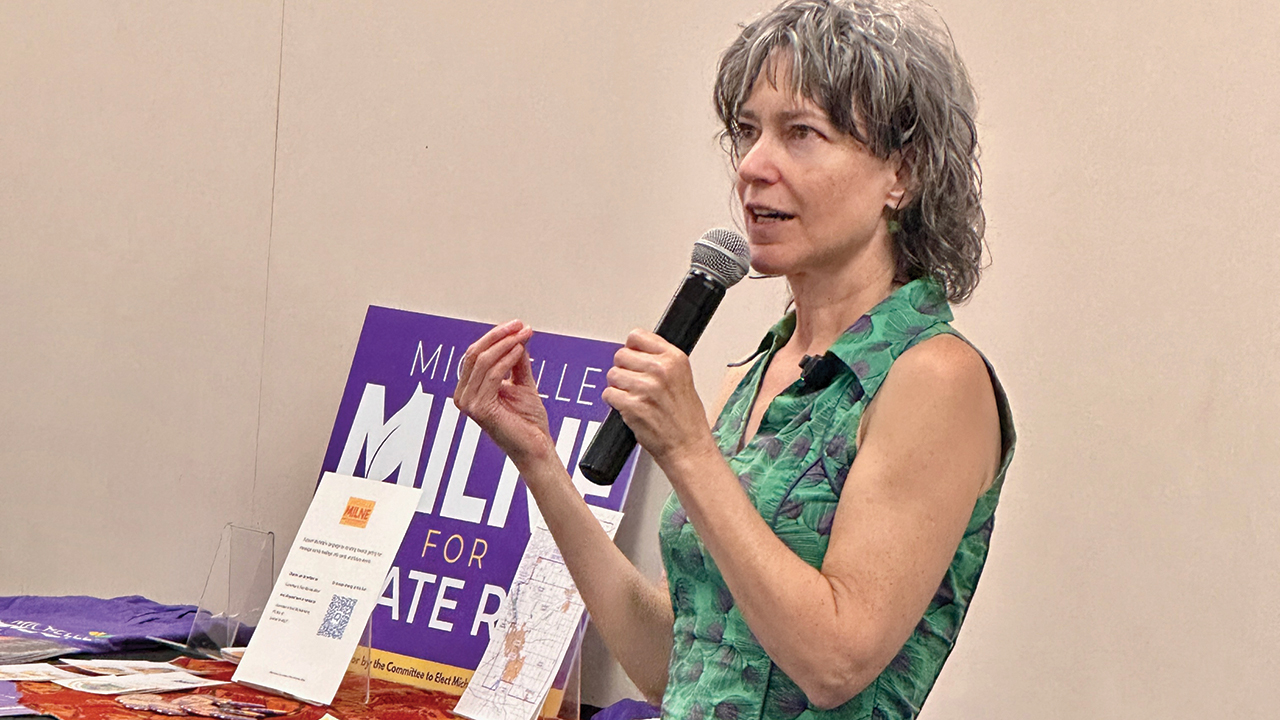
Michelle Milne is the Democratic Party nominee campaigning to represent District 49 in the Indiana House of Representatives. This conversation from early September has been edited for brevity and clarity.
Anabaptist World: How would you describe what kind of Anabaptist you are?
Michelle Milne: I grew up going to Mennonite churches, but we moved around a lot and attended other denominations as well. The Quaker church we attended for a few years in Bloomington, Ind., had a big influence on me. My parents worked for Mennonite Central Committee and Goshen College, so international experiences influenced me when we lived in Malawi and Haiti, but Goshen, Ind., was always “home base.” I also did MCC’s Serving and Learning Together (SALT) program in Japan when I was 21. The values I’ve carried from my Mennonite background are creation care and care of resources, respect for the humanity and dignity of every person, care for anyone suffering, connecting resources to values, being of service over gaining material things, distrust of hierarchy and a belief in cultivating equity.
Beyond your local neighbors, other Mennonites might remember your traveling theater work, right?
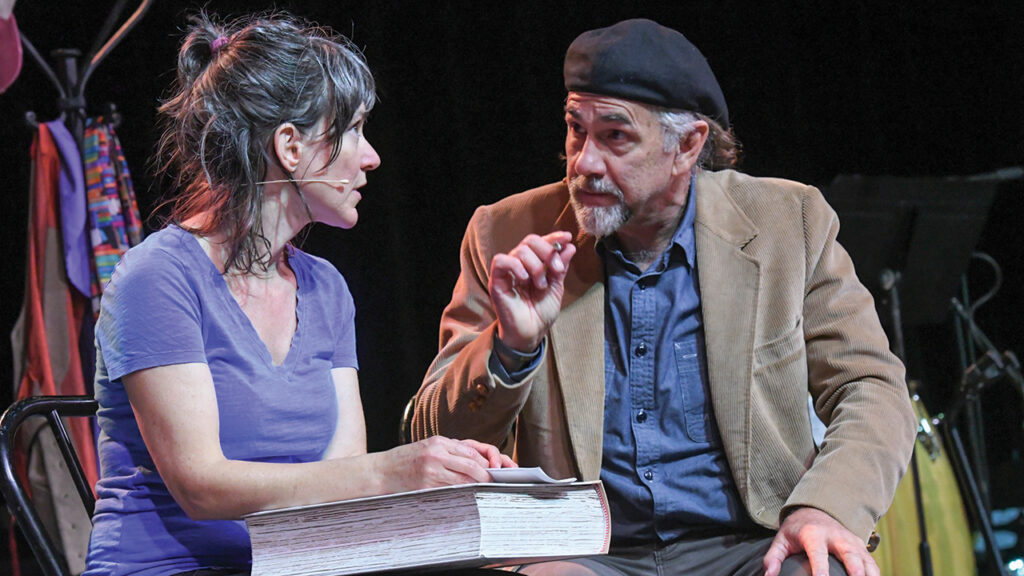
Yes, I’ve acted and directed professionally across the U.S. and Canada. I’ve performed plays I’ve written about bees, immigration and the environment and have won awards for directing plays about mental health and the Bronte sisters. Musician Heather Kropf and I have toured a storytelling show exploring what “home” means. In Baltimore, I wrote and performed a one-woman show that drew on my MCC SALT experience in Japan and asked what being Mennonite means.
Other people may know me from my work teaching at colleges, universities, prisons, jails and community centers. I’ve also performed, written, directed and produced with Ted & Company. We continue to tour We Own This Now (about the Doctrine of Discovery and issues of land ownership) by Alison Casella Brookins. Ted Swartz and I are writing two shows together, one about the Enneagram and the other about mental health and the life of Bev Miller, who died from cancer in 2020. And I will have two plays in Acting Up: Anthology of North American Mennonite Plays, edited by Lauren Friesen, coming out later this year.
A lot of self-described Christians are in politics today. What is it about your faith that inspires your effort to represent the people around Goshen and Middlebury?
I have a deep belief that we are here to care for each other. We are better together. My neighbors are suffering, and I can’t just ignore that. I have always fought for people who are treated unjustly, who are overlooked or ignored. I’ve always believed that every voice is valuable, and we need to actively work to bring out, listen to and support all voices, especially those who don’t already have a platform. I believe we are meant to feed and clothe our neighbors, welcome the stranger and share what we have. When we use those values to inform how we create and manage budgets and decide on rules to guide our society, we will develop systems that are good for all humans and the natural world around us.
Your opponent, Republican incumbent Joanna King, introduced a bill during the 2025 Indiana session urging legislators to “humbly submit” their work to Jesus and govern according to biblical principles. How would you love your neighbor differently than her?
Loving our neighbors is not telling them how to worship. I think it’s a choice. Isn’t that the whole idea of Anabaptism? Adult baptism is literally about having a choice and choosing something. As soon as we legislate it, it’s no longer a choice.
I have this theory that most of us agree on 85% of what we want. We disagree sometimes on how to get there. And that other 15% can be tricky. What I’m finding is so many people want easier lives, and they want to love their neighbor and not have to be afraid and not have to worry. I mean that in terms of economically being afraid, but also afraid because they just don’t feel understood. Or afraid someone’s going to take away their way of living. They’re living in a lot of fear. None of us wants that fear. I’ve seen what King put out there, and I don’t think that’s good for government. I don’t think it’s good for the church either.
I have a hard time picturing Jesus submitting a bill calling on legislators to be like himself. It’s just not . . . Christlike.
Exactly. And correct me if I’m wrong, but wasn’t he saying there’s a higher law than the law of the land?
He often didn’t answer things straightforward. It was typically from the sides: “Give to Caesar what is Caesar’s. I’ll let you figure out what that means.”
Right. That also says something. That’s making space for people to be people. He’s not saying, “This is the right way.”
We have separation of church and state. And you are driven by your faith. How do you hold those two together? Your faith calls you to care for people and get other people to care for each other. But what are the limits to how much you’re going to tell people how to do that?
I strongly believe in the separation of church and state. It’s in the Constitution, and it’s best for the health and integrity of both institutions. One interpretation of faith shouldn’t control how others are able to live out their own faith. We can — and should — use our true values to guide our own actions and interactions with others. We should not try to force our values and beliefs on others. That isn’t love — that is control. I believe that is sin and would be denounced by the man I understand Jesus to have been.
If I look back at that bill that Joanna wrote — that we need to put into law and legislate that Jesus is what everyone believes in — what does that actually do? That just makes people angry at the church if they’re not already in it. It seems counterproductive and actually causes harm to people and institutions.
You’ve been returning to themes of harm and protection. What are some examples of things you would change as a legislator that are harming people now?
We need to get so much money out of politics. We need some money to get our message out in campaigning, but it means people start listening to the powerful instead of the people we’re meant to serve and protect and care for. In Indiana, we had a big law last year that gave huge tax breaks. It was promoted as the biggest tax cut. It’s true, property tax rates came down a little bit, but everyone’s homes were reappraised for a high amount. Federal cuts did one thing, but Indiana made more cuts, and now I’m talking to people at the city and county level who are trying to figure out their budgets.
A fire station was supposed to be built to serve the south side of Goshen, where there are growing communities and growing needs. That had to be put on hold because of this big bill of cuts to big out-of-state corporations that already have a lot of money and power, and we’re giving even more to them and taking safety from our community. So that’s causing harm.
Indiana has a $4 billion surplus and turned down $100 million in federal funding to feed hungry kids during the summer because it would have required $12 million in administrative costs. Indiana said, “That’s too much.” They chose not to accept money that would feed hungry children. We could probably just take it out of that $4 billion and not feel it, and we said no. There are some church groups and community organizations stepping up, but they can’t do it on their own, and they weren’t sure they were going to get through the summer. So that puts stress on communities and causes hunger to children and their parents.
It’s very basic stuff — to have empathy rather than a legalistic, judgmental attitude. To me, the most Christian thing is to hear people’s stories and have empathy and look for where we can help.
Tim Huber is associate editor of Anabaptist World.



Have a comment on this story? Write to the editors. Include your full name, city and state. Selected comments will be edited for publication in print or online.