


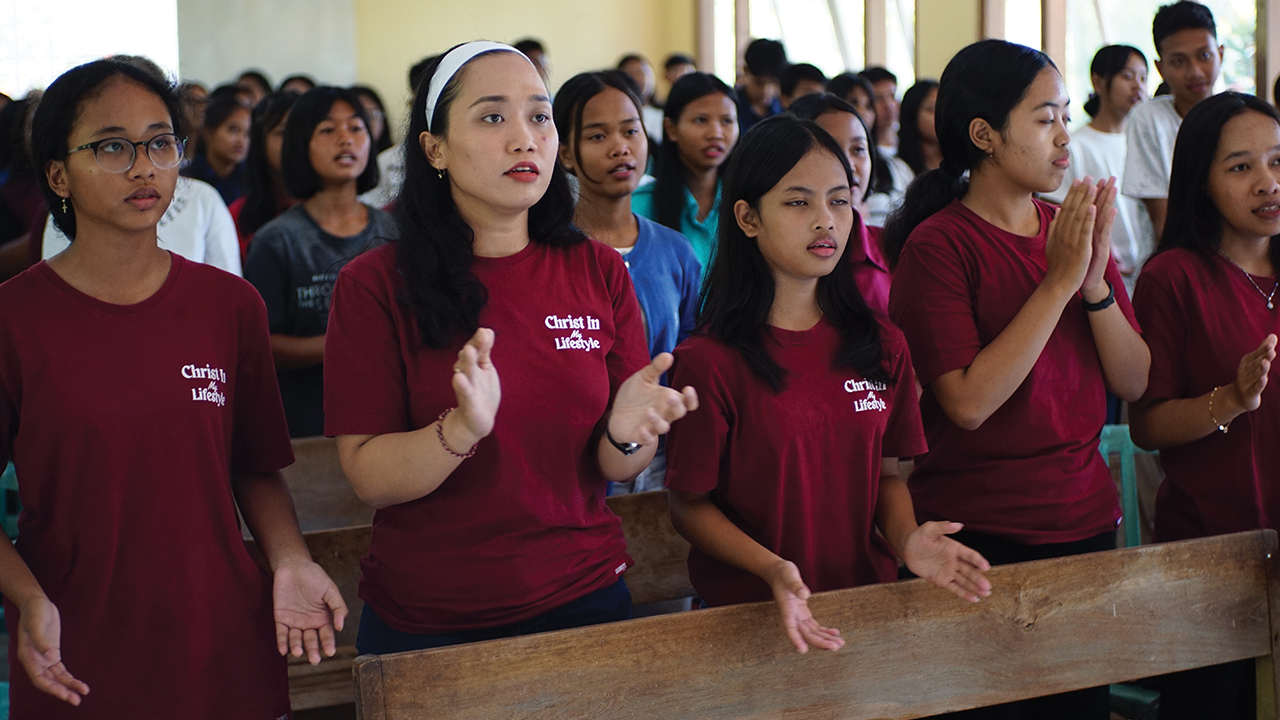
In August, youth along the northern coast of Central Java in Indonesia took a step toward building interfaith relationships. About 250 youth from 20 congregations of the Mennonite conference Gereja Injili di Tanah Jawa (GITJ) gathered for worship and a service project, distributing essential supplies and cleaning up a beach alongside Muslim youth.
Their activity represents a small step toward threefold friendship: bonds among church youth, interfaith connection and humanity’s relationship with creation.
The activities began with delivering food to families in need in Dermolo, particularly widows and households facing economic hardship.
For the Mennonite community in Jepara, the name Dermolo carries memories of a troubled past. For two decades, from 2001 to 2021, the narrative surrounding Dermolo was marked by intolerance, suspicion and grief between Muslims and Christians. Conflict arose when plans to construct a church building for GITJ Dermolo met opposition from a local Islamic organization and were stalled by complex government regulations. In Indonesia, the licensing of religious structures has often tested interfaith dynamics.
Although relations among neighbors near the church site remained cordial, resistance from external groups left psychological scars. News media highlighted Dermolo as a symbol of religious tension. A turning point occurred in 2021 when the local government issued the building permit.
Today, social initiatives of Mennonite and Muslim youth represent an effort to mend relationships. The recent event might be the first interfaith activity hosted in Dermolo since the dispute.

Can a shared project instantly heal decades of traumatic memory? It might look like merely a symbolic gesture. Yet symbolic actions carry profound value. A symbol is a catalyst for reflection that inspires action.
The youth gathered for their main event at GITJ Beji, a small congregation tucked away inside a former state-owned rubber plantation. The area was once the home of many workers, including Christians. When operations ceased, residents relocated in search of new livelihoods. Only a few families remain today. Sunday attendance at GITJ Beji is only about five, nearly all elderly.
Traveling to Beji required considerable effort. Several groups losing their way along faint plantation tracks.Getting lost turned into a memorable adventure. Most were visiting for the first time, discovering a Mennonite presence in an isolated setting. Selecting GITJ Beji as a gathering point was designed to foster solidarity with people they had never met.
In a digital age that connects people virtually while minimizing physical presence, traveling bumpy roads under the hot sun left a lasting impression.
A church leader shared a message with the visitors: “If you enjoy a comfortable place to worship and ever feel reluctant to attend church, remember us here, where simply gathering for worship requires a great struggle.”
After worship, the youth gathered at the beach for a cleanup. Reaching the shore proved even more challenging; roads were too narrow for cars, requiring a 20-minute motorcycle ride along local paths.
At the beach, the Mennonite youth worked alongside youth from an Islamic boarding school. Collecting trash polluting the coastline, they built friendship while caring for creation. In pluralistic Indonesia, environmental stewardship transcends religious boundaries.
For many Mennonite youth, standing shoulder to shoulder with Muslims to take environmental action was a novel experience, an authentic interfaith connection.
As the sun set over the beach, a shared commitment emerged to nurture future encounters.
Building friendship and peace rarely happens quickly or easily. It’s a gradual process of building trust and learning to be trustworthy. Yet even a small step forward is worth celebrating.


Have a comment on this story? Write to the editors. Include your full name, city and state. Selected comments will be edited for publication in print or online.