


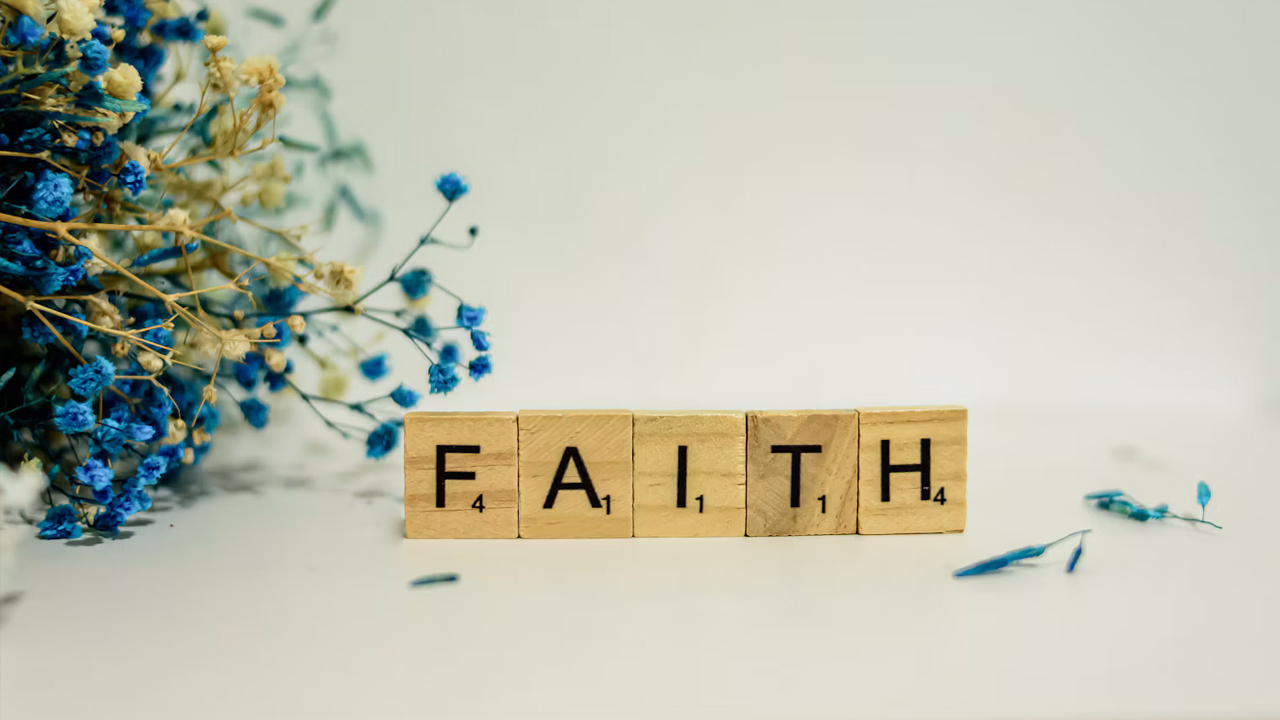
I know the plans I have in mind for you, declares the Lord; they are plans for peace, not disaster, to give you a future filled with hope.
— Jeremiah 29:11
“I don’t know.” With each passing day, I’m uncertain of a lot, but I am sure of one thing: I don’t know the future.
For anyone who struggles with anxiety, even the occasional hint of it, not knowing is excruciating.
For many, the root of our anxiety is the fear of the unknown. We can’t control the future, but that doesn’t stop us from trying desperately to control the outcome of things that weigh heavily on our minds — or even things that don’t weigh heavily. It might be just a future problem we want to solve before the moment arises. After all, if you stay ready, you don’t have to get ready.
Being prepared is a definite plus in life. But some of us, like me, take it to an extreme. I admit, I can be a control freak. I outline exactly how I want my day to go. If something major disrupts things, I throw a little tantrum (but only on the inside; I don’t let it show). I prepared! I thought ahead! I deserve to have things go my way!
God often has other plans.
Therapists call it radical acceptance. Some of us refer to it as “letting go and letting God.” I prefer to think of it as “I don’t know.” Or, “I sure hope God has my back.” I know God does, but in the midst of a life shakeup, “I sure hope” is about all I can muster.
Such is the mystery of faith. Some of us have audibly heard God, others haven’t. Some of us have witnessed a miracle, others haven’t. And yet, all of us are supposed to have faith that things will work out for our greater good.
That’s the message we hear from Jeremiah. God says (via Jeremiah): “I know the plans I have for you.”
Me: “Oh, good!”
God: “They are plans for peace and not disaster.”
Me: “Are you sure? OK. I don’t know, but you seem to.”
God: “I will give you a future filled with hope.”
Me: “Again, are you sure? I’m glad you’re so confident. I’m not, because I just don’t know.”
It’s exhausting to carry the weight of always needing closure and control. When my anxiety kicks in, I run loops in my head like a hamster on a wheel, doing all I can to make sure the outcome is what I want. I’m convinced that my hamster-wheel loops will reveal the key that unlocks the secret to controlling how things are going to go, so that I can eventually stop running.
But that’s just a trick our minds play on us. For me, the only antidote is to surrender and say, “I don’t know.”
“I don’t know” is a holy surrender.
Isn’t surrender a bad thing? Doesn’t it mean you’ve given up the fight? That you’re weak? That’s what I used to think.
No, surrender can be holy. Surrender is letting go of the illusion that we have control. This does not mean we never plan or prepare. Yes, we have agency, but we do not have ultimate control. That’s God’s job.
I believe God is inviting us to rest. I don’t do this very well. I know God invites us to let God work behind the scenes — and to relax, because we don’t have to do God’s work. I have a hard time giving up the reins of control. But I’m getting better at it.
Every morning, I write out my joys from the previous day. It’s a spiritual practice. Since I tend to dwell in the negative, this helps me have gratitude.
Then I write down my intention for the day. Today it was trusting that God is handling my life for my own good.
I’m recording my moments of surrender. Sometimes those moments are few and far between, so I celebrate each one.
Surrendering our need for certainty might be the ultimate act of faith. In fact, it is what faith is all about. Faith doesn’t mean certainty. Faith requires uncertainty, because if you can be certain of something, you don’t need faith to believe it.
Surrendering isn’t an attempt to avoid responsibility. It’s not an admission of spiritual weakness. It’s a radical act of trust. It’s a sign of strong faith when we reject the myth of human control and trust God to take care of the future.
What’s not helpful, though, is telling someone to “just have faith.” It’s an empty phrase that sidesteps real pain or trauma. It’s much better to release knowing — to surrender — than to tell ourselves or others to “just have faith.”
When we surrender, we can stop exhausting ourselves on the hamster wheel of anxiety, chasing after control and certainty. We can rest.
Take a deep breath. Let it out slowly. We don’t control the future, but God does. Rest in the holy surrender of “I don’t know.”



Have a comment on this story? Write to the editors. Include your full name, city and state. Selected comments will be edited for publication in print or online.