


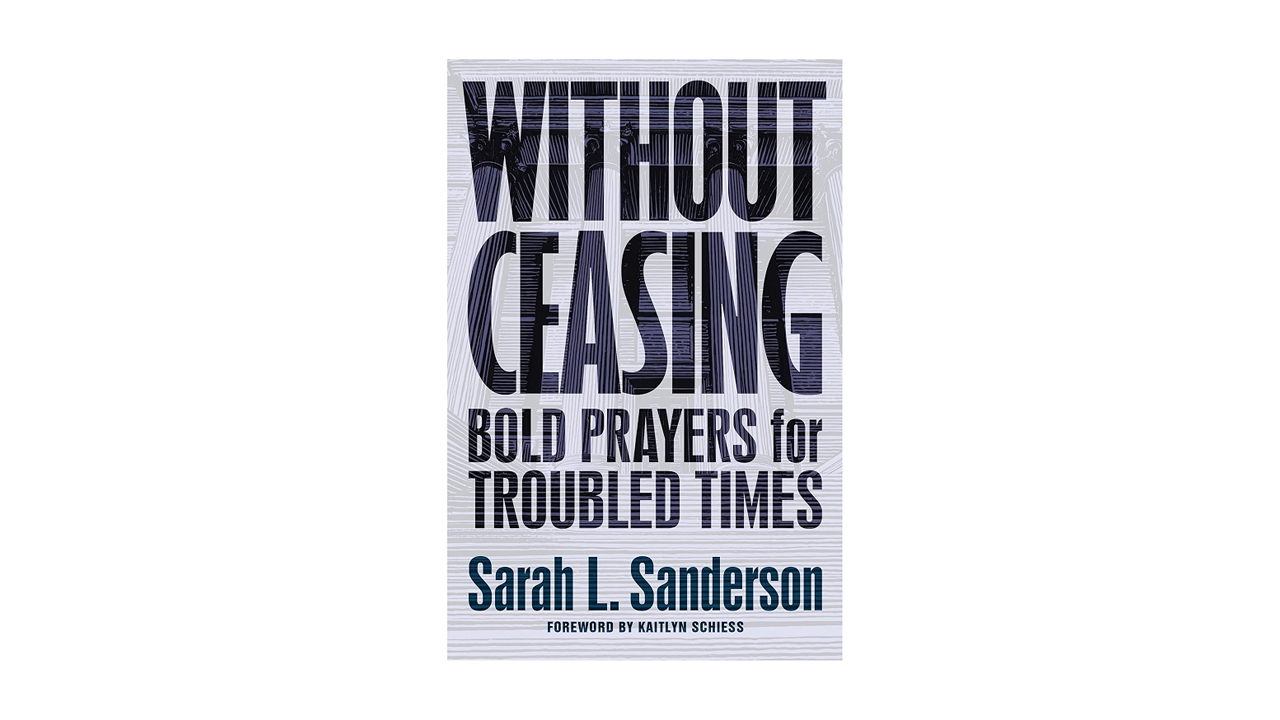
Though without Ceasing promises “bold prayers for troubled times,” Sarah L. Sanderson’s book is humble. It doesn’t detail a successful prayer campaign that changed the world. It doesn’t outline a strenuous plan promising that you, too, can become a “prayer warrior.” In fact, in beginning her prayer journey, Sanderson admits, “I wasn’t quite sure what I hoped to accomplish,” but she steps out — literally — in faith, trusting that “when we pray, things happen.”
Without Ceasing documents Sanderson’s commitment, made after the 2024 election, to pray for the U.S. while walking around the White House monthly for a year. Her friends participate, some praying from afar, some in person. Each month’s prayers have a theme: disability, peace, climate, racism, incarceration, homelessness. The themes sensitize her to everyday people’s challenges, so she can no longer pray for others “while walking right past them.” Thus, her prayers provoke action, including distributing food to unhoused people on Pennsylvania Avenue.
In deciding to “show up at the White House and pray for God’s will on Earth,” Sanderson joins a tradition of political prayer likely more familiar to conservative Christians than progressive ones. Bible stories like Joshua’s circling of Jericho, which Sanderson invokes by walking around the White House seven times on her final visit, are tropes in Christian nationalism. Indeed, in the days after Trump’s 2020 defeat, “Jericho Marches” circled many state capitols to protest the election outcome, and, on Dec. 10, one was held at the U.S. Capitol, an action that provided both theological justification and practice for some Christians’ participation in the Jan. 6 insurrection.
Except for her disapproval of unidentified “Turn or Burn” picketers, Sanderson only reports on Christians she sees as praying right, like a Caribbean group that sends Black missionaries to the U.S., reversing the usual direction. She prays with Baltimore Prayer Circles, which organizes on-the-ground prayer for specific locations around the city, even visiting a school for which the group prays to learn its turnaround story, which Baltimore Prayer Circle credits to prayer. However, she either doesn’t notice or doesn’t report that the group is informed by the Seven Mountains Mandate, a dominionist movement that argues that Christians are to take control of seven areas of society — including schools and religion — to build a distinctly charismatic, evangelical, politically conservative and Protestant U.S.
Knowingly or not, Sanderson is praying alongside Christians whose Seven Mountains framework contributes to the “troubled times” that Without Ceasing’s subtitle laments. For example, Russell Vought, Trump’s Office of Management and Budget director, was key in ending USAID, which The Lancet reports will result in 14 million preventable deaths, disproportionately among children in sub-Saharan Africa. Christians like Vought don’t believe we live in “troubled times”; they believe they are “occupying” the U.S. until Jesus’ return (Luke 19:13) and that their prayers are yielding fruit: incarceration, deportation and the dismantling of the U.S.’s already-weak welfare state. Sanderson names people promoting these politics as an “enemy” and calls for us to “hold love and confrontation together at the same time,” but she does not name the danger of wanting politics to reflect Christianity when so many American Christians have been captured by MAGA.
As Sanderson’s experiment nears its end, she veers between expectation — because God promises that faith moves mountains — and embarrassment that she’s still dragging her friends around Lafayette Square, even when “nothing seemed to have gotten much better. A lot had gotten worse.” Still, she hopes in their final walk, in January 2026, to experience an “obvious answer to our prayers, a clear change of heart in our leaders, a regime change of sorts for the United States of America” because implicit in prayer is that it “actually did do something.”
Though she doesn’t witness miraculous changes, Sanderson is faithful to her call, even if she didn’t fully understand it. “Jesus himself had called different people to do different things at different times,” she reminds herself when criticized that prayer doesn’t solve problems. “Maybe the most important thing was simply for each of us to listen for the calling God has for us. And then go and do it, one step at a time,” she concludes — the “maybe” reminding us that others may achieve different results, insights or growth. In prayerful walks around the White House, your mileage may vary.


Have a comment on this story? Write to the editors. Include your full name, city and state. Selected comments will be edited for publication in print or online.