


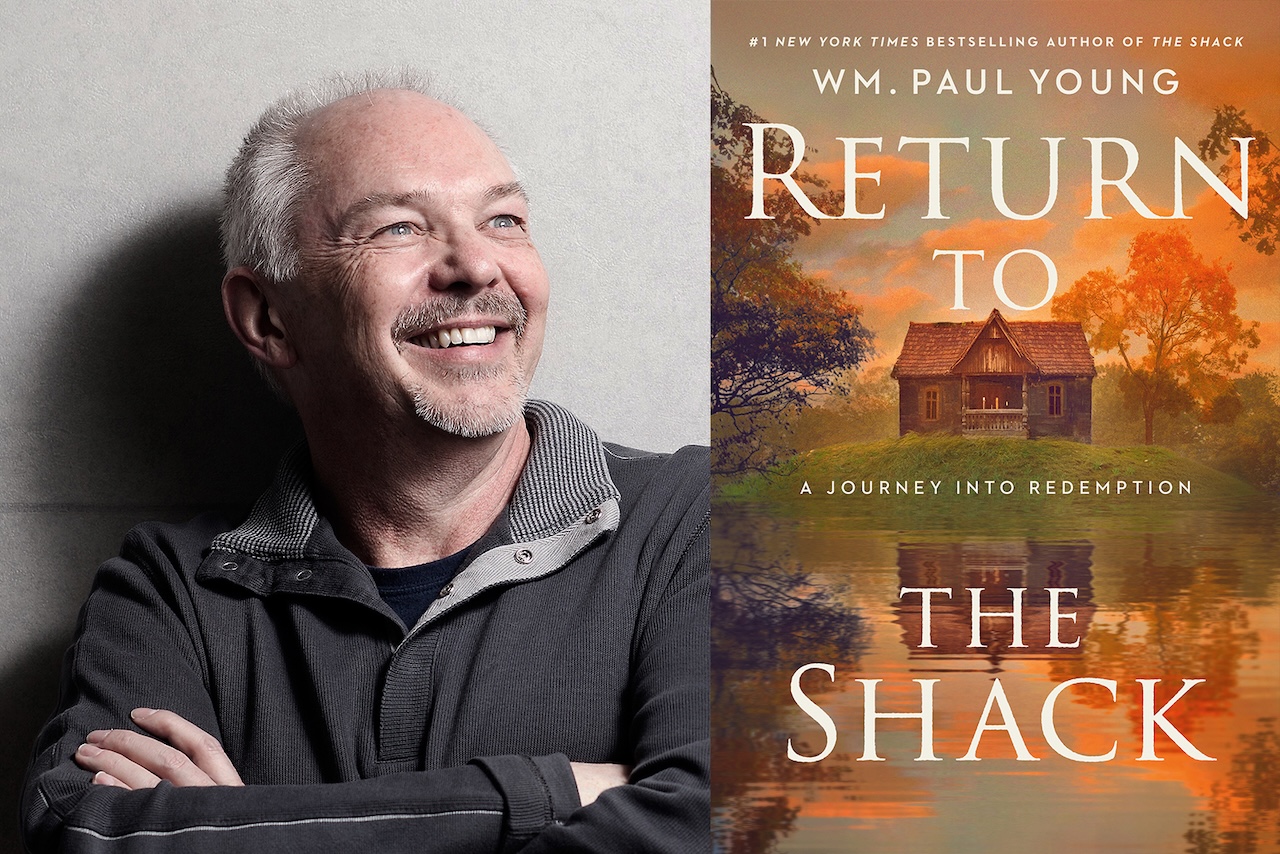
Two decades ago, William Paul Young was a publishing rock star.
His novel The Shack, which was originally self-published, was a blockbuster New York Times bestseller, selling more than 20 million copies. It sparked devotion and controversy for its depiction of God as a Black woman named “Papa” who helps a grieving father cope with the loss of his young daughter, who had been kidnapped and murdered.
When he wrote The Shack, Young was in his early 50s and struggling to make ends meet. His family had lost their home to bankruptcy, and he was recovering from years of addiction, grief and memories of childhood sexual abuse. The shack was a metaphor for the place he hid all his sorrows.
The book changed his life.
But not in the way you might expect. Sales of the book helped pay the bills and led to speaking gigs across the country. Wherever he went, people would share their stories of pain and loss and tell him how the book had helped them heal.
“It offered me an invitation to walk on the holy ground of other people’s stories,” Young told Religion News Service in a recent interview. “I’ve been invited into places that I would have never been invited to before.”

Among those places was death row at the Riverbend Maximum Security Institution in Nashville, where he has been visiting inmates for more than a decade. That prison is the setting for his new book, Return to the Shack, which was released on October 6 by Apiary, an imprint of Hachette.
In the new book, Mack Phillips, the main character from The Shack, meets face to face with the man who killed his daughter. He is also befriended by several death row inmates, who are based on men at Riverbend whom Young has met over the past decade.
He was invited to the prison because one of the inmates on death row was a fan of the book. They have since become friends, said Young. “Proximity changes everything,” Young told RNS, quoting one of his friends on death row.
Young said he has learned that people are more than the worst things they have ever done. That’s one of the lessons he learned from writing The Shack and through his friendship with inmates.
“I haven’t met one person in Unit Two who wants to be a killer,” he said. “Not one who wants to be someone who lies. Not one who doesn’t want to be gentle and kind and good.”
Young said that his friendships with inmates on death row have made him think through the tension between forgiveness and having consequences for those who commit crimes.
“There are folks who probably never will be released into the public as part of the consequences,” he said. “But there’s got to be more than that. There’s got to be a recognition of transformation, and the way the system is set up, it’s almost impossible to get anybody to recognize that.”
The inmates he’s met aren’t the same people they were when they committed the crimes that landed them on death row, Young said. While inmates face consequences for their actions, Young rejects the idea of the death penalty.
“I don’t agree with using evil to try to destroy evil,” he said. “Something they say is, ‘This is the place where you kill people who kill people to prove that killing people is wrong.’ Even on their death certificates at an execution, it says homicide as cause of death. So, how do you reconcile it?”
Three of the people that Young befriended have been executed since August 2025. Four of the men he’s known on death row have been exonerated. On Oct. 1, Tennessee Gov. Bill Lee halted executions in the state, pending a review of the botched execution of Christa Pike, according to the Associated Press.
At the heart of both Shack books is the idea that God loves people unconditionally, said Dan Mann, who also visits with prisoners at Riverbend. Mann, a former speakers bureau agent, represented Young when The Shack first became a hit and introduced him to the inmates on death row.
That first book, he said, came out during the subprime mortgage crisis, when a recession and mass foreclosures had many Americans looking for hope. They found it on the pages of The Shack.
“People were looking for a God who loved them unconditionally, who was there and could meet them in their lowest point,” he said. “When that book came out, there was so much uncertainty and anxiety.”
Young looks back at the success of The Shack and shakes his head.
“I chalk it up to God’s sense of humor,” he said. “When I step back for a second and try to think about it, it just makes me laugh.”
He wrote the book for his kids after years of struggle. When the book was done, he made 15 copies and gave them to family and friends. Then he made more copies, one of which made its way to Wayne Jacobsen, a pastor who had an early podcast called The God Journey. The two men, along with a friend named Brad Cummings, polished the book and decided to self-publish it and sell it out of a garage.
That podcast helped the book sell by word of mouth, said Daniel Silliman, a journalist and author of Reading Evangelicals, a history of Christian fiction.
The book also came along at a turning point for Christian publishing. Big box stores and major bookselling chains had discovered that there was money to be made selling Christian and inspirational books — bypassing the gatekeepers at Christian bookstores.
It also appeared at the same time as a movement called the emerging church, which had begun to question some more traditional aspects of Christian theology. That created an opening for a book with an unconventional portrayal of God, said Silliman.
Along with the characterization of God in The Shack, Jesus appears as a Middle Eastern man and the Holy Spirit is an Asian woman.
“It’s a book that encourages you to have a conversation,” Silliman said.
Eventually, the book was picked up by Hachette Nashville, a publishing group based in Music City, and became a runaway hit. That success led evangelical leaders like Al Mohler, president of the Southern Baptist Theological Seminary, to criticize the book’s theology — generating controversy that likely helped sales grow. A 2017 film adaptation made nearly $100 million worldwide, according to Box Office Mojo, and returned the book to the top of the New York Times best-seller list.
Now in his early 70s, Young is a bit creakier these days than he used to be but says he’s happy. Young spends much of his time with his grandkids, a dozen of whom live near his home in Washington state, just across the border from Portland, Oregon, when he is not out speaking. And he’s glad he still gets to visit with people and hear their stories.
Young said he wrote the sequel for the same reason he wrote The Shack — to help people experience God’s love the way that he has. “I want to see if there’s a way that we can reduce the impediments that keep you from loving well,” he said.


Have a comment on this story? Write to the editors. Include your full name, city and state. Selected comments will be edited for publication in print or online.