


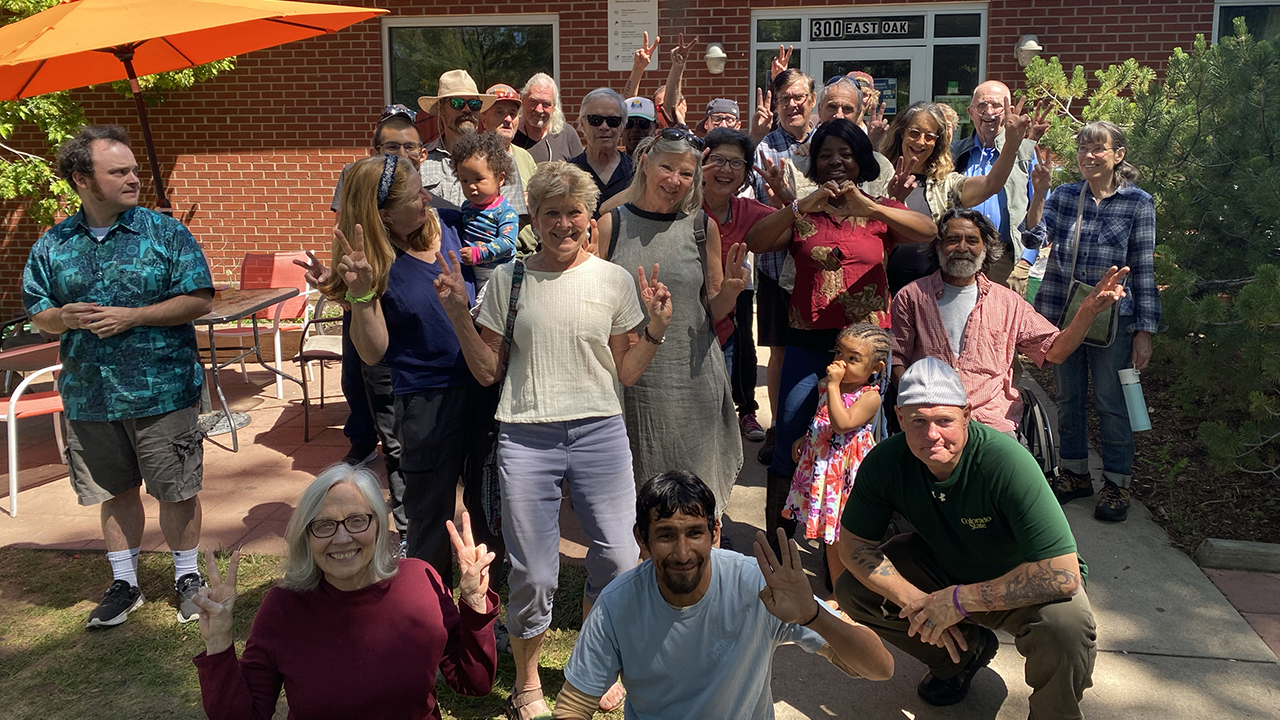
Fort Collins Mennonite Fellowship in Colorado has been without a home for nearly a year after a long conflict with local government to limit its ministries with people experiencing homelessness culminated in the closure of its building Dec. 9 for methamphetamine contamination.
The congregation has navigated multiple legal battles for over a decade because of its outreach to marginalized groups. The property sits in a downtown district that has gentrified in recent years. Ministries like outdoor lockers for “loitering” homeless people rankled neighboring business owners.
Pastor Steve Ramer said the health department ultimately closed the church and erected a fence after the police department surveilled the church for three years. Meanwhile, the city developed ordinances for “chronic nuisance properties” that allow police to cite both a perpetrator and property owner for crimes like littering or drug use.
“[Government] wouldn’t build enough housing or facilities for treatment, so we become the target,” Ramer said about receiving the nuisance designation in 2023. “Not only are they criminalizing the poor, but they are criminalizing anyone who wants to help under the guise of community safety and health. . . .
“We are hospitable. We are encouraging. The police came by a couple months before we were shut down and said we should put up ‘no trespassing’ signs. I said I can’t do that. I don’t think Jesus would. This is not my property. It’s God’s property, and everything I read about God is welcoming.”
In 2024 the small church hosted 5,400 overnight stays, provided 3,200 showers and did 1,800 loads of laundry. Forty people found permanent housing and 23 completed recovery programs. But Ramer acknowledged that ministry sometimes gets messy when welcoming people struggling with addiction.

“We don’t do drug tests on who can come to church, and I don’t think Jesus would, and we don’t think they will contaminate us,” he said, noting several public libraries in the state have been found to exceed the limit, and California’s benchmark for meth contamination is three times higher than Colorado’s. Australia’s is 40 times higher.
“We think if they are loved and accepted and cared for with some boundaries, we can maybe help them, and we’ve seen it work. We’ve seen the fact that kindness can work — not 100% or immediately — but it can work. And many times we’ve been told, ‘If I hadn’t gotten into the church at some point I would be dead now.’ ”
The congregation looked into having the contamination cleaned, but that would have cost $60,000 to more than $100,000 — more than the annual budget. And there was no guarantee the city or county would not come back.
Local businesses complained about the lockers, and new neighboring residents also voiced complaints.
“A church across the street from us was sold two years ago, and they’re just about ready to open luxury townhomes worth $2 million where it sat,” Ramer said of what some call the “Aspenification” of Fort Collins.
“. . . We now have these three- to four-story buildings surrounding us on all sides and people looking down literally on the property with cameras. I have definitely heard from some of those neighbors that they don’t deserve to be bothered.”
The congregation was able to sell its property for $1.3 million on July 31 after purchasing it for $400,000 in 2002. But even that kind of growth falls short amid a property boom that has increased many values four-fold or more.
A homeless shelter used to be located nearby, but a wealthy donor helped facilitate a move out to the edge of the city. The congregation looked into relocating nearby to continue its homeless ministry, but hasn’t found a property it can afford to make suitable.
As the property hunt continues, the congregation meets during nice weather in a park across the street from its old fenced-off home. Other times it has met in a building owned by a co-housing group where a few members live. But no matter where their exile takes them, Ramer is certain they will be following Jesus.
“Once you’ve seen miracles happen, you’re addicted,” he said. “You want that experience again because you know it’s possible, and you want to be part of it again. When you are part of that, that builds hope, because no one out there is beyond the reach of change.
“Hope is the strongest substance in the world, because it keeps people off drugs. Yes, it was tough, and we made some mistakes. Yes, people took advantage of us. But Jesus says don’t dwell on the people who take advantage of you.”


Have a comment on this story? Write to the editors. Include your full name, city and state. Selected comments will be edited for publication in print or online.