


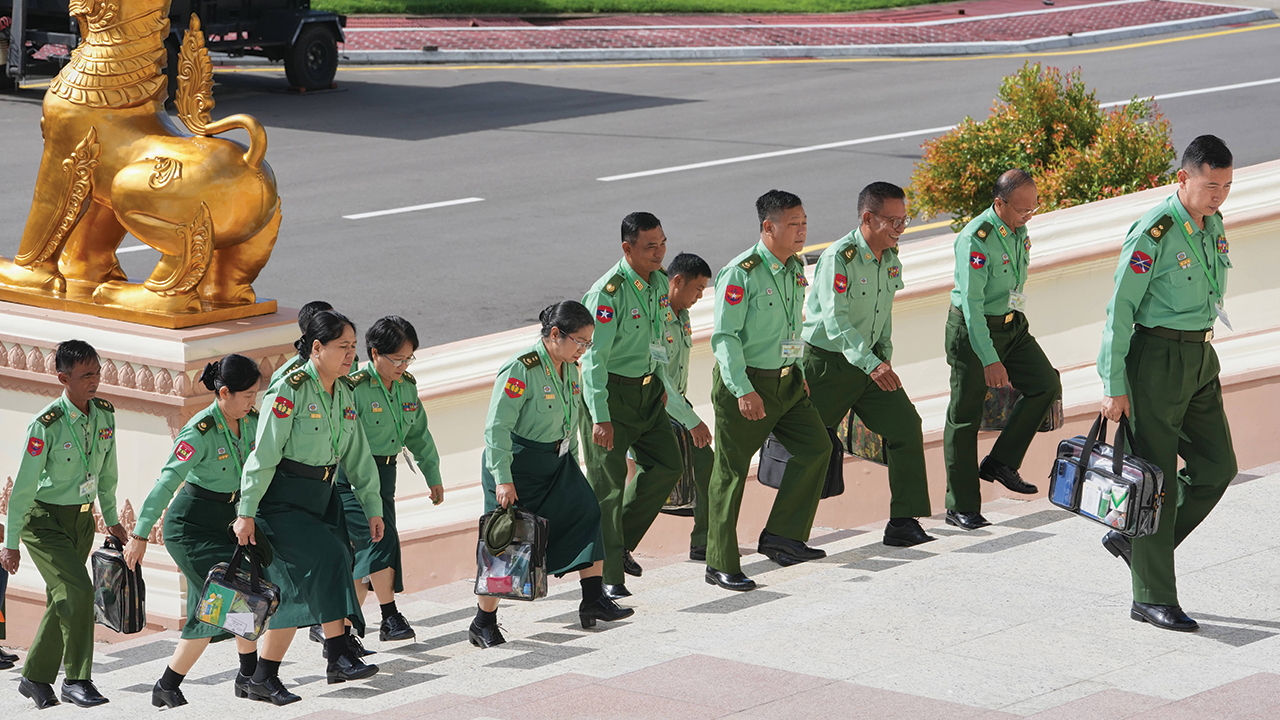
The Selective Service System’s effort to make military draft registration automatic appears to have paused. It is unclear if any changes will be made to the U.S. agency’s war-readiness system.
Last year’s annual National Defense Authorization Act, signed Dec. 18, required Selective Service to make registration automatic for males ages 18-26. The deadline for implementation is Dec. 18 of this year.
Selective Service submitted its automatic draft proposal March 30 to the Office of Information and Regulatory Affairs, a governmental entity that processes proposals before publishing them for public comment. Selective Service withdrew its proposal July 23 without giving a reason.
“Now that the Selective Service System has withdrawn their proposed plan for automatic draft registration implementation, time is running out to complete the required regulatory procedure,” said Mennonite Central Committee U.S. legislative associate Galen Fitzkee, who has been monitoring the situation in Washington.
“It is unclear whether the SSS will try to sidestep the regulatory process, thereby inviting legal challenges, or work with Congress to delay implementation. As advocates, we are encouraging Congress and the administration to scrap the policy altogether.”
Without a proposal of regulations, concerns have been raised about privacy, accuracy and how Selective Service would gather information. The agency has not responded to media inquiries. Its alternative service manager who related to organizations such as MCC retired this year, and peace church organizations have not been informed of a replacement.

Reviving a military draft would require congressional approval.
“Whether you believe there will be a draft soon or not, we are living in a context with increased state-sanctioned violence, and churches should be called to strengthen their understanding of what it means to be a peace church,” said MCC U.S. peace education coordinator Nathan Toews, noting materials are available on MCC’s website.
“. . . Part of our recommendation to churches is to educate and accompany young people in their process of discerning what it means to be a conscientious objector. Because we haven’t had the draft in decades, young people today might not have a firm theological grounding on what it means to be a peace church.”
The automatic registration proposal was withdrawn amid an unpopular war with Iran during an election year. The White House fueled concerns March 8 when press secretary Karoline Leavitt declined to rule out a draft, stating on Fox News that it was “not part of the current plan right now, but the president, again, wisely keeps his options on the table.”
On May 14, Sen. Ron Wyden, Democrat of Oregon, introduced a bill to abolish Selective Service. Cosponsored by Republicans Rand Paul of Kentucky and Cynthia Lummis of Wyoming, the bill did not make it out of the Armed Services Committee.
“I’ve long stated that if a war is worth fighting, Congress will vote to declare it and people will volunteer,” Wyden said of the bill, which MCC and American Friends Service Committee supported. “This outdated government program no longer serves a purpose and should be eliminated permanently.”
Currently, young men must take action to register when they turn 18. Mennonite Church USA maintains a fund, established in 1983, “to help replace potential government grants and loans lost by students who for reasons of Christian conscience choose not to register with the U.S. Selective Service System,” according to the denomination’s website.
MC USA also partners with other organizations to offer the Peaceful Futures Scholarship to provide a financial alternative to students considering paying for college through military enlistment.
Even if the Selective Service automation proposal is canceled, growing militarism in the United States can still be measured in dollars. The Trump administration has requested a 2027 defense budget of $1.5 trillion, a 50% increase over the previous year.
Military preparedness is on the rise in many countries, with impacts on peace churches. Germany switched to an all-volunteer military force in 2011 and suspended conscription.
“With it went the alternative of civilian service, along with public discussion of conscientious objection,” said Tim Thiessen, who works in military counseling for the German Mennonite Peace Committee, an initiative the group revived this year. “Since Russia’s attack on Ukraine, first in 2014 and then at full-scale in 2022, the security debate has changed dramatically.”
Lawmakers revived mandatory military registration for men this year. The first 18-year-olds are required to report for health examinations starting Jan. 1, 2027, though actual induction into the armed forces remains voluntary. The German military seeks to nearly double its strength to 470,000 active and reserve soldiers by 2035, with significantly increased recruiting in schools. Defense spending is expected to nearly double from its 2022 level to a planned €140 billion next year.
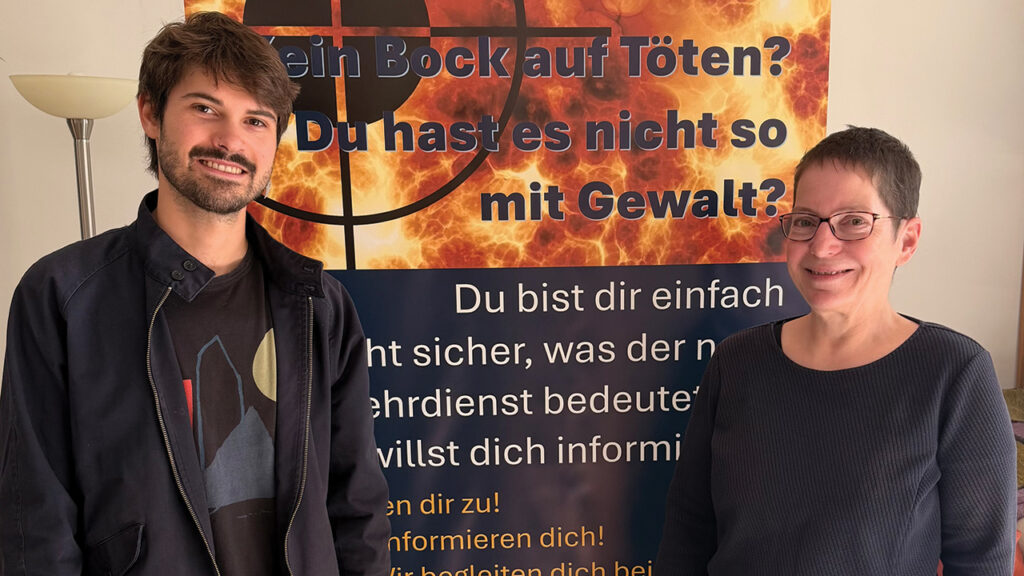
Peace and service organizations connected to the Association of Mennonite Congregations in Germany held four online meetings in September on compulsory military service and conscientious objection, including input from representatives of the Mennonite Church of Colombia (IMCOL) about their experiences of advocating to establish the right to object to military service and of accompanying men going through the CO application process.
All men between 18 and 24 years old in Colombia must register and serve for 12-18 months, with nonmilitary alternative service options available. Before he assumed the presidency Aug. 7, Abelardo de la Espriella sparked controversy when he called for reducing options for avoiding military service, saying “everyone here is going to do military service, to move this country forward, to make it great.”
“This is about refusing military service out of deep Mennonite conviction,” said IMCOL treasurer Grace Morillo, “out of the firm belief that violence is never the way.”
Increased European security concerns inspired Switzerland to bolster its military by making CO status harder to attain. A national vote, opposed by the Swiss Mennonite Conference, passed new restrictions June 14, with 52.5% in favor.
Swiss President Guy Parmelin warned during parliamentary debate in April that alternative civilian service had “become a problematic mass phenomenon.” However, Lukas Sägesser of Schänzli Evangelical Mennonite Church pointed out the size of the Swiss Armed Forces is already above 140,000 people, the maximum allowed by law.
“All is not so bad,” said Sägesser, who is also a board member of the Swiss Civil Service Association. “Nevertheless, the specter of the Army’s strength being at risk persists.”
Swiss Mennonite Conference general secretary Jürg Bräker said the conference does not track how many young men in its churches choose military or civil service. Some do basic training to see what life is like in a “peace army” that is restricted from going on the offensive.
“With the new law, young men have to decide whether they object to military service or not before entering military training,” he said. Service is required of all men, and initial military service is for a shorter period than the civil service, on which the country relies for work with the elderly and environment.
“Soldiers often only realize what it all is about once they are in the service, and the new law makes it harder to change,” he said. “The goal is to hinder men from switching for reasons of comfort, but the effect is less freedom of conscience.”
Myanmar’s military overthrew the elected government in 2021 and introduced mandatory military service. By the following year, at least half the members of Bible Missionary Church, a Mennonite denomination, were displaced after fleeing to jungles or across borders to escape violence and conscription.
On Feb. 10, the military junta bombed a village, killing six people instantly, most from BMC. Eleven other church members needed emergency medical treatment.
BMC President Amos Thang Chin said forced conscription of young people is increasing. Many are fleeing to neighboring countries. Those who remain avoid public gatherings.
Lan Aung Pway, who serves as a pastor together with his wife at the Mennonite church in Min Naung, Yangon, has experienced war since childhood. In comments recorded in September for the upcoming Asian Anabaptist Mennonite Network meetings in November, he said becoming an Anabaptist in 2016 gave him a path that follows Jesus to forgive enemies and work for peace rather than participating in killing, giving him new hope and strength.
“I am sharing the way of Christ with as many children, youth, adults and elderly as I can reach,” he said. “I also face misunderstanding from some Christian brothers and sisters who do not wish to practice this path. I am sometimes called a coward or one who sits on the fence.
“Being falsely accused by my own loved ones is extremely painful, but I must continue walking the Anabaptist Mennonite path I believe in.”
A young person who withheld their name agreed it can be difficult to be a Mennonite in a place like Myanmar.
“People call me weak. They say I have no patriotism. But my pride lies in a place others do not understand,” the person stated. “My weapon is prayer. My fortress is faith. My victory is reconciliation. My path is the path of the cross, the path of endurance.”
Amid its war to repel Russia’s invasion, Ukraine lowered its conscription age by two years in 2024 to include men ages 25-60. Roman Rakhuba, chair of the Association of Mennonite Brethren Churches in Ukraine, said Christians who get drafted have the right to refuse to carry weapons and be assigned noncombatant duties. All AMBCU clergy have deferments.
“Very few men in our churches choose to serve in the military in combat roles,” he said. “As far as I know, we have had only two or three such cases.”
Checkpoints are scattered throughout the country to check military registration documents, and those without a valid deferment are taken to military duties. This has happened to a few men from AMBCU congregations, though Rakhuba noted most have deferments due to being enrolled in educational institutions, having medical conditions, caring for disabled family members or having three or more children. Clergy also have deferments.
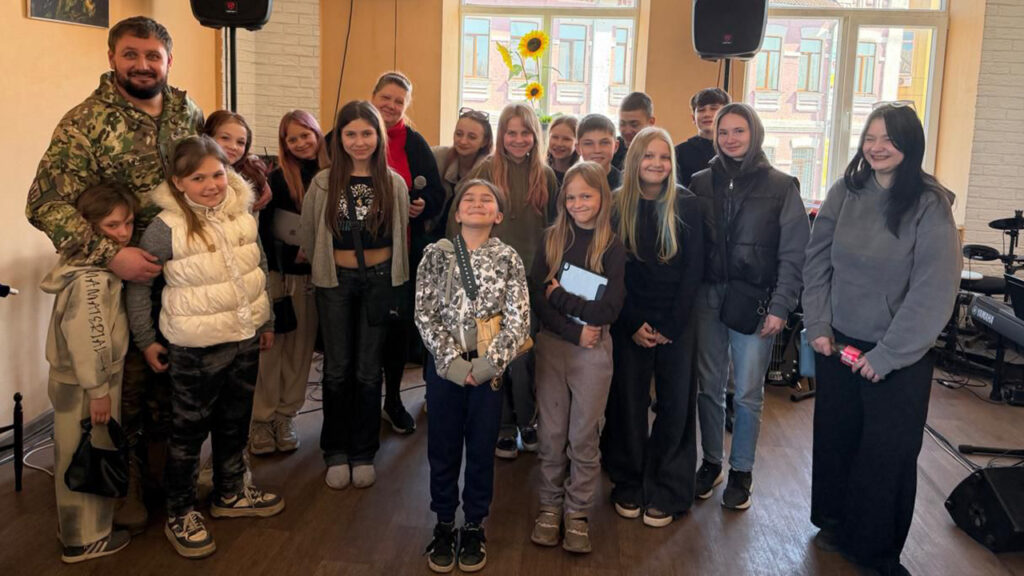
“It is very rare for someone from our Mennonite Brethren churches to choose active combat service,” Rakhuba said. “. . . Most of the men who decide to serve in the military choose to become military chaplains. They have the opportunity to provide spiritual care and support to soldiers, and we have had significantly more cases of this kind — probably more than 10.”
Legislative changes have sometimes added challenges regarding military service and deferments over the years, but Rakhuba said this year the process became easier for clergy deferments.
“The legal framework has become clearer and more consistently applied, and government officials now have a better understanding of the procedures,” he said, noting he has never experienced hostility or criticism from the military regarding pacifist convictions.
“. . . We work closely with military hospitals, supplying medicines and medical equipment, as well as providing spiritual care, psychological support and rehabilitation services to wounded soldiers and veterans. We have also helped military personnel receive prosthetic limbs.”
Rakhuba communicates with military personnel almost every day regarding needs both physical and spiritual.
“Both the military and government officials frequently turn to churches for assistance because they are often unable to address all the challenges and needs they face,” he said. “The coming winter is expected to be extremely difficult.
We are facing serious shortages of food, fuel and other basic necessities.” AMBCU is best able to distribute assistance via donations to Mission Eurasia. “Our greatest challenges are related to limited resources and humanitarian needs rather than difficulties in our relationships with the military or government authorities.”
Russian Baptists and Mennonites in Western Siberia were still receiving military service exemptions at the beginning of this year, reported William Yoder, a religious journalist based in Russia. Draft boards acknowledge that the Russian Constitution permits exemptions for reasons of conscience.
The Religious Society of Friends in Moscow reported no changes in legislation in the last decade, with alternative civil service in a wide variety of fields lasting 21 months compared to the 12-month military term.
South Korea’s compulsory military service is one of the world’s strictest systems. Anabaptist conscientious objector SangMin Lee was jailed in 2014-15 for refusing to do alternative service. The alternative service term is 36 months — the world’s longest, double the length of military service — and requires participants to work and live in correctional facilities.
Min-hyung Kim, a staff member of the Korea-Vietnam Peace Foundation, is the first nonreligious CO to refuse alternative service. Prosecuted for his refusal, he pleaded not guilty in September.
The International Peace Bureau called on the South Korean judiciary to acquit Kim and ensure his fundamental human right to conscientious objection to military service without punitive discrimination, as outlined in the International Covenant on Civil and Political Rights, which South Korea has ratified.
The next hearing in Kim’s trial is scheduled for Nov. 12.

Have a comment on this story? Write to the editors. Include your full name, city and state. Selected comments will be edited for publication in print or online.