


Walking down the peaceful, windy and hilly streets of the Old City of Assisi, one enters the sacred chapel of the Papal Basilica of St. Francis. Faithful show their devotion to God in silent prayer, many genuflecting before the crucifix upon entering the narthex; others prostrate on their knees. In a profoundly moving display of faith and solidarity, thousands of worshipers gathered there last week to commemorate the 40th anniversary of the World Day of Prayer for Peace, launched by Pope John Paul II in that city in 1986.
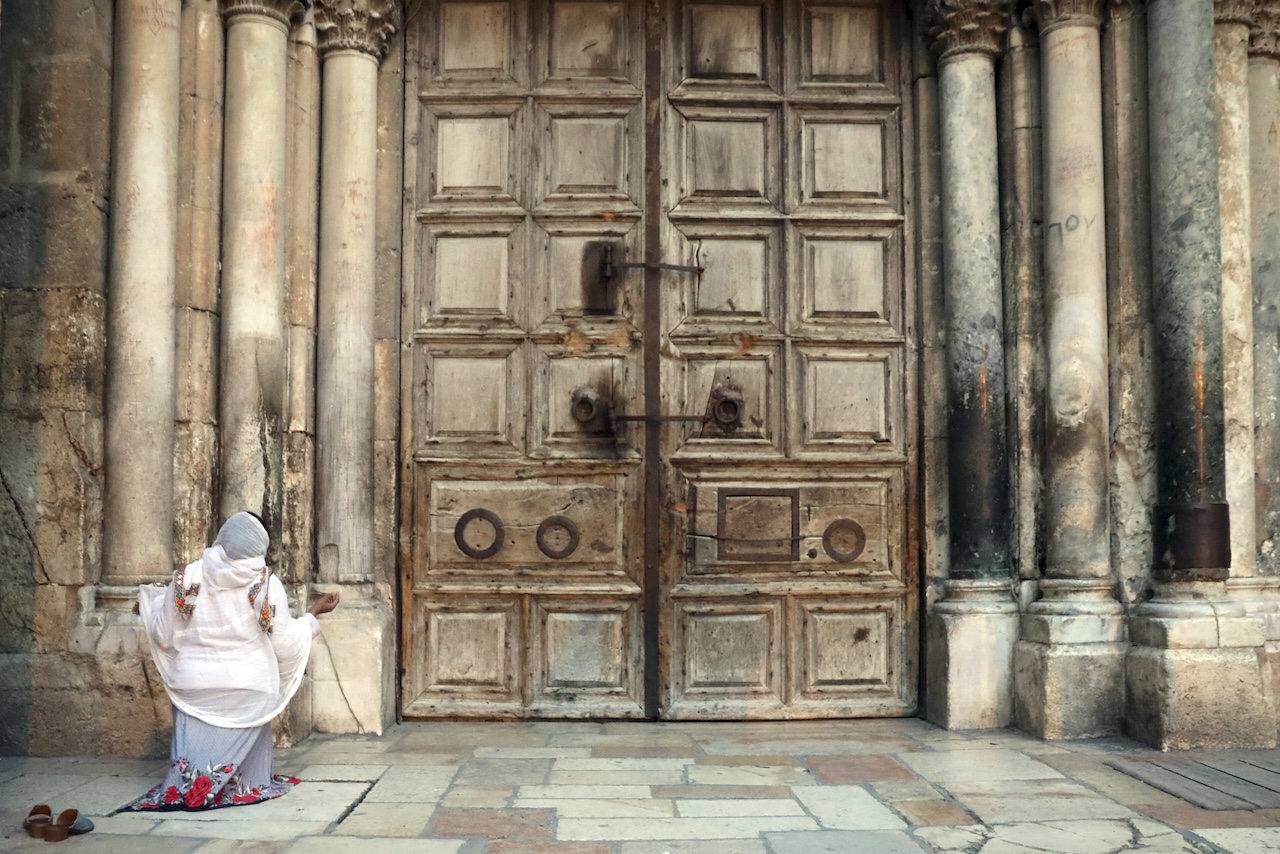
Just a few days before I joined them there, I entered the most sacred holy site in Christianity, the Church of the Holy Sepulchre in Jerusalem. On previous visits, I have seen hordes of Christians, local and international pilgrims, desperate to kiss, touch or at least witness the believed historical site of Golgotha, Christ’s crucifixion, and the tomb of Jesus. Yet this time, I found the sacred church of Jerusalem almost empty.
This day was no anomaly. Intensive wars, conflict and repression are drastically limiting Christian tourism to the region — but more alarmingly, they have also put Christian communities on the path to disappearing entirely from Palestine and the Middle East. Palestinian Christians from the West Bank are routinely denied permits by the Israeli government to travel and worship, frequently keeping them out of Jerusalem and other holy sites on thin and arbitrary security pretexts — even during sacred holidays like Holy Week.
Violence, oppression and the Israeli government’s entrenched occupation have made daily life so impossible that hundreds of Palestinian Christian families have fled East Jerusalem, the West Bank and Gaza entirely. In the West Bank alone, more than 200 Christian families have emigrated since October 2023, according to one pastor there.
During the past two months, I have spent nearly five weeks traveling in the Middle East, including the occupied Palestinian territories. In conversations with Palestinian Christian leaders, families and communities, I kept hearing a similar story: Virtually every Christian family has either experienced the emigration of a relative, knows someone who has left or is seriously considering leaving themselves.
In Gaza, the Christian community has dwindled to approximately 500 people among more than two million Palestinians. In historic Christian towns like Taybeh in the West Bank, families face growing uncertainty about whether they can remain on their land. Lebanon, Syria, Iraq and other parts of the region are experiencing their own waves of Christian displacement and emigration.

Christianity’s historic presence in the region where our faith was born has reached a critical breaking point — and Christian leaders around the world are increasingly alarmed. During the gathering in Assisi, more than 200 bishops and executive leaders from across a wide range of denominations, representing more than 25 countries, came together to issue a new Global Christian Declaration about the future of Christianity in the Middle East, organized by the group I lead, Churches for Middle East Peace. The signers include the Episcopal bishop of Washington, D.C.; a cardinal and numerous Catholic bishops; an Anglican archbishop; an Armenian Orthodox archbishop; the general secretary of the Mennonite World Conference and many, many more.
These leaders warn: “Ancient churches that have borne witness to Christ for nearly two thousand years are shrinking as families emigrate in search of safety, stability, and a less uncertain future. If these trends continue, the birthplace of Christianity risks becoming a place where Christians remain only as visitors rather than living communities rooted in their historic homeland. We must act now, or Christians may all but disappear from the Middle East.”
The situation is urgent. Christians across the region have reached historic population lows. When Israel first occupied the West Bank in 1967, Christians made up about 6% of the population; today that number is roughly 1%. In Southern Lebanon, thousands of Christians are among the nearly 1 million Lebanese displaced by Israeli bombing and the clashes between Israel and Hezbollah. Political instability, economic hardship, religious discrimination and generations of devastating wars have made it increasingly difficult for Christian families to envision a future in their ancestral homelands.
These trends have accelerated dramatically since Hamas’s Oct. 7, 2023, attacks on Israel and the start of Israel’s assault on Gaza — a turning point that unleashed an extraordinary escalation of violence with devastating effects on communities in Israel and the broader Middle East. The subsequent military campaigns and regional confrontations have brought immense suffering, with the expanding war including Iran, Israel, the U.S., Saudi Arabia, the Houthis, Hezbollah and more — threatening communities across the Gulf, Yemen, Iraq and the wider region. The promise of U.S. and regional security through military strength has not delivered lasting security. Instead, it has produced further displacement, destruction and instability.
Western governments, churches and citizens bear much responsibility for the conditions that have helped perpetuate this suffering. Our governments make decisions about weapons exports, military assistance and foreign policy that affect millions. Our churches sometimes embrace theological frameworks — like “Christian Zionism” — that justify inequality, occupation or the suffering of our neighbors. We cannot keep separating our faith from the consequences of our political and economic decisions.
The Christian leaders who signed the declaration are insisting — across denominational and geographical boundaries — that the current trajectory cannot continue. The bishops are not calling for special privileges for Christians, nor are they suggesting that the future of Christianity can be separated from the future of our Muslim, Jewish, Druze, Yazidi and other neighbors. Rather, they recognize that the survival of Christian communities is inseparable from protecting equal rights, human dignity, religious freedom and security for everyone.
We must examine the theologies we preach, the policies we support, the representatives we elect and the institutions we fund. We must advocate for humanitarian assistance, diplomatic engagement, accountability for violations of international law and the protection of vulnerable communities.
As we shared in our declaration, “The diminishing presence of Christians in the Middle East is not simply a Christian concern. It signals that justice, equality, security, and hope are failing for everyone.” In this spirit, the world should care about making sure that the land of Jesus’ birth remains home to living Christian communities — and we should all help build a future in which Christians along with all of the region’s people can live together in peace.


Have a comment on this story? Write to the editors. Include your full name, city and state. Selected comments will be edited for publication in print or online.