


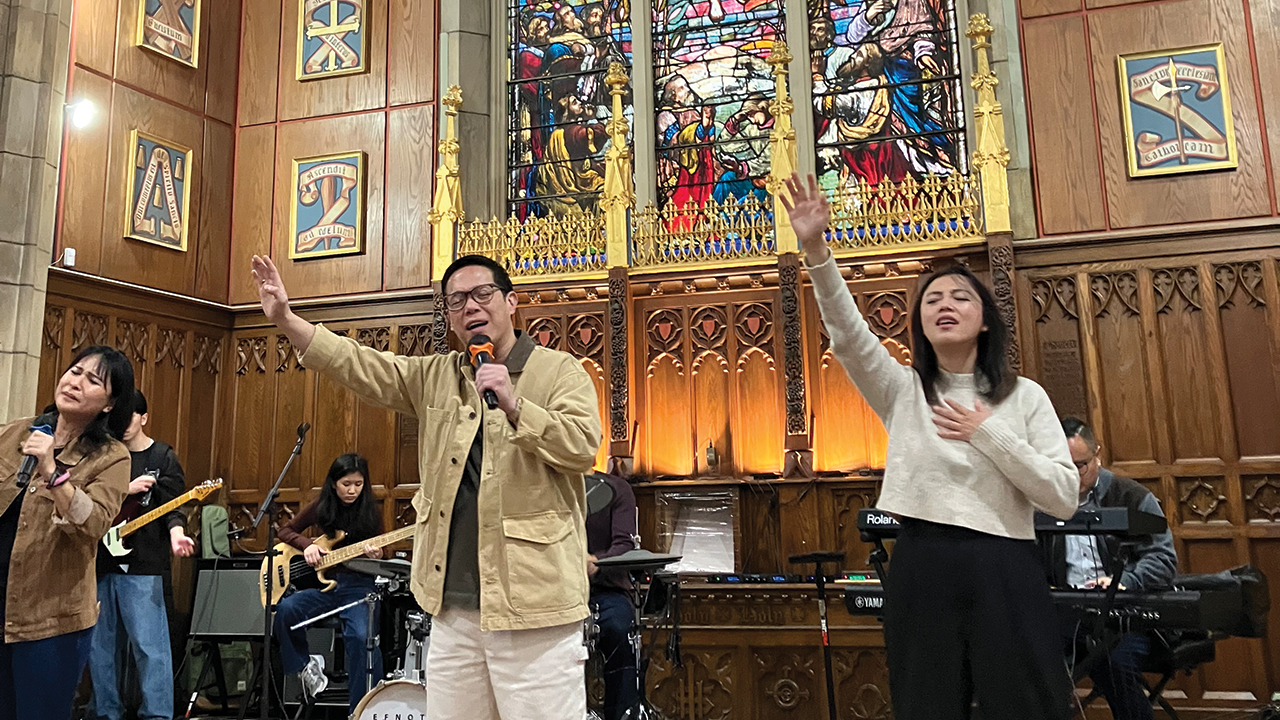
Mosaic Mennonite Conference wants to be a place where “high expectations and gracious hospitality meet.” Philadelphia Praise Center has mastered the hospitality part. On a sunny November morning, members greeted visitors with “happy Sunday,” handshakes and smiles long before they reached the doors.
Once inside, worshipers could choose between an English service in the parish hall and a much larger gathering in the main sanctuary, where Indonesian was spoken and sung.
After worship, a midmorning spread of sandwiches, chips, fruit and cookies provided a substantial bridge to lunchtime. Down the block, past the Lutheran cemetery, people gathered around more brunch options in a building that houses Mennonite Central Committee’s East Coast office.
Then, to get the full experience, the visitors stayed for the third service, presented in Indonesian, with listening devices available for English translation.
As Mosiac’s largest congregation, Philadelphia Praise Center draws about 400 people on a Sunday morning. Its spirited worship (complete with children’s choreographed dancing in the English service) reanimates a stately 19th-century building whose elaborate stained-glass windows preserve the memory of a once-prosperous Lutheran congregation that no longer exists.
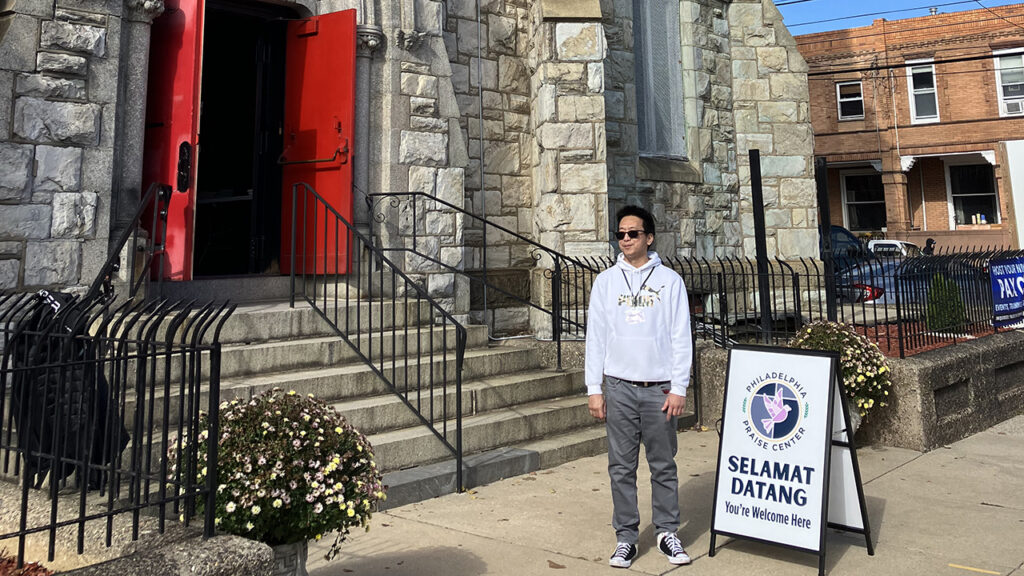
Just as a vibrant Indonesian congregation has breathed new life into a venerable landmark of wood and stone, so also can a fresh wind of the Spirit blow through national and international communities of Anabaptists.
How else shall the Spirit do a new thing among us unless we seize the opportunities that new realities bring — even if the changes are not what we would have chosen?
Mosaic moderator Janet Panning doesn’t think anyone is happy about her conference’s split from Mennonite Church USA. But, after mourning the loss, it’s time to move on and harness the new energy and ideas that are bubbling up — whether in Mosaic, MC USA, LMC or any other Anabaptist stream.
Yes, it’s ironic to glean ideas about unity from a conference that has just made a split. But, as scripture says, there’s nothing new under the sun. Mosaic leaders who are touting a model of unity — the concept of a centered-set church — aren’t taking credit for it. They cite the work of Mennonite Brethren scholars Paul Hiebert and Mark D. Baker. Mosaic’s “Clarifying Our Center” document draws on these ideas.
As Baker writes in Centered-Set Church (InterVarsity, 2021), a set can be bounded, fuzzy or centered. A bounded set draws firm lines that define who is in and who is out. A fuzzy set draws boundaries that aren’t clear. A centered set is entirely different. Rather than marking boundaries, it creates its identity by defining a center and drawing people closer to that focal point.
Mosaic’s document says the conference aspires to be a centered set, and the center is Jesus.
A centered church values people more than rules. “We will rarely be able to draw clear lines of inclusion and exclusion,” the Mosaic document says. “. . . We will prioritize a posture of curiosity and learning (Acts 11:18), prioritizing understanding over judgment (Mark 3:20-30).”
A centered church does not ignore the differences within it but acknowledges them “with grace and humility, knowing that each of our communities is needed in order for us to see the full picture of who God is and what God is doing in the world,” the document says.
“We desire to honor each other’s pursuit of faithfulness and movement toward our common center, even when we may choose different interpretations and practices to get there.”
How strong is this desire? Is it strong enough to preserve unity even when differences involve sexuality? Situated between the more conservative LMC and the more progressive MC USA, Mosaic might stand in the right spot to answer this question.
If the answer is “yes,” it is likely that relationships will be the key. The centering document puts it this way: “Rather than focusing only on shared beliefs, Mosaic emphasizes how members relate to one another.”
At Philadelphia Praise Center, a “happy Sunday” welcome attests to the strength of those relationships.


Have a comment on this story? Write to the editors. Include your full name, city and state. Selected comments will be edited for publication in print or online.