


Anabaptist World: How did you become an artist?
Emily Smucker-Beidler: I think being a visual artist is something that was always in me. One of my earliest memories is of watching the early morning sun shimmer on the water and trying to capture it with my seven-color box of crayons. I didn’t even have the vocabulary to express what I was trying to achieve — just a deep- seated need to draw the world around me.
AW: What is fraktur, and how did you come to practice this art form?
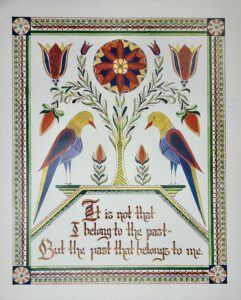
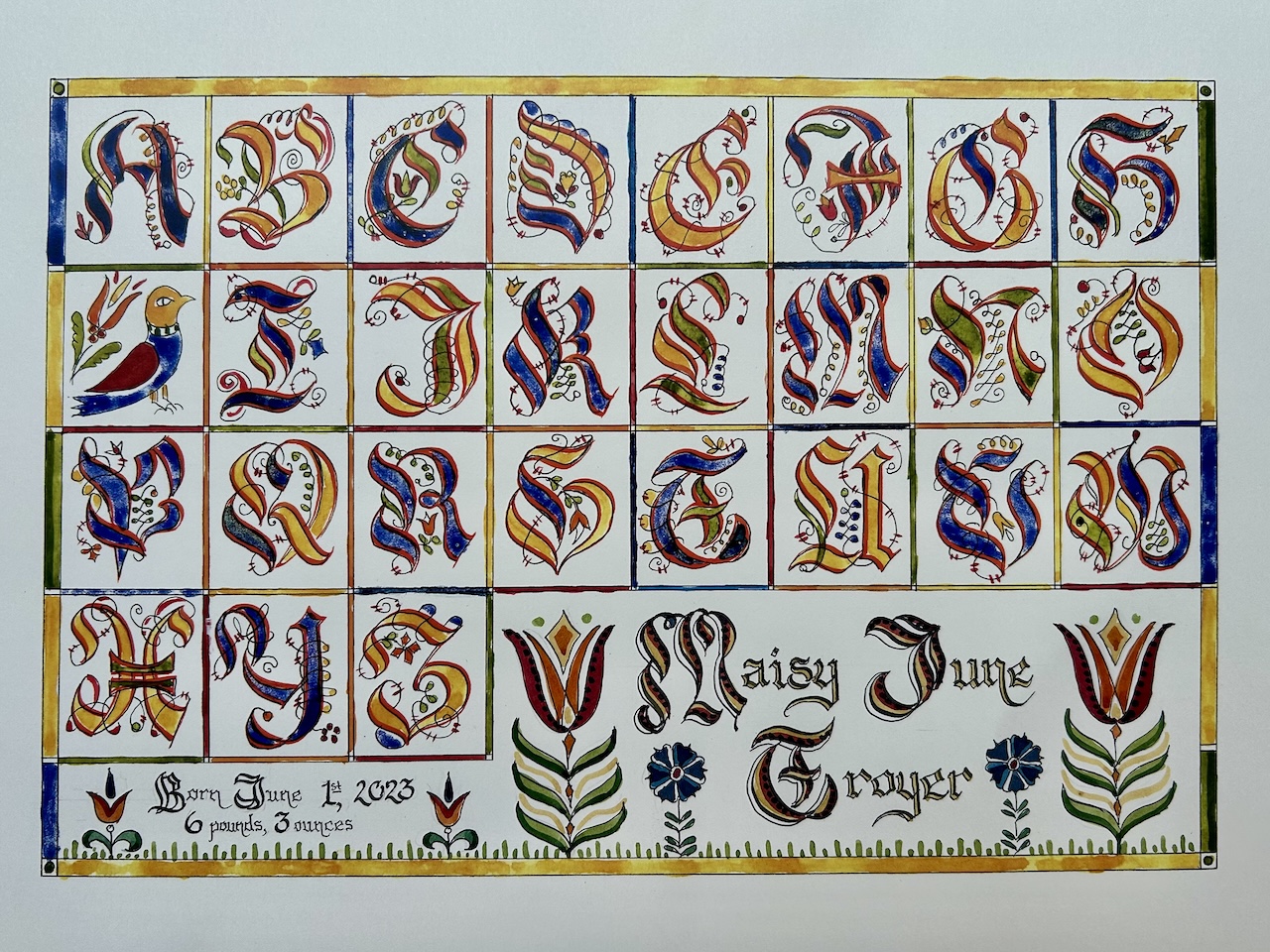
ESB: Fraktur was created by Pennsylvania Germans during the eighteenth- through the mid-nineteenth centuries and features calligraphic text decorated with colorful birds, hearts and flowers. It’s created with ink and watercolor and is one of the earliest American folk arts. I marvel at the way these images were carried over the ocean in the visual memory of our early Swiss-German Ancestors. The seed of memory sprouted and grew into this folk art that carried not just the images of the European homeland, but also an avenue to express Anabaptist and Pietist values.
In sixth grade at what is now Dock Mennonite Academy, I learned fraktur from Roma Ruth — a well respected fraktur artist from Montgomery County, Pa. After receiving an art education degree from Goshen College and master’s degree in art education from Millersville University, I’ve had the pleasure of teaching art in the public schools, retiring recently after 33 years.
AW: What does it mean for you to be working in traditional Pennsylvania German artforms?
ESB: In my early years of teaching, I tried to distance myself from fraktur as a folk art, but there’s something in the art form that has always resonated with me. It connects me to my Pennsylvania Swiss-German past, while giving me room to innovate and apply the fine art principles I’ve learned in my formal training.
When I’m creating a commission, I know that I’m making something that may become an heirloom, not just something that fits current trends.
AW: What traditional fraktur elements in your work have you retained, and where do you innovate?
ESB: I’ve begun working with historic pigments in efforts to recreate the vibrant colors of fraktur as they were first created (made, imagined, envisioned, designed, devised, produced). Recently I completed a research fellowship at the Mennonite Heritage Center in Harleysville, Pa., on the fraktur of Samuel Gottschall, a young, single schoolmaster who found ways to manipulate gum arabic and smalt to create a pooling effect with his watercolors.
AW: You are also a redware artist. What is redware, and what kind of redware do you create?
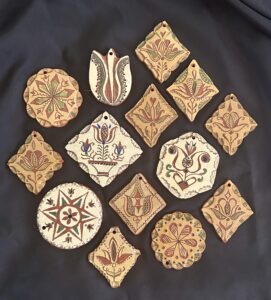
ESB: Redware is the term used to describe early American low-fire clay plates and bowls. Plates, bowls and other utilitarian pieces were made from the red clay found in southeastern Pennsylvania farmland. The clay was processed and formed, then covered with a white liquid clay (slip). Designs were then scratched through the white surface to reveal the red clay beneath. And these are the same images that are found in fraktur!
During Covid, I learned how to make German feather trees (another early Pennsylvania German folk art), but couldn’t find any ornaments that I liked. So I began creating my own that fit the early 1800s time period. Being an art teacher means learning to work with any and all art media, so I already had the knowledge base to explore redware pottery.
AW: What do you hope people will learn or take away from your work?
Since retiring from teaching school, I’ve created a curriculum of folk art workshops that I teach at several historical organizations. Even after years of teaching, there’s still nothing better than helping someone discover and create — and then watching them get lost in the creative process.
In my younger days I didn’t like the label folk artist. I wanted to be true to my education. But now I embrace it. Folk art is made by the everyday person. It springs up from the joy of creating, putting perfectionistic ideals on the back burner. And isn’t that what we all need right now?


Have a comment on this story? Write to the editors. Include your full name, city and state. Selected comments will be edited for publication in print or online.