


Leadership: A word from Mennonite Church USA leaders
People from dominant culture groups often ask me, “Why do we need to work on undoing racism and becoming interculturally competent?”
 I’m excited to hear this question. When we ask questions that make us vulnerable, it means we are becoming more honest with each other. Also it shows there are differences between people of color who advocate for change and people from dominant culture groups who struggle to understand why.
What does it mean to be interculturally competent? For many people, it means getting along with and being sensitive to people from other cultures. However, in recent years we’ve found that that is not enough.
Being interculturally competent means we are able to see and understand cultural differences deeply, knowing why they exist and how they help shape one’s worldview.
It means that as the dominant culture we learn to adapt to differences rather than trying to find ways to assimilate them; we allow our interactions with people outside our cultural understanding to change us. It means we’re able to recognize who holds power and privilege in various settings.
If we are serious about following God within our context, we must be willing to engage with “the other.”
Our world is rapidly changing, and as a church we need to find ways to adapt to new realities within our communities, which are no longer homogeneous enclaves. And if we are going to be serious about Matthew 28:19-20—the Great Commission—we must be willing to be in relationship with people who are different from us.
To illustrate how complex it can be to understand our diverse context, I often share about how my 5-year-old grandson Gavin asked why he was just half-Mexican.
I explained to him that his mother was Mexican and his father was white. He then asked how he could become fully Mexican, and I laughed and tried my best to explain about ancestry and identity.
That afternoon, as we pulled into Pollo Loco, a Mexican fast-food restaurant, Gavin asked, “Can I eat here even though I am half-Mexican?” I assured him that anyone could eat at Pollo Loco.
Well, he ran inside and up to the counter, announcing at the top of his lungs to the Asian clerk, “I’m half-Mexican, but my nana says I can still eat here.”
As Gavin struggled to understand himself in a rapidly changing, diverse context, we as the church also struggle to do so.
This fall, Mennonite Church USA will train resource people in area conferences in two initiatives to help congregations work at intercultural transformation: Bienvenido, a program designed by Gilberto Pérez Jr. that empowers first-generation immigrants to navigate and engage U.S. culture; and Communities of Hope, a process that helps congregations become interculturally competent by using a narrative approach to work at undoing the barrier of racism.
The narrative approach of the Communities of Hope process is a way of owning our stories. Each congregation has a story of its beginnings and of how its members see themselves currently.
Using the story of the Syro-Phoenician woman (Mark 7:24-30) to stay centered on Jesus, congregations engaging this process will create their own narrative. They’ll be given tools to critique their narrative from the perspective of undoing racism and/or advancing intercultural transformation.
Ultimately, they’ll construct a new narrative of who they want to become in their present and future context, establishing a covenant that outlines ways they will work at this together.
One of the tools we use in this process is the Intercultural Development Inventory, which helps us see where we are in the process of becoming interculturally competent, taking into consideration issues of power and privilege at both interpersonal and systemic levels.
The theory behind the tool is that people must work on skills that develop their capacity to authentically see commonalities and differences, to accept differences and then adapt to them.
Beginning these trainings is a big step for the church. Pray for the Communities of Hope process and the people and congregations who will work with it. We hope every area conference will get involved. May we become Communities of Hope that will weave our stories together in love and grace.
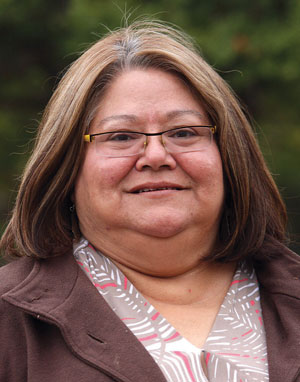
Iris de León-Hartshorn, Portland, Ore., is director of transformative peacemaking for Mennonite Church USA.


Have a comment on this story? Write to the editors. Include your full name, city and state. Selected comments will be edited for publication in print or online.