


One has to have one’s eyes open, one has to ask questions when they come to mind, or one finds oneself finished with a two-year term not knowing what kind of people you were amongst all the time.
— John M. Janzen in a letter home
To learn to know something new is the heart of this extraordinary book describing the journeys of two young American men who went to the Congo for a two-year term of service and then spent three and a half months driving in their own car through East Africa, the Middle East and Europe before coming home to the United States.
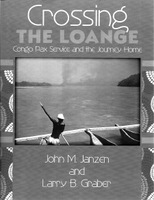
What do Mennonite men do instead of going to war? I am most familiar with stories of men like my father, drafted during World War II, or young men from my youth, conscientious objectors during the Vietnam War. I am less familiar with the middle chapters, and this book is a compelling story.
From 1957 to 1959, Larry Graber and John Janzen served with Pax (Latin for peace), a program of Mennonite Central Committee for legal alternatives to military service; approximately 1,200 men participated from 1951 to 1976. In the late ’50s, there was a draft but no active war, and thus deferments were not uncommon. A personal tragedy motivated both Graber and Janzen to want to serve specifically in the Congo, and both volunteered before actually receiving a draft notice.
Crossing the Loange (named after one of four rivers in the region) is a collection of letters written while in the Congo and during the long trip home, but selected and edited by the two men more than 50 years after the experience. Included are vibrant photographs from their personal collection and two essays — on the culture and music of the local Chokwe tribe, written by Janzen and Graber, respectively — when in the Congo.
The book has a wonderful sense of narrative; it begins when they are waiting to board the ship going across the Atlantic, and the last letter is written from the S.S. Queen Elizabeth on the journey home. The men (who are white) describe the missionaries they meet, the food they eat, the roads traveled and the rivers (some metaphorical) crossed as they live in their new home. Written mostly to their parents, the letters are literal, but such insistence on the concrete gives a vivid and unpretentious retelling of what happened.

Thus they honestly share their first impressions. Graber writes: “Congo is not as backward as many people think, at least not for the white people. The natives live in bamboo huts with grass roofs. Many young children have no clothes. Looks like a breeding ground for disease.” Janzen writes: “There, around the smoke of a smoldering fire, we saw, what to us had been limited to storybooks, the unadulterated dance of this backward culture.”
Such naïveté and prejudice are acknowledged by both men in the introduction, written after both finished successful professional lives. Graber completed a master’s degree in social work, made significant contributions to family therapy across the United States and served as manager of Family-Based Services for the state of Oregon. Janzen completed a doctorate in anthropology and worked for 45 years in teaching and graduate-student advising at the University of Kansas and other universities; his research into Central and South Africa is recognized world-wide.
Crossing the Loange shows the reader how their thoughts evolved and their life-long personal and professional interests were sparked. Graber learns about the loving interaction of African families, the mystical beauty of the people and the intricate rhythms of their music. Janzen decides a conversation around a fire with native people “beats a stale artificial atmosphere of so many American circles.”
After Graber and Janzen learn how their work ethic and practical skills serve them well in helping with mission schools and hospitals, they launch an idea (not completely trusted by their parents) to purchase a used Citroen (French car) and travel what was eventually 27,000 kilometers by road and boat before returning home to college. Only after mission and church officials reassure their parents do Graber and Janzen go ahead. (If their parents had known the two would be robbed at gunpoint while sleeping in their car in Germany, would they have acquiesced?)
This is also a story of Mennonite families and institutions who made these experiences possible. It was the mothers who saved the letters all these years! They connected with and visited other Mennonites, including Pax and MCC workers, as they traveled.
Mennonite values provide the framework as they encounter an incredible slice of history and time: the end of colonialism in Africa, burgeoning independence for the Congo, Europe still rebuilding after World War II. They travel through communist Yugoslavia; they drive into East Berlin before the building of the wall.
Among the many substantive issues raised by this reading, I think most of diversity. The complexities faced by Graber and Janzen as they encountered new people in a new landscape are still with us. The globe is more connected, but the challenges seem more pressing. The question remains: How do we open our eyes to people among us all the time?
Ardie Goering is a Christmas tree farmer and freelance writer living in both central Kansas and Albuquerque, N.M.


Have a comment on this story? Write to the editors. Include your full name, city and state. Selected comments will be edited for publication in print or online.