


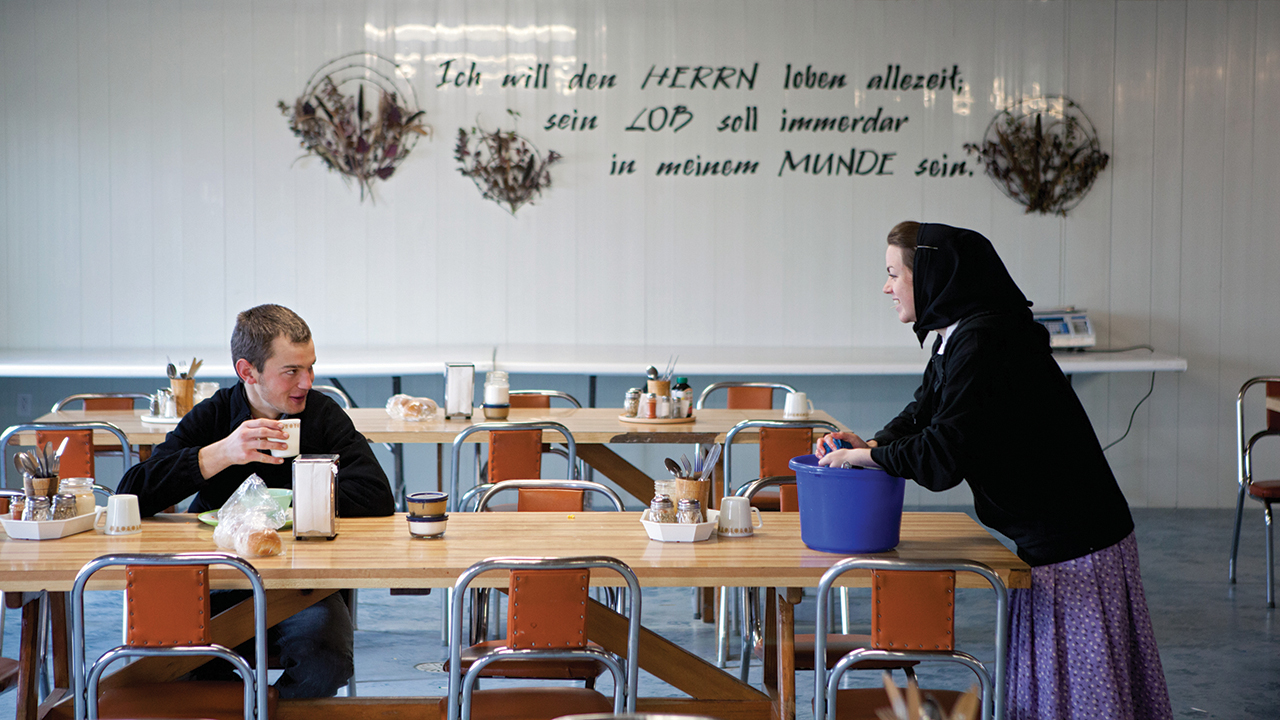
The first attempt at a detailed census of Hutterites — the communal- living branch of Plain Anabaptists — reveals a population of 58,392 in 544 colonies in North America, almost 3 out of 4 in Canada.
The research, published Jan. 29 in The Journal of Plain Anabaptist Communities, was conducted by the Young Center for Anabaptist and Pietist Studies at Elizabethtown College in Pennsylvania. Young Center director Steven M. Nolt said his team was often asked — sometimes by the U.S. Department of Agriculture — about the number of Hutterite colonies and people but didn’t have recent data to offer.
The Young Center acquired a 2024 Hutterite-published directory with information for all 544 colonies in North America and tabulated the number of adults and children.
The new census follows a 2009 study by researchers Rod Janzen and Max Stanton that recorded 483 colonies, but not the number of people. Hutterite directories at that time didn’t report population figures.
Based on typical colony size, it can be estimated that the Hutterite population in 2009 was somewhere between 47,092 and 55,352. The Young Center study did not speculate about the 2009 population.
Hutterites trace their beginnings to 1528 in Moravia when a group of early Anabaptists coalesced around sharing possessions as described in the early church of the New Testament.
Today’s Hutterites fall into three main groups, based on the original three colonies started in South Dakota between 1874 and 1877: Dariusleut, Lehrerleut and Schmiedeleut (the latter with two subgroups after a 1992 division) and a handful of independent colonies.

Colonies have historically been made up of 75-150 adults and children, with Schmiedeleut colonies averaging about 115 people per colony and Dariusleut about 98.
When a colony nears 150 members, it begins planning to “branch” a new colony, with about half of the group moving to buy land, construct buildings and divide assets. The Lehrerleut continue the tradition of casting lots to determine who will move and who will remain, while other groups decide by discussion and mutual consent.
The number of colonies has grown 12.6% from 483 in 2009 to 544 in 2024, not counting colonies in formation. The Lehrerleut, the smallest of the three groups, added the most colonies in the last 15 years, growing by 16.5% to 162 colonies. The Dariusleut grew by 20 to 179 colonies, and the Schmiedeleut added 16 colonies to number 195. Nolt’s research speculates the Schmiedeleut’s slower growth could be attributed to continuing frustration or disillusionment from the 1992 schism.
The Lehrerleut have 18 colonies in formation, the Dariusleut 10 and the Schmiedeleut 11. Nearly all are in Alberta and Saskatchewan, already home to the highest concentration of colonies.
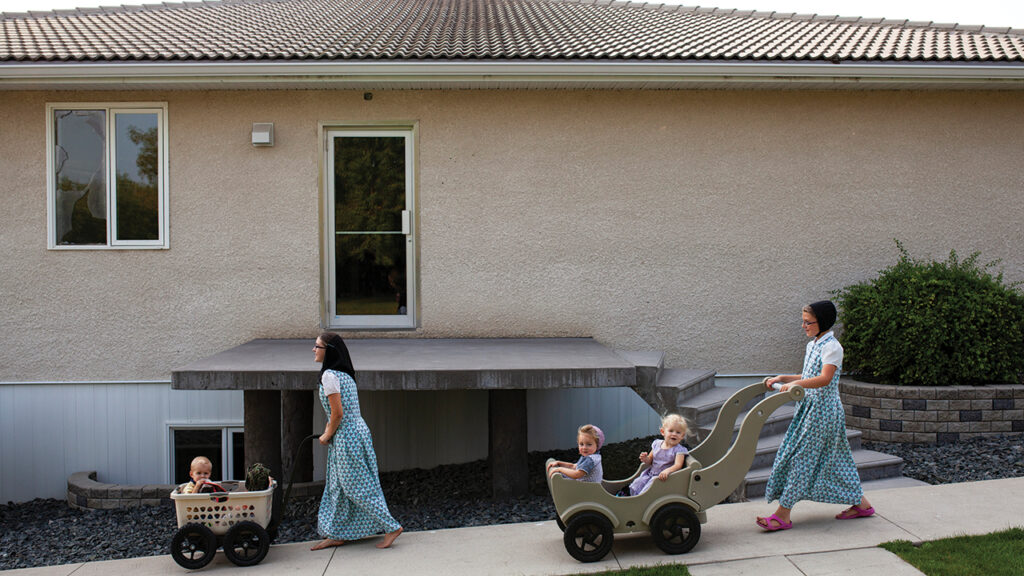
The Young Center focuses most of its research on Plain Anabaptist groups, such as the Amish.
“I do find it interesting that [Hutterite] population growth and family size are not as large as in the past and less than one would find in Old Order Mennonite and Amish groups,” said Nolt, noting the other groups have doubled in size about every 20 years.
Smaller families could be a result of Hutterite architecture. Colonies are built in recent decades to a rather standardized blueprint with physical space limitations compared to Amish houses that have room for sprawl.
“That would be distinctly Hutterite — the way people live,” Nolt said. “You don’t just decide to add on a room or house like an Old Order Amish or Mennonite family.”
Hutterite families were much larger until the middle of the 20th century, with more than 10 live births per woman. Janzen and Stanton reported in their 2010 book The Hutterites in North America that birth rates began declining in the 1960s, dropping sharply to 4.8 births per woman by 1990 due to “later marriages, fewer children . . . and higher defection rates.”
Nolt said Hutterite researcher John A. Hostetler documented retention rates of 98% into the 1970s.
“Amish groups have retention of 85-90%, so those are remarkably high retention rates,” said Nolt, acknowledging retention is lower today but still high compared to other religious groups in North America. “I don’t think it’s been on a downward trajectory. It’s similar to other Plain groups.”
The latest numbers show 20,999 Hutterites in Alberta, followed by 12,655 in Manitoba, 7,955 in South Dakota, 7,873 in Saskatchewan, 5,706 in Montana, 1,058 in Minnesota, 1,049 in North Dakota, 648 in Washington, 294 in British Columbia, 78 in Missouri and 77 in Oregon.
Canada accepted many Hutterite immigrants who left the U.S. due to anti-German hostility during World War I and persecution of conscientious objectors in U.S. military prisons.
The study does not include Hutterites outside North America. There is one colony in Nigeria, another moved recently from Australia to Paraguay, and a small group in Japan disbanded in 2019.



Have a comment on this story? Write to the editors. Include your full name, city and state. Selected comments will be edited for publication in print or online.