


Organizing church around the moving of the Holy Spirit
Over the four years I have been on the pastoral staff of North Suburban Mennonite Church in Libertyville, Ill., I’ve had numerous conversations with pastors seeking to increase ministry effectiveness by revitalizing their congregations through a programming effort. In one such conversation, a church planter showed me a 30-step plan his denomination had given him for planting a church. Seeing all the steps he was expected to follow, I said, “All you need to do is add people, and you’ll have a church.” Missing the tongue-in-cheek nature of my comment, he said, “Yes, that’s right.”
For almost three years, North Suburban Mennonite has been on a different track, the fruit of which is revitalizing us. In seeking to be a missional church, we have been exploring what it means for us to be a Spirit-led community.
Being a 25-year-old community facing a major transition, with most of our children off to college and likely not returning, we asked whether God still wants an Anabaptist witness in Lake County, since we are the only Mennonite congregation in the area. We discerned that God is not done with us yet but wants us to be a community where all those the Spirit brings into our midst can be formed as disciples of Jesus—radically committed to Jesus, stubbornly loyal to one another and committed to ways of peace.
Realizing this, we saw that we need to be more courageous in living as a missional community. And so we have explored ways we might more intentionally participate with God in the redemptive mission of making all things new (cf. Revelation 21:5). We have asked how we might develop greater sensitivity in noticing what God is noticing and for the Spirit to set our ministry agenda.

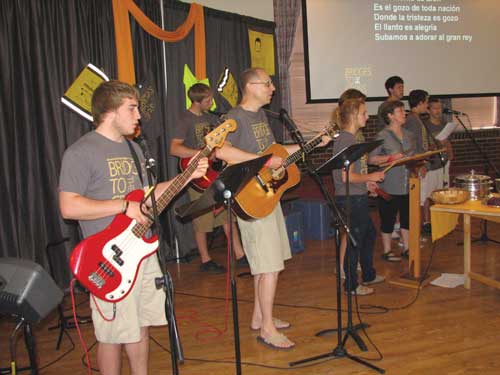
- From left: Nate Yordy, Craig Kym, Dale Kempf (youth leader), Alia Munley, Deanna Sell (hidden), Kay Kempf (youth leader), Caleb Longenecker, Philip Longenecker and Isaac Longenecker lead worship following Pittsburgh 2011
This focus on the Spirit as the vital element in being missional is iterated in The Missional Church in Perspective: Mapping Trends and Shaping the Conversation by Craig Van Gelder and Dwight J. Zscheile. They write: “It is vital to keep at the forefront of our imaginations the creative power of the Spirit in shaping church organizations. … The creativity of the Spirit animates and renews forms of church organization as part of God’s dynamic and ongoing creation.”
As a result, we’ve had serious dialogue on how to develop ministry that is led by the Spirit in our midst. It has taken some time to learn how to be more open to the Spirit’s leading. In the early days of this dialogue, people often expressed how chaotic this seems to be: “How can we control or give shape to what we need to be or do if we are led by the Spirit?” Being open to the leading of the Spirit often seems like chaos to us because we want to shape the way we do ministry.

What opened us more to the Spirit’s leading happened about a year ago and involved reconciling relationships within our community. A few years ago we mishandled the way we dismissed people who served on our pastoral team. This caused much pain and created barriers with one another and the Spirit. When we took the courageous step to forgive and be forgiven, the Spirit brought about reconciliation. We experienced the breaking down of barriers and healing of relationships. Then, almost immediately, the Spirit led new people into our community who were seeking a different way of following Jesus.
The Spirit has brought us together to revitalize our Anabaptist witness in Lake County. Over the past year or so about 20 new people have become part of our community—almost one-third of our Sunday worship gathering. These people are exploring how to be disciples of Jesus in Anabaptist ways. This has not come through any marketing effort, though it helps to have a good web presence so that we can be more easily found by those seeking out our Mennonite community.
In learning to respond to the Spirit’s leading we are being stretched and renewed in these ways:
1. We have developed the understanding that whoever comes into our community are those the Spirit is bringing. We realize this requires our being open in new ways. We are discovering that these new people appreciate the safe place that such a welcoming attitude creates for exploring faith, discipleship and healing. As a result, their presence is changing our personality as a church. They bring new questions, new ways of seeing things and new ways of doing things. In welcoming them, we are also opening ourselves to the work of the Spirit in us.
For example, there has been more speaking of God’s presence in our lives during our sharing and praying and in our coffee fellowship conversations. Like other Mennonites, North Suburban’s witness has often been more focused on actions than words—we minister to children in our community, help provide access to healthy produce for lower-income families, give support to the homeless and work for peace and justice.
The new people in our community, many of whom come from evangelical contexts, are drawn to the way we live out the gospel. However, in finding a home with us they also challenge us to speak more openly of Jesus and of God’s presence in our lives. Their presence is changing us, shaping us to give witness to Jesus and the gospel in both actions and words.
2. In receiving those the Spirit brings, we realize they are not just brought into our community to backfill our ministry openings, as if their only value is for the gifts they have. Rather, in recognizing their presence as the moving of the Spirit, we receive these people as gifts. They are gifts of the Spirit to the community—shaping our life, our ministry, our witness, our participation in what God is doing in the world.
As a result, we are exploring perspectives they bring to our attention. As a peace church, we have not given much thought to how we can minister to war veterans returning from Iraq, knowing that we could not participate in celebrating their service.
Not until, that is, a new participant in our community asked, “Do we have anything to offer returning vets?” Not only did this lead to a discussion about Anabaptist opposition to violence and military service, it opened the door for some of us to participate in a workshop hosted by Associated Mennonite Biblical Seminary in Elkhart, Ind., on “Healing the Spiritual Wounds of War.” There we came to realize that we as a peace church have much to offer war veterans, who have become victims through their participation in violence. We learned that many soldiers who experience combat suffer great moral injury and cannot align themselves with the training they received that justifies killing human beings. Bringing healing to war veterans suffering such moral injury may never lead us to be seen as a military-friendly church, but as we explore how to minister to traumatized war veterans, we may become a church friendly to veterans who have been injured by the military.
3. Receiving these new members as gifts of the Spirit, we find ourselves learning to be more open to what the Spirit wants to do in us as a community. We are talking about issues in ways we never have before. These people are giving us fresh eyes to look at ourselves and our practices and invite us into exploring deeper ways of being Anabaptist followers of Jesus.
Our adult Sunday morning class has grown significantly—almost threefold—and the discussion has never been livelier. New people want to explore what it means to be a Mennonite. We studied a 16th-century Swiss Brethren tract to guide our discussion. As expected, the dialogue exploring how Anabaptist practices might be incorporated into our lives excited these new people, yet their questions also helped those of us who have been part of this community for years take a deeper look at what shapes our being Mennonite. Our mutual exploration of being Anabaptist is leading the whole community to more deeply affirm our Anabaptist distinctives.
4. We are coming to recognize that what is going on in our midst cannot be readily depicted on an organizational chart, because what is happening is being shaped by the rhythms of the Spirit. The Spirit is leading us into new rhythms and teaching us how to be in partnership with God’s reconciling and re-creating mission. We are learning to trust the Spirit to lead us and organize us as we become partners with God.

Sensing the freedom to engage in issues they felt they could not explore in their previous churches, many newer people are forming small group gatherings around justice concerns, dialogue on Scripture and exploring Anabaptist perspectives and practices. In being led by the Spirit, we are open to giving space for new people to develop new ministry directions. One such ministry is focused on the development of an Anabaptist study center—not only for equipping our community but for creating a way to express an Anabaptist witness in the wider community—presenting an alternative way of following Jesus, a way that embraces peace, justice and nonviolence.
I am excited about the continuing direction the Spirit is leading us in as we are open to the Spirit. As North Suburban journeys alongside those the Spirit is bringing into our community, we all participate with God in God’s mission in the world. The Spirit is leading us to develop our witness, outreach and ministry in distinctively Anabaptist ways.


Have a comment on this story? Write to the editors. Include your full name, city and state. Selected comments will be edited for publication in print or online.