


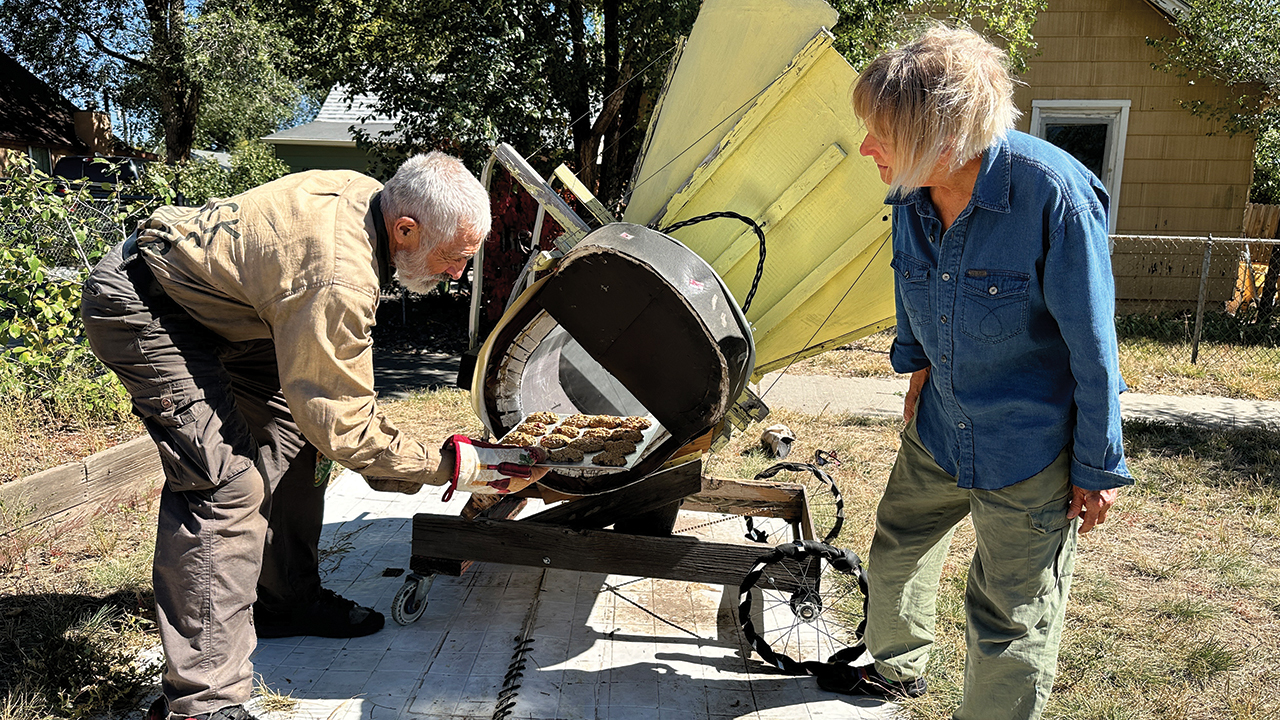
It’s impossible to pass Peter and Mary Sprunger-Froese’s house in Colorado Springs, Colo., without noticing the large yellow contraption resembling a homemade telescope in the front yard.
On closer inspection, a lucky passerby might discover a batch of cookies bubbling in the insulated box at the center of the dish. Instead of radio waves, the reflective panels of this solar oven concentrate sunlight for baking food.
“We leave the oven outdoors in front of the house all the time,” Mary said.
That way, it’s always available when they or their neighbors want to use it.
With dry air and plenty of sunshine, Colorado Springs is an ideal place for cooking with solar energy, and the couple have been doing it since they moved to the mountain city over four decades ago. Peter said cooking with solar ovens is a way for the Mennonite couple to resist the “energy assumptions in this country” and promote a more sustainable alternative to gas and electric stoves.
“We so much assume that we have an infinite supply of energy,” Peter said. The U.S. is the second largest consumer of energy after China, with one of the highest rates of consumption per person. In 2023, only 9% of that energy came from renewable sources like wind and solar.
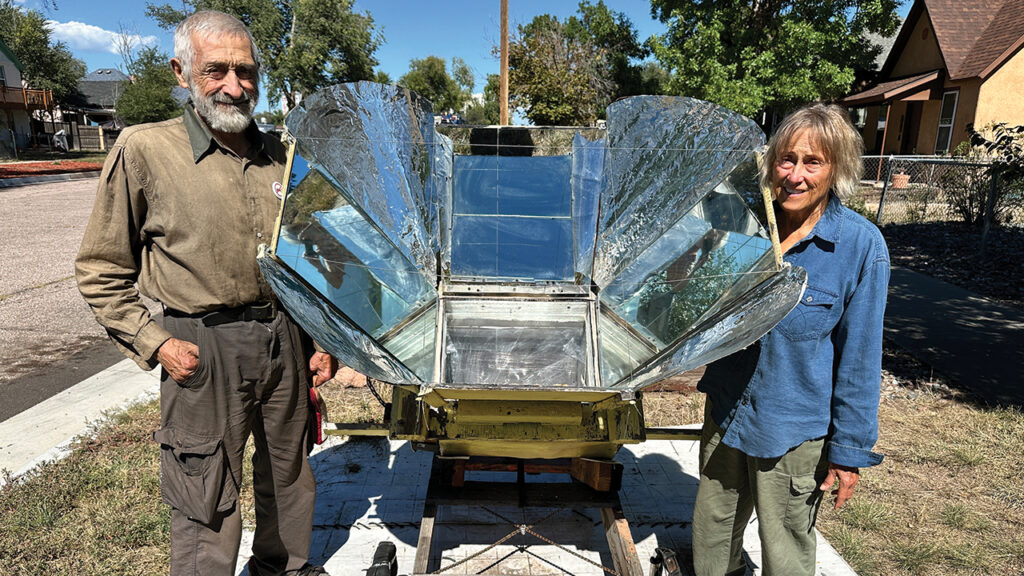
Cooking with energy from the sun is a way to “explore what it means to conserve planet resources,” Peter said. Although still small, there is a growing movement to harness the sun’s energy for carbon-free cooking.
The idea of heating and drying food using solar energy isn’t new, but it wasn’t until the 1950s that Massachusetts Institute of Technology scientist Maria Telkes designed the first functioning solar cooker.
Her design used four flared reflective panels to direct sunlight into an insulated box with a glass lid. It generated temperatures up to 430 degrees and provided the model for all future box-type solar ovens.
Peter built his first solar oven while studying at what is now Anabaptist Mennonite Biblical Seminary around 1987. It didn’t work very well, but that was the start of a decades-long journey toward perfecting his own design. In 2017, after many iterations, Peter and Mary produced a booklet with building instructions for the “Barrel O’ Sun.”
Mary called it the “Cadillac of solar ovens” because “it gets probably hotter than any of the other ones, but it is extremely complicated to build.”
Peter’s design uses a multiple-pane glass lid to maximize heat retention. The cooking chamber is made of tin sheet metal painted flat black and surrounded by fiberglass insulation.
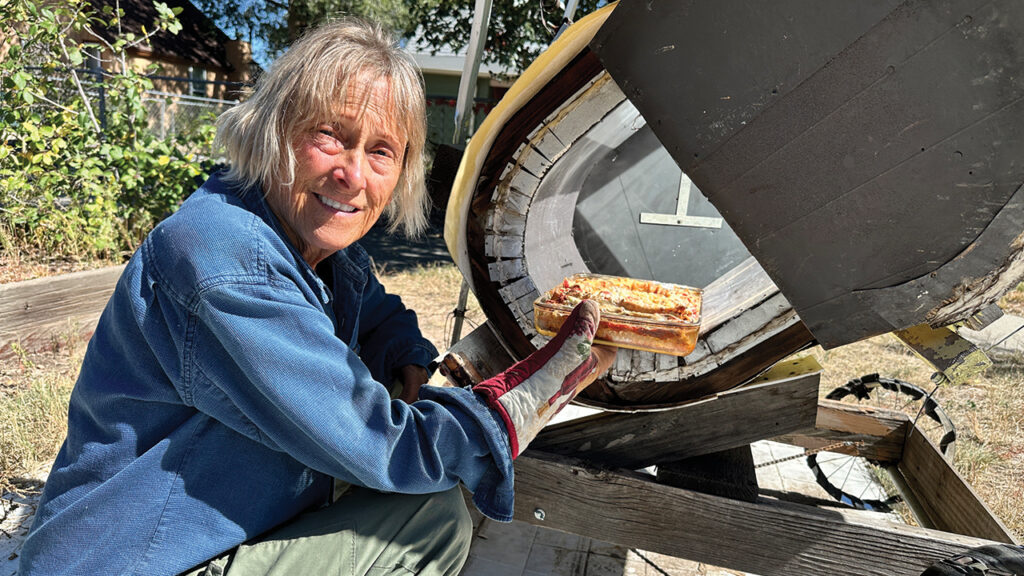
The oven’s barrel shape can be adjusted to match the sun’s angle. A frame suspended from a horizontal pivot bar keeps the food level while it bakes inside. The highest temperature Peter has registered is 532 degrees.
“That is definitely not needed for most baking purposes,” he said. But the real advantage is that it can still get up to 350 degrees even on partly cloudy days. “And look how many things you can bake at 350.”
Peter and Mary use their solar oven for “most anything that you would normally put into your oven in the house,” he added.
It’s not their exclusive cooking appliance, but if the sun is out and they want to bake, they do it in the solar oven.
Using the oven requires planning and working together. They have to pay attention to the forecast, building in extra time in case a cloud passes overhead.
Preheating the oven requires aligning it with the sun’s position, and that’s often done by someone other than the baker. Someone must also be available to reposition the oven every 30 to 45 minutes while it bakes.
“There’s a distinct communal dimension to that,” Peter said.
He has made over a hundred solar ovens, many constructed with salvaged materials such as bike parts and gifted to friends. With all the time and skill put into them, Mary said, “They were really labors of love and artwork.”
And, Peter added, expressions of peace.
Working for peace has been central to the couple since they were married in 1978. When they moved to Colorado Springs the next year, they joined a peace-focused, ecumenical intentional community, which they are still part of today. Like other members, they resist war taxes by living under the federal income tax level. They participate in peace talks, nonviolent protests and acts of civil disobedience.
“We live in a totally militaristic city,” Mary said. “There’s five military bases here. Half the work is related to defense industries.” They’ve used stints in jail to speak out against violence.
Peter runs a bike clinic where he repairs and gives away bicycles to people who can’t afford them.
“I often go scrounging in dumpsters for bike parts or bike carcasses with my homeless friends,” he said, “and I take them to the bike clinic and bring them to life there. That allows the homeless friends to participate in providing raw materials for what will become a functional secondhand bike for someone.”
Mary has led a peace and justice- themed theater troupe, taught English as a second language in schools and spent four years as an artist in residence at RAWtools, an organization founded in Colorado Springs that addresses gun violence by turning guns into garden tools and teaching conflict resolution skills.
When Peter and Mary printed the “Barrel O’ Sun” manual in 2017, their hope was to get it into the hands of someone who would produce and distribute the ovens more widely. They sent a copy to Mennonite Economic Development Associates, but the organization wasn’t interested at that time.
When the successor they hoped for didn’t materialize, they turned their attention to other things, including volunteering with Mennonite Action.
The Sprunger-Froeses don’t know of many others using solar cookers in their area, but their region’s climate has potential. Solar cookers work best in sunny, dry conditions. They are more practical near the equator where the sun is high year-round.
This is one reason they are catching on in the Asia-Pacific region, according to a report by Acumen Research and Consulting. Because they eliminate firewood and reduce health risks from cookstove smoke, solar cookers are promoted around the world.
While the benefits to American cooks are less obvious, Peter and Mary believe they’re still useful, partly because of what they teach.
“Learning to share, learning to be more communal,” Peter said, “are good values that we have, and the solar oven fits right into that.”
A copy of their design is available by contacting [email protected]. But, she warned, it’s a project for a skilled carpenter. To everyone else, she said: “We just encourage people to build their own simple one or buy one and use it!”
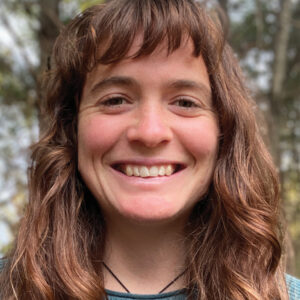
Sierra Ross Richer is a freelance writer and farmer from Goshen, Ind. She writes on climate change and sustainability in her Substack, “LANDing.” This article is the fourth in a series on faith-based action caring for the land and environment.


Have a comment on this story? Write to the editors. Include your full name, city and state. Selected comments will be edited for publication in print or online.