


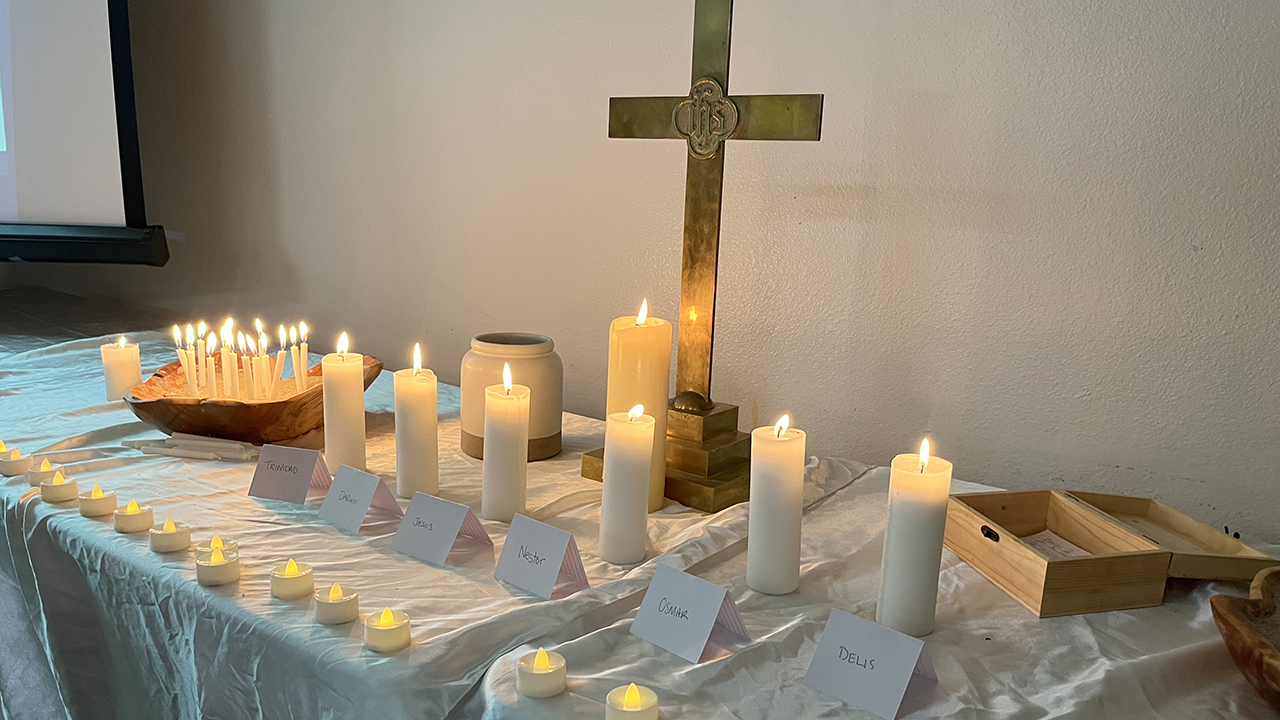
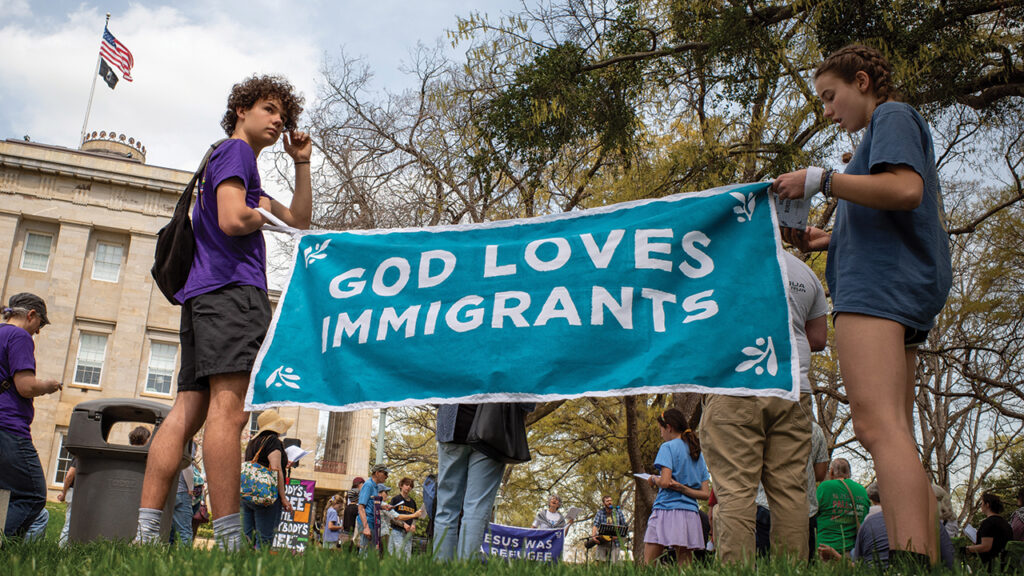
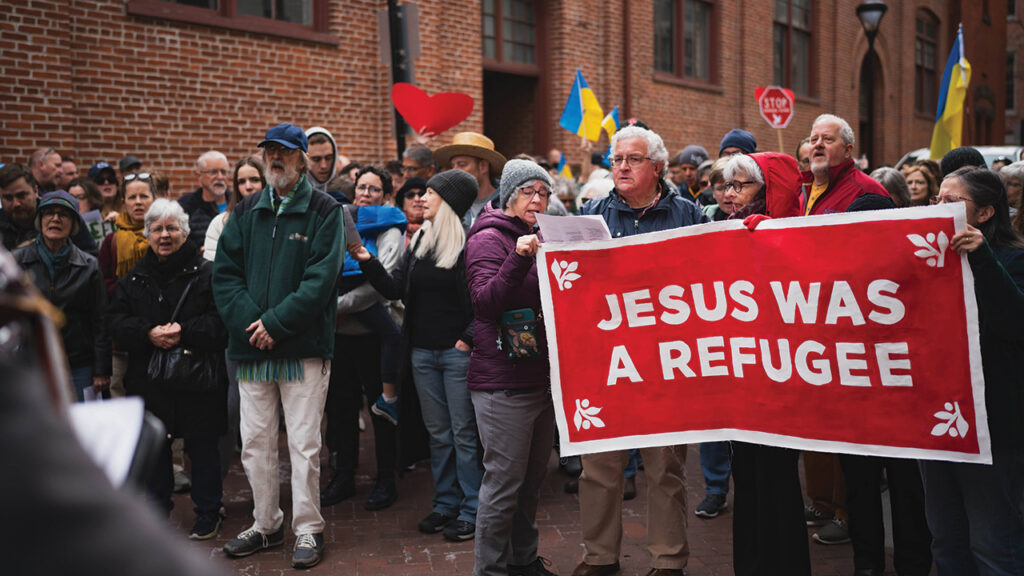
A growing number of people detained or deported by Immigration and Customs Enforcement are members of Anabaptist churches in the United States.
In recent weeks, Anabaptist World heard stories by phone and email from across the country of families separated and congregations mobilizing to increase support for households that have lived in fear for years as they pursue legal status and peaceful lives.
Dianne Garcia, pastor of Iglesia Cristiana Roca de Refugio (Rock of Refuge Christian Church), a Mennonite congregation in San Antonio, Texas, said that in her experience, every asylum seeker has good reasons to need sanctuary.
“Almost everyone has suffered trauma that we can’t even imagine here — the death of a loved one by a gang, the death or serious illness of a loved one due to inadequate medical care, years of abuse or domestic violence, years of not having enough to eat or being able to take care of your children adequately,” she said. “Everyone has a horror story. . . . Immigration to the U.S. is the result of pure desperation and a deep love for their children. It’s not just hoping for a better life.”
Conference and denominational leaders described lower physical participation in some congregations as members avoid public gatherings for fear ICE agents might detain them.
The scope of the immigration situation is likely underreported due to factors including fear, trust and privacy concerns. The Pew Research Center reported in June that one in four U.S. adults (23%) “worry a lot or some that they or someone close to them could be deported,” up from 19% in March.

Iris de León-Hartshorn, Mennonite Church USA associate executive director of operations, said the denomination has not been tracking individual cases of church members being detained, but is keeping an eye on ICE interactions that take place on church property. She heard about one such situation at a Hispanic congregation in Illinois.
“ICE was in their parking lot on Easter Sunday,” she said. “The only reason they knew it was ICE was because one member had just retired from a government job and knew it was a government license plate on the vehicle. She went to talk to the agent in the vehicle, and it left. . . .
“That same congregation told me that people are self-deporting because they don’t know where they might be sent. A lot of times they aren’t sent back to their previous country.”
At least 11 members from six Church of the Brethren congregations have been deported, and at least 10 other church members have been held in detention. Founa Badet, Church of the Brethren director of intercultural ministries, said some of the impacted families are homeless and in need of legal and financial support.
One Brethren congregation that’s affected is West Charleston Church of the Brethren in Tipp City, Ohio, where a member, Armando Leonel Reyes Rodriguez, was deported in June to Honduras after being separated from his spouse and two children.
Reyes Rodriguez was summoned to an ICE office in April under the pretext of removing an ankle monitor he was wearing for non-criminal reasons. He never returned to his family.
Irvin Heishman, another pastor from the congregation, said Reyes Rodriguez was not eligible for asylum because he had entered the U.S. earlier in life, but was allowed to be present under an earlier federal policy allowing families to stay together while pursuing an asylum case.
“A real dilemma for them is that they were forced to choose between being together as a family or pursuing their asylum case,” he said, noting the rest of his family remains in the U.S.
The trend of detaining nonviolent immigrants at court hearings and other required appointments grew over the summer. The Washington Post reported Aug. 15 that ICE intends to spend billions of dollars to double immigrant detention capacity by the end of this year.
One member of First Mennonite Church of San Francisco under the age of 21 experienced detention after a government official unexpectedly moved to dismiss his asylum application at a required court appearance. He grew up attending a Mennonite church in Colombia where his mother was a pastor offering education and other support to prostitutes.
“When we started the church, the chairs we used were lent to us from the brothel,” his mother said, speaking in Spanish to AW digital strategist Juan Moya. “That led to many problems, because back then the paramilitaries controlled my town. I received many threats, since I was helping the prostitutes leave that life. The church was relocated, I divorced, and I said to myself, ‘I have a tourist visa, no work, people threatening me. So I’ll go to the U.S., work, and . . . then I’ll return to Colombia.’ ”
Paramilitaries recruit young people to carry out violence, but wealthy families avoid it by paying them off. She dreamed of her sons studying at university, but things fell apart when the threats started.
“In Colombia, people think pastors have money,” she said. “Since I was in the U.S., they thought I was sending money. . . . And second, [my son] got into community politics. He wanted to help low-income people. That drew more threats.”
She came to the U.S. six years ago. A friend from a church in Indiana connected her to First Mennonite Church of San Francisco, which assisted with food, rent and other things. Her two sons followed more recently.
“The language barrier was hard, starting over at 40-something years old. Even crossing the street scared me,” the mother said. “But you do it out of love for your children. … It’s endless work and fear. And being undocumented makes it worse. … I get terrified when I see a white or black SUV — I think it’s ICE.
“We barely go out. I work nights cleaning offices, but I leave home terrified. [My son] has depression and anxiety. He doesn’t like to leave the house.”
The young man appeared at a court hearing Aug. 1 for his asylum case, and things were looking positive when the judge set the date for his next hearing in 2028.
“But the government attorney intervened, and ICE arrested me on the spot,” he said.
A lawyer with the Department of Homeland Security asked for the asylum case to be dismissed, which resulted in six ICE agents detaining the young man the moment he left the courtroom.
First Mennonite Church was able to connect him quickly with an immigration lawyer who secured a temporary restraining order from a federal judge to provide time to work on a special immigrant juvenile status petition to strengthen his asylum claim.
He was released Aug. 4 after being detained three days.
“My advice to others is always attend your court hearings, even if they arrest you there,” he said. “It’s worse if they come to your house. And always seek legal help. There are many nonprofit organizations with free lawyers. Thanks to them, I’m free. And I thank the church, because they supported me even more than some family would.”
He is one of the lucky ones — for now.
By mid-August, Iglesia Cristiana Roca de Refugio had at least eight people in detention who at some point attended the church.
“But we have also been connected to eight other families who have family members detained and have become connected to our community,” said Pastor Dianne Garcia.
She said increasing dismissal rates of asylum cases is a way of accelerating deportations, but it varies from judge to judge. In the asylum case of “Maria,” a church member with three children who was detained in July, a judge ordered her deportation Aug. 12 after an immigration lawyer requested more time to work on her case. Appeal efforts are underway. (Update: “Maria” and three other people from the congregation were deported to Venezuela Aug. 26.)
“I’ve heard of people begging judges not to dismiss their case, but they do anyway,” Garcia said. “And yes, the majority of people who have asylum cases actually don’t have what would be considered a ‘valid’ case under the law. Legal asylum cases are defined very narrowly. You have to prove that you were persecuted or tortured by the government for political or religious reasons.”
For a family, that means each adult and each child must demonstrate persecution, which Garcia said raises a standard that is difficult to meet even for those coming from unstable countries like Venezuela or Haiti.
Ferdinandus (Ferdi) Nahak, a member of Upland Peace Church in California, was detained by ICE in July. The congregation is a member of Pacific Southwest Mennonite Conference of Mennonite Church USA. Pastor Nehemiah Chigoji presented a request in early August that Nahak be released on bail, but Pacific Southwest conference minister Stanley Green said that request was not granted.
“Pastor Chigoji accompanied Ferdi’s spouse, Sahlina, to immigration court [Aug. 8] where she was summoned to appear,” Green said. “There was great fear that she too might be detained by ICE following her appearance,” but instead the judge extended her hearing to Aug. 28.
Green requested prayers for the couple and their two sons, one of whom is in the U.S. Navy.
Beyond prayers, the conference is seeking other ways to assist immigrants. Pacific Southwest’s Missional Task Group hosted a webinar Aug. 14 with an immigration attorney for sharing and learning about ways to respond to ICE detentions.
“Some of the PSMC congregations have reported a decline in physical participation in worship since ICE has disregarded the sanctity of worship spaces to detain and initiate deportation procedures against those they have snatched up,” Green said.
The advocacy organization Mennonite Action is working to build up training resources for congregations. The Fall Term Courage School is meeting online on Tuesday evenings in September to address how to effectively demonstrate for people of Gaza and respond to ICE’s growing impacts on communities.
“In many locations there are already immigration-focused organizations that will be much more knowledgeable than us about situations on the ground,” said Nick Martin of Mennonite Action. “. . . Instead, the training will be focused on supporting churches and participants to think about how to set up rapid response decision-making structures in their churches, how to connect and work with local groups on the ground and how to mobilize their church members to take action in important moments.”
Mennonite Action is developing other in-person trainings for fall and winter. They will be relevant because taking action can have consequences.
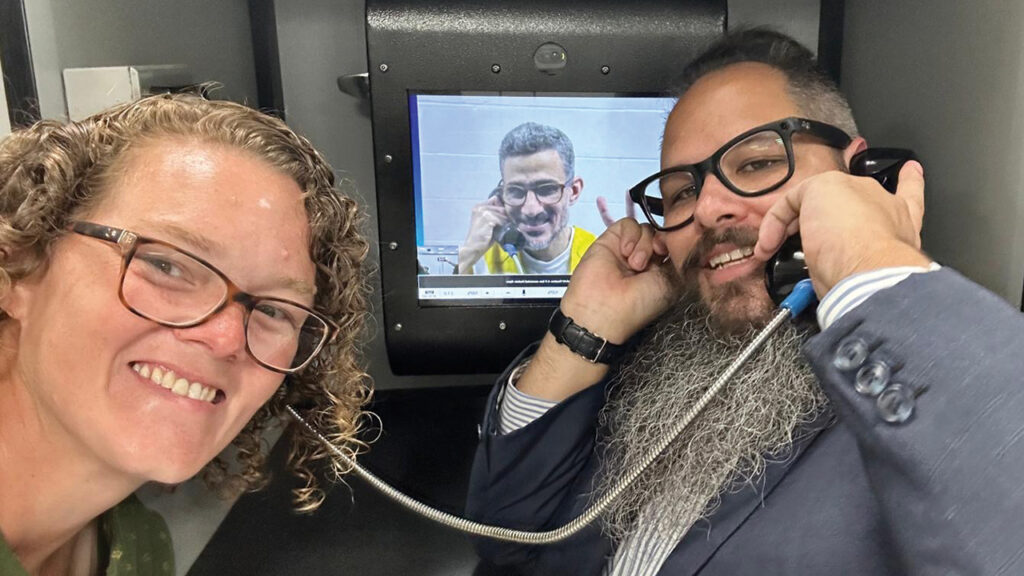
Cincinnati Mennonite Fellowship member Adam Allen lost his job as a chaplain at Cincinnati Children’s Hospital after supporting a Muslim chaplain who was detained by ICE after his asylum case was dismissed. Allen is ordained in MC USA and is an alumnus of Fresno Pacific Biblical Seminary and Fuller Theological Seminary.
The Muslim chaplain, Ayman Soliman, was an imam in Egypt for 14 years. He left his wife and daughter because he was jailed and tortured for his journalistic work during the Arab Spring uprising, receiving asylum status in the U.S. in 2018. His lawyers claim a U.S. asylum officer began working in late 2024 to terminate his asylum status because Soliman once served on the board of a nongovernmental organization that provides medical and charitable services that previously had community development links to a Muslim organization President Donald Trump has considered designating as a terrorist group.
Soliman was detained in early July when he appeared at a required check-in appointment.
“The government reassured him that this meeting was just a basic meeting and then arrested him,” Allen said. “He could be deported and will be executed if he returns to Egypt.”
Allen posted criticism of ICE on social media and appeared at a July 17 vigil attended by other members of the church wearing a T-shirt stating, “I do not represent Cincinnati Children’s Hospital.” The vigil developed into a protest, and the following Monday a human resources representative from the hospital informed him that his social media usage did not fall in line with the hospital’s values and that he and one other chaplain were terminated.
“We asked what the hospital’s values are, and they couldn’t cite them,” he said, noting his situation is still relatively positive compared to his colleague and friend. “. . . I spent the last five years caring for parents and children who were dying. Believe me, I know how bad things can be, and currently nobody in my family is dying. So I’m counting my blessings.
“I saw a family on social media I’ve been working with for a year, and their child just got a kidney and liver transplant. I don’t have that situation. I’m just going to stay grounded in that.”
Seventy miles to the north at West Charleston Church of the Brethren, pastors are assisting a church member whose brother was detained and is scheduled to be deported. Pastor Irvin Heishman said things moved quickly until he was jailed, and now he waits through delays with no information in difficult prison conditions.
“In his case, he was appealing the court decision to deny him asylum,” he said. “Detained, he then appealed to be released on bond while he pursued his case, but bond was denied.
“This left him with the unbearable ‘choice’ of pursuing his asylum case while incarcerated, which would take up to three years, or agree to be deported. He chose the latter, and I helped his wife purchase airline tickets for herself and their children to Honduras. The family in this case is choosing to voluntarily self-deport in order to remain together as a family.”
As the family works to sell belongings, the church is planning an ecumenical public service of lament in September for church members detained and deported.


Have a comment on this story? Write to the editors. Include your full name, city and state. Selected comments will be edited for publication in print or online.