


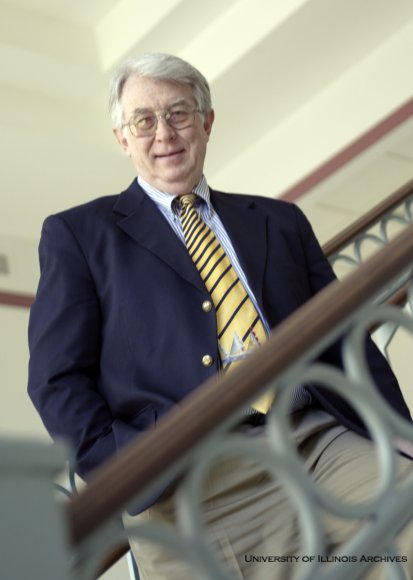
Name: Earl Kellogg
Congregation: First Mennonite Church of Champaign-Urbana and Shalom Mennonite Church in Tucson, Arizona
Occupation: Professor Emeritus and Former Associate Vice President at University of Illinois, higher education consultant and member of the Mennonite Church USA Executive Board
1. What is your earliest memory of church?
I was literally born on a farm. There was no hospital near us in Western Kansas. I remember my mom and dad were very heavily engaged in church. We attended a little country church. It wasn’t big enough for a pastor, so we had a traveling pastor from a church near us come and preach on Sundays. Much of my church was essentially people from this little tiny town and many of those who attended were my relatives. I remember being interested in worship, but more than that, I remember sitting with my cousins and enjoying them.
2. Tell me about your work at the University of Illinois. What did a normal day entail?
I had been a professor there doing teaching and research in agricultural development. I then left the university for 12 years. Ibecame the president of a consortium of 11 universities headquartered here in Tucson. And then I became the Chief Operating Officer of a large NGO founded by the Rockefeller and Ford Foundations to do research, human capital development and development programs around the world to alleviate poverty. Then the University of Illinois called and said they created a new position to enhance the international dimension of higher education at U of I and I went back as the first Associate Vice President for International Affairs I am now a consultant to universities around the world on how to strengthen the international dimensions which is critical for excellent in higher education these days.
I think in those days when I returned to the U of I, back in 1997, we knew that the international dimension of education was important, but we didn’t quite know what to do with it at a large land grant university like the University of Illinois. I was to develop programs and raise money to provide international opportunities for students both on and off campus. I was also assigned to develop a much more globally connected research program and access the best minds and facilities around the world for our faculty. We built up systems for more engagement on international issues and we began to do a lot more work on connecting with our alumni who are extremely important people around the world. We started international alumni chapters and awards, and we did a lot of development programming and contracting with foundations and United States government agencies.
I was there for eight years in this role and then retired.
3. Talk a little bit about this new phase of life: retirement. What has this phase of life been like for you?
This is a wonderful time! If you want to stay professionally engaged, you can do that, it’s just more on your own terms than before. You do have a lot more freedom to say no and to be involved in more intense ways with your children, your grandchildren and with your marriage and social life.
You can travel and do things that you’ve said that you’d like to do, but perhaps didn’t have the time. It’s a special time in life, especially if you have health, both physical and mental, and a reasonable amount of money. It’s terrific! You can be creative in all kinds of different ways that you couldn’t when you were doing an “8-8 job.”
You can also delve more deeply into theology and what God is calling you to be and do. My wife is a mentor for me as we read and think together about God’s calling, Jesus’ messages as they relate to our own spiritual growth and contemporary issues affecting all of God’s children, particularly those on the margins.
4. You have two congregational homes. What’s the gift of having these two separate spiritual communities?
I live a lot of my life in this really international, cutthroat consulting business for the private sector world. I need my Christian communities to help keep me balanced and to understand that God’s kingdom is different. I find refuge and safety in church to help me with that.
They are both terrific congregations.
The Champaign-Urbana community is populated a bit more by professors and retired faculty and students, but community people as well. It sits right on the edge of this huge U of I campus. It has really focused on Christian Education and on worship, and on keeping engaged on issues that matter and with all the many people that flow through. It’s a congregation where lots of people come and go. They come to school and they’re there for a few years and then leave. And there’s an international part of it where students from around the world come. So it’s a congregation that challenges me intellectually and spiritually.
The community in Tucson is also a thriving and very heavily invested community in important matters. We’re trying to figure out what God’s call is for us as a community that sits literally 90 miles from the border with Mexico. Here in Tucson, immigration is right here in your face. You can’t walk around town without engaging this issue. And there’s an emphasis on creation care in a different way when you have a fragile ecology like the desert. And we are enriched by the Native Americans who are here in Tucson and who have been modeling sustainability for a long time.
We also have had a fairly large influx of refugees from the Congo. These are people who were refugees in Tanzania, born and raised in the Congo. One family was in Tanzania for 14 years, and during that time they went through a Mennonite church. When they came to Tucson, they wanted to find a Mennonite church. They called up our pastor and said, “We’re here and we’d like to come to church.” So, we probably have 20 new people from the Congo attending this church. They’re learning English and we’re trying to learn Swahili. We’re challenged by how we integrate each other into our worship experiences. We have a sending hymn every Sunday and it’s usually in Swahili. It’s very spiritual, but also a lot more danceable!
Then in the second hour after worship some of us get together to worship with and learn each other’s songs. It’s just a joyful time! It’s a whole new dimension to this church that’s been very enriching.
5. Your congregation in Champaign-Urbana has built a relationship with the local mosque. Tell me about the importance of this relationship for you.
It is a vibrant relationship. One of my joys in my Christian walk is that the Champaign-Urbana church is adjacent to the largest mosque in Illinois outside of Chicago. They sometimes have up to 600 people in attendance at prayer time. They are partly so large because the U of I has the second largest number of international students of any university in the U.S. In the mosque, they have Muslims from Africa, Asia, Latin America and the U.S. The Imam is a man from Burkina Faso and so there is this incredible global faith community right across the street from us.
We have been engaged in many ways, both trying to understand each other’s faith and trying to be servants for each other’s welfare. And we’ve now begun to collaborate on some programs. When our pastor retired and I was on the search committee for the next pastor, the Mosque had been so heavily involved with us in all kinds of ways that they called and asked if it would be ok if they would have a chance to interview our final candidate (Janice Guthrie). They had a lunch for her at the Mosque library and they asked her very good questions. After they were leaving the library and we were getting ready to go, one of the women from the mosque whispered in my ear, “Hire her.” And we did, not only because of that, but all kinds of reasons.
We’ve also decided we really need to think about working more with the Jewish community in our city. The new Rabbi in the Champaign synagogue has joined with our pastor and the Imam. They meet once a week reading a book together on interfaith collaboration. We have also started to develop summer program. We’ll bring the youth from these three faith traditions to do a summer camp to learn about each other and develop relationships. Given the fact that we have this huge university sitting near us and all these people from all over the world, we have an opportunity to make a difference in this world over time. We are sending people from our community and university out who have had a chance to interact in healthy, in depth ways with people of other faiths. I have had people at the Mosque tell me that they have never had an interaction with a Christian that was positive. I’m sure there are young people in our church and the university who have never had a chance to interact meaningfully with someone from the Islamic faith. There’s a real calling here that God has for us.
6. Why did you say yes to serving on the MC USA Executive Board?
When senior people from the faith community call and ask me to do something, I’ve taken that very seriously. But I was shocked by this invitation. I’ve been in a Mennonite church for 47 years now and had every kind of position within local congregations, but had never served on a conference board or done anything at the broader Mennonite church level, so when this call came, I was completely shocked. As I thought about it, I thought that maybe I could bring a different perspective to this work since I’m not clergy and I live in a sort of different work world. I’ve dealt with Nobel-winning science folks and prime ministers and navigated the dog-eat-dog consulting world in addition to the marginalized people in poor countries. I serve on numerous secular boards. And I thought perhaps that there was something I could contribute.
7. What are your hopes for the 2017 Mennonite Church USA convention in Orlando?
I hope we can envision a mission and an agenda for our church that follows God’s call in these contemporary times. We must realize that there will be differences among us regarding issues, but God’s calling is more important than the differences we might have on various issues I hope that we treat each other and trust each other in kind ways. I know that we can be more effective in God’s kingdom work if we do it together. That’s what I would hope for.
8. If you could only recommend three books to someone, what would they be?
- I’m reading Alexander Hamilton’s writings right now and I find it fascinating. I may never see the show, but the book is fascinating because it is a detailed account of the founding fathers how fragile this country is and was. It points out the flaws and the weaknesses and the bitter battles that were a part of the beginnings of this country. I’m feeling like what we’re going through now is not without precedent, although I’m very sad about it.
- Another book I found interesting, partly because of my profession, was Rich Christians in an Age of Hunger. One of the things that has always challenged me is that I go to lots of places that are deep in despair. How can I be faithful to God’s calling in these spaces? That’s always been a question for me.
- Micah 6: This Scripture passage is really important to me. That brief little piece there that talks about the whole notion of walking humbly with God and loving kindness and doing justice is really important to keep me balanced. I didn’t grow up Mennonite. I didn’t even know about them until I married one and read their theology. But the theology and practice of the Mennonite church has always been helpful in helping me keep balance.
Interview conducted by Hannah Heinzekehr, The Mennonite, Inc.


Have a comment on this story? Write to the editors. Include your full name, city and state. Selected comments will be edited for publication in print or online.