


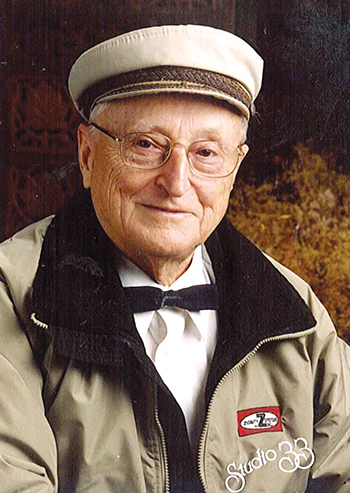
Eldon Hostetler left the Amish church to become an inventor and entrepreneur.
From the first week of his life as an Amish baby until today as a 91-year-old inventor and entrepreneur with more than 65 patents to his name, Eldon Hostetler has surprised his community and his world.
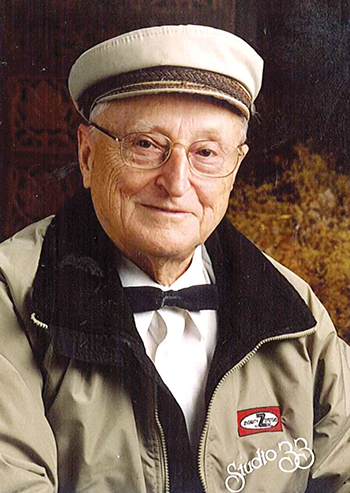
After Hostetler was born on Christmas in 1922, the eldest of 13 children to the late Lizzie and Mahlon Hostetler, he was blessed in a Jewish temple. He was the only Amish young man in his community in Shipshewana, Ind., to own a car. As an adult inventor, he received patents around the world for poultry-raising equipment. And in retirement, he donated his Hudson car collection to a museum in Shipshewana.
These are unusual experiences for someone born Amish who received only an eighth-grade education. However, Hostetler, now a member of North Goshen (Ind.) Mennonite Church, says God called him to take the path less traveled and, in many cases, to blaze new trails. One trail was blazed from his father’s fulfillment of the wishes of the late Dr. Black, a Jewish physician who delivered Hostetler into this world.
“Dr. Black told my father that I was a real God send and that he wanted my father to bring me to a Jewish temple in Ligonier, Ind., so they could perform the usual Jewish rite,” said Hostetler, of Middlebury, during a mid-July telephone interview.
An influential person
“After the ceremony, the rabbi told my father he thought I was going to be an influential person in the world. My father waited until he was 70 to tell me this story. He said at the time of the circumcision he didn’t give the rabbi’s comment much thought. But later he realized that I would never have been able to do what I did without that blessing.”
This experience would not have occurred if his father hadn’t operated on the outer fringes of Amish tradition, Hostetler said. Coupled with his father’s free-thinking were the innovative tendencies of his maternal grandfather.
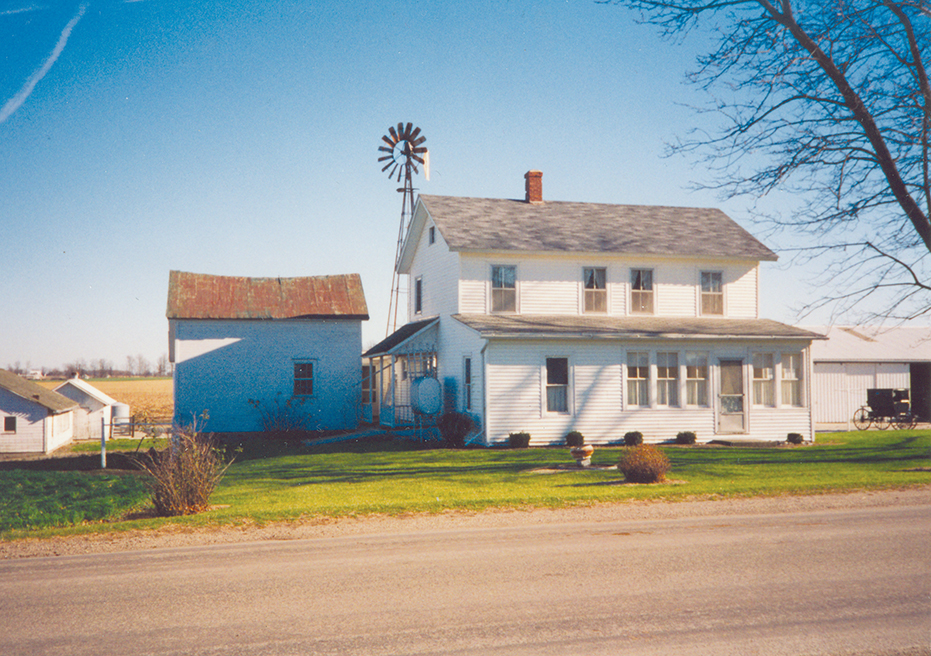
Hostetler’s parents owned the Pashan Farm in Shipshewana, near where Hostetler attended a one-room school. His maternal grandparents lived about 500 feet south of this farm. His paternal grandparents, the late David and Leah (Lambright) Hostetler, lived in Emmatown, Ind., where they grew mint, spearmint and peppermint.

“My Grandpa Shrock had tractors and threshing machines, and I was much more interested in that stuff than in farming with my father,” Hostetler said. “I helped grandfather renovate machinery. He was Amish, but he traded his steam engine in for a gasoline-fired tractor when I was 4 years old. That was considered a worldly thing to do, and he shouldn’t have been doing it, but he did.”
In his book The Life and Times of Eldon “Ziggity” Hostetler: An Autobiography, Hostetler writes about how his grandfather traded in his steam engine for a gasoline-powered 20-40 Huber tractor.
“Dad took me in the buggy to Goshen [Ind.], and I was privileged to drive back with Grandpa on the tractor, which went three times as fast as the steam engine would go in high gear. On the way back, we stopped to buy a spring wagon that he later converted to what we call an ‘oil wagon.’ He had a 50-gallon drum with his fuel and oil and things on it, and he pulled it hundreds of miles around the country doing threshing.”
Hostetler said that when he was 18, he was helping his Grandpa Shrock in his shop one day when his grandpa told him he felt Hostetler would not stay Amish.
“He then said that if I promised never to tell my mother where I got the money, he would loan me $350 to buy my first car, a 1938 Hudson,” Hostetler said. “I was the only person in our community who had a car, and so I hauled a lot of Amish people around. They paid me so much per mile and gave me R stamps [stamps used by farmers] so I could buy gas. It was during World War II, and I couldn’t get tires. I had to recap those tires until I couldn’t recap them anymore.”
So he traded in the 1938 Hudson for a 1940 model with 27,000 miles, the second of many cars he owned in the coming decades.
Leniency and legalism shape the faith of a young man
This leniency in conjunction with the more legalistic stance of his mother and paternal grandparents shaped Hostetler’s views about God and religion, he said. The mixed milieu—though oft-confusing—was steeped in a faith that later guided Hostetler out of the Amish community into the Mennonite church.
Two of the more striking memories about faith involved his paternal grandfather, Hostetler said. “I remember how grandfather held me on his lap, showed me pictures in the Bible story book and told me how important it was to obey God. That made such a deep impression on me.”
Equally impressive was his memory of the conflict between his father and grandfather. In the late 1920s, when Hostetler was about 6 or 7, their family attended a conservative Mennonite church—a choice of his father’s that his mother prayed would change, Hostetler said.
She did not like the fact that the services were sometimes in English and that some of the people drove cars to church. About this time, his father put a down payment on a 1927 Chrysler, a decision that evoked a visit from his father’s parents.
“Dad and I had just come into the house from working in the fields,”Hostetler said. “When Dad saw his parents, he said, ‘I think you are here because I put a down payment on a car.’ Mother ran out of the room crying but later came back. Grandpa said that if Dad took delivery on that car then he would have to take Dad off his inheritance list. Dad replied, ‘The Bible says that the love of money is the root of all evil.’ Grandpa started crying and said, ‘You are my child and I’ll never quit loving you. But if you get that car, I will have to disinherit you. On the other hand, if you give up that car, and they won’t give you your money back, then I will pay you that amount.'” His father decided against buying the car.
Leaving boyhood behind
Hostetler said it was in the midst of that powerful emotion that he first knew he didn’t want to join the Amish church. He did not want to risk the same kinds of things happening to him. He took his first steps off the farm into work in 1944 and soon after out of the Amish church.
That year he married Edna Yoder, whose brother Joe worked at Creighton Brothers in Warsaw, Ind., the largest leghorn farm and hatchery in the United States. Hostetler, who had been deferred on the farm by the LaGrange County draft board, was then deferred by Creighton when he was hired to work there.
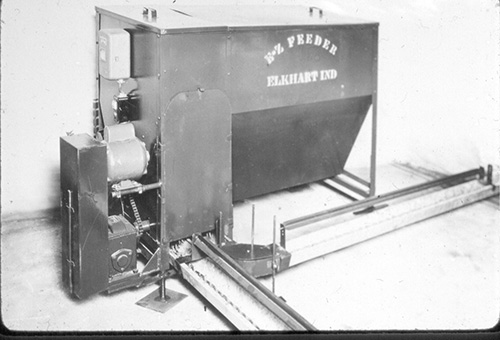
His jobs included catching leghorn pullets on range and moving them into laying houses for egg production, traying eggs for the incubators, and egg grading. He later became certified to do poultry blood-testing. Hostetler then moved into the world of invention and innovation. After he became manager of the hatchery at Creighton Brothers, his hands-on work with bird selection and trap nesting led to his learning about poultry genetics. He began a hobby of cross-breeding for a better and larger white bird that had more breast meat. His experimentation led to a new breed of broilers, the White Meateor.
His first patent was for the E-Z Feeder, an automatic feeder system. In conjunction with having a mind that quickly retained large amounts of details, spiritual experiences sometimes inspired him, he said.
“One night, I came home from work after having trouble getting the old feeder to work,” he said. “Ground corn cob and little chunks of rock got stuck in-between the sprocket wheels and stopped the machine. I fell into a deep sleep, and all of a sudden on the bedroom wall flashed a vision of what would make that feeder work better. I got up at 2 a.m. and drove to the plant in Elkhart and started pulling the old machine apart to reassemble it.”
That reassembled feeder became the E-Z Feeder, followed by many other inventions, including the Ziggity watering system, Chore-Time feeders and a ceiling-mounted winch system that was used to raise and lower the feeding system. In April 1977, he opened his own company, Ziggity Systems, Inc. It enabled him to sell his newest product at the time—a snap-in, nipple-type drinker for poultry.
“As a person without an education beyond eighth grade, it was hard to get more educated folks to listen to my ideas for how to do things more efficiently,” he said. “Without an engineering degree, I had to swim twice as fast upstream in order to contribute my gifts. But today, there are 200 million broilers processed every week in United States. Ninety percent of all broilers grown in the world are fed and watered with stuff I designed, as well as copies of it.”
Transitioning from life with Edna to life with Esta
In the fall of 1975, a year and a half before he started Ziggity Systems, his first wife, the late Edna (Yoder) Hostetler, was diagnosed with cancer. For the previous several decades, they had been busy raising a family of six children—MaryEtta, Ruby Arlene, LeAnna, Dale Eugene, Robert Dean and Eldon Jr. And in the mid-1960s, they transitioned from being part of a conservative Mennonite church to becoming members at North Goshen. She died on April 22, 1977, when she was in her 50s.
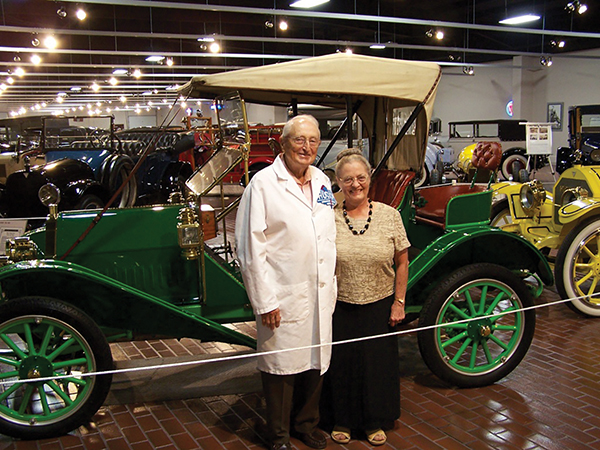
In April 1978, Hostetler married Esta Yoder, a member of North Goshen and a longtime secretary at Goshen College. “I was 43, and he was 55, and I had not married before,” she said. “In a very short time, I became a wife, a stepmother to six and a grandmother to eight.” She also became Hostetler’s travel companion on business trips as well as his fellow collector of unusual Hudson antique cars.
In late 1997, Hostetler met with Norm Kauffmann, then manager for the Town of Shipshewana, to explore the gifting of 50 of the cars to the town. “It was a long journey from that first meeting until the completion of the museum [Hostetler’s Hudson Auto Museum, located in Shipshewana Town Center] in 2007,” Kauffmann said during a late July telephone interview.
“In our many conversations, it was clear he maintained a deep respect for his parents and grandparents over the years, even though he was no longer Amish. He had a profound appreciation for that tradition. … His faith was at the core of who he was. It was something that always rooted his life.”
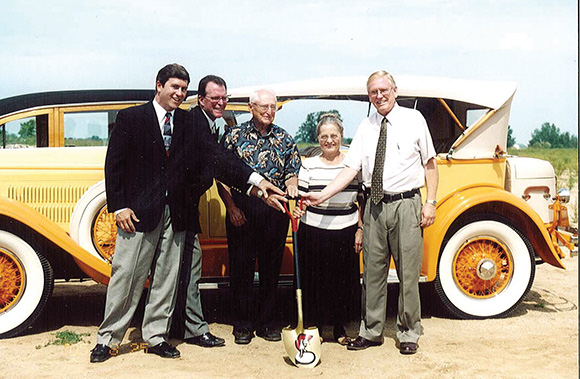
Kauffmann said he was struck by how much Hostetler invented and how creative he was. “His creativity was not allowed to come out in the Amish community, so that is why I think his parents and grandparents encouraged him to go do what he had to do,” he said.
“He didn’t have a lot of book learning, but he had an amazing ability to observe life and figure things out. He spent a lot of time in the chicken house and figured out that turkeys would only drink out of green containers and chickens only out of red ones. He tried to share his new design ideas at his work places. And if the people would not do it with him, he would go somewhere else where they would.”
Serving by inventing
It was a spirit of serving God by inventing that Ervin Stutzman, executive director of Mennonite Church USA, sensed in Hostetler when he met the couple earlier this year, he said during a late July telephone interview. They visited with Stutzman about his book Jacob’s Choice, historical fiction about a common Amish ancestor, Jacob Hochstetler.
“Two things struck me about Eldon,” Stutzman said. “First, he was blessed by a Jewish rabbi, which became a formative part of Eldon’s journey. And second, it is really unusual for one person to have that many patents. It makes me wonder if more Mennonites that we don’t know about have patents, too.
“When I travel around Mennonite Church USA, I ask business folks to show me what they do. We don’t often hear from the pulpit how God speaks to business people. But I have discovered, through serving as a devotional Bible study leader for MEDA [Mennonite Economic Development Association], that many entrepreneurs deeply incorporate their faith with their work.
“Entrepreneurship is given by God to the church and is a way for people to use their God-given gifts in ways to bless other people.”
Blessing other people and doing good work were central to Hostetler’s drive to create—values he learned when he sat on his grandpa’s lap, listening to Bible stories.
“At Ziggity Systems, we never had a meeting to talk about how we could make more money,” Hostetler said. “Our goal was making a better product, and the money followed.
“Today I still try to help as much as I can, but there isn’t much energy left anymore. But one thing I will never do is stop thanking God for all the ways he has blessed me. … If Grandfather were alive today, I would tell him that the things he told me I have never forgotten and that I have learned they are true.”
Laurie Oswald Robinson is a free-lance writer in Newton, Kan., and the author of Forever Family.


Have a comment on this story? Write to the editors. Include your full name, city and state. Selected comments will be edited for publication in print or online.