



Covering five centuries of Anabaptist history in one book is no small feat. In Anabaptism’s 500th anniversary year, Astrid von Schlachta, a German historian, has stepped up to the challenge.
An English translation of Anabaptists: From the Reformation to the 21st Century was published in late 2024 by Pandora Press. Publisher Maxwell Kennel edited Victor Thiessen’s translation, which is Volume 10 in Pandora’s Anabaptist and Mennonite Studies series.
Kennel said von Schlachta’s European approach to the span of Anabaptism’s expressions and movements complements and contrasts with Troy Osborne’s North American Radicals and Reformers: A Survey of Global Anabaptist History, published last year by Herald Press.
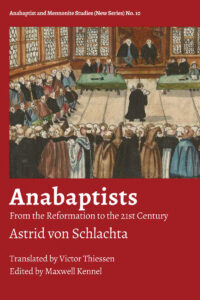
“Troy’s book is roughly chronological, while Astrid’s is thematic, and both attempt to cover all 500 years up to the present,” Kennel said. “Anabaptists has an interesting chapter at the end on Mennonites and the arts, which you don’t see covered so much by historians.”
Kennel noted that Osborne brings special attention to Dutch Mennonites, who often get overshadowed by coverage of Swiss and German Mennonites, while von Schlachta’s specialization is Hutterite history, which is featured in the book. She directs the Mennonite Research Center in Weierhof, Germany, and co-led the committee planning commemoration activities for the 500th anniversary of Anabaptism in Germany.
“She approaches Anabaptist history differently, because she doesn’t put pressure on herself to think of the Anabaptists as a unified singular whole,” he said. “That’s what allows her to tell a bunch of very odd and different stories. She doesn’t decide beforehand who counts as Anabaptist. She’s more comfortable with contradictions and tensions in Anabaptism than any writer I’ve seen.”

Von Schlachta brings expertise in European history and events like the Peasants’ War that greatly influenced early Anabaptism. The book comes together in a sprawling work that covers matters both major and minor, such as the time Simon Pänntzl’s squirrel escaped through a window, inspiring a secret “squirrel sign” of recognition that renegade Anabaptists could use to facilitate their illegal gatherings.
“Everyone’s read about Dirk Willems,” Kennel said, “but Astrid pulls vignettes from Anabaptist history that the average North American Mennonite reader will be coming across for the first time.”
Osborne’s Radicals and Reformers was created for use in college and seminary courses as well as by general readers. Von Schlachta’s Anabaptists is scholarly as well, but Kennel stressed that shouldn’t scare readers away.
“On a scale from a popular text that anyone can read to an academic text that only an academic person would read, I would put Astrid’s book almost squarely in the middle,” he said. “Anyone with a college degree can work their way through it. People will be intimidated that it was published in an academic series. It is slightly less, but not much less, accessible than Troy’s book.”
Chapters conclude with discussion questions, which have been updated since the original publication in German. Kennel said he has already used the book in Sunday school as part of his role as pastor of Hamilton Mennonite Church in Ontario.
“It’s win-win that we have had these two books come out, and you should read both,” he said. “Astrid is big on quotations and stories. She talks about how Anabaptist families navigated the tension if the husband became Anabaptist; it had consequences for the rest of the family.
“She’s not afraid to talk about how they were distinctive. In North America there’s a reticence to talk about Anabaptist distinctives because we don’t want to be triumphalist. Astrid doesn’t do that, but she does talk about how Anabaptists have changed over history. They stood out.”



Have a comment on this story? Write to the editors. Include your full name, city and state. Selected comments will be edited for publication in print or online.