


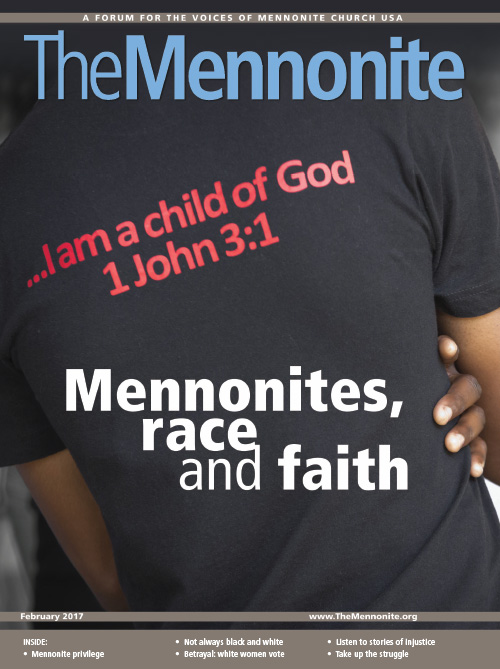
Hannah Heinzekehr is the Executive Director of The Mennonite, Inc. This editorial appeared in the February 2017 issue of The Mennonite magazine, focused on Mennonites, race and faith.
Christianity has had great moments where it could have effected great social change at a quicker rate, but people were afraid.— Reverend Susan K. Smith
These words have hovered in my mind since I spoke to Rev. Smith several weeks ago. She is one of more than 50 Christian leaders who have signed onto the Call to Protect All Peoples. Rev. Smith noted that when it has come to key moments in the struggle against racism in the United States, white Christians, and the Christian church as a whole, have missed opportunities to speak out and stand up on behalf of people of color and against racism, often out of privilege, fear or ignorance.
Her words echo those spoken by Mennonite leaders of color. In a 1958 editorial in The Mennonite, Mennonite pastor Vincent Harding wrote: “So above all, the question I wish to raise is this: Can Mennonites afford to be die Stille im Lande in the face of today’s American tragedy? Is it possible for any group which takes seriously its Christian faith to be silent at such a time as this?”
Harding spoke extensively at Mennonite congregations and conventions on “the race problem,” exhorting Mennonites to join the Civil Rights Movement and drawing connections to Anabaptist commitments to nonviolence to provide the impetus for engagement. Eventually, Harding left the Mennonite church. Lupe De León and John Powell, two leaders from the Minority Ministries Council, both left the Mennonite Church at one point over frustrations with its inability to adequately listen to and address the concerns of Mennonites of color.
And more recently, Cyneatha Millsaps, pastor of Community Mennonite Church in Markham, Ill., wrote a plea for the church to engage the Black Lives Matter movement: “The question for the Black Lives Matter movement is not whether black lives matter to God; we know black lives matter to God. The question is whether or not the world realizes that black lives matter.”

And Carlos Romero, Executive Director of Mennonite Education Agency, urged the church not to be silent in the face of renewed racism and hate in our church and country: “How can we be silent when we are the voice of Christ, speaking justice to the nations, breathing love to all the earth? My brothers and sisters, let’s move forward with the commitment that we will not be silent, with the realization that the work of healing a broken country and world must begin with us.”
These words from church leaders also remind me of Martin Luther King Jr.’s 1963 “Letter from a Birmingham Jail,” where he states that the great “stumbling block in the stride toward freedom” for black people is not “the White Citizens Councillor or the Ku Klux Klanner but the white moderate who is more devoted to order than to justice, who prefers a negative peace, which is the absence of tension, to a positive peace, which is the presence of justice.”
Time and time again, leaders of color have called on white Mennonites and church institutions to be bold and to place our bodies and resources on the line in the struggle for justice. MC USA’s Purposeful Plan, its guiding strategic docment, lists “undoing racism and advancing intercultural transformation” as one of seven priorities. But too often this priority can become just words on a page.
Soon after I wrote the original draft of this editorial, I traveled to Hampton, Virginia for two days of meeting with leaders of color at the Hope for the Future gathering. In the session focused on the Black Lives Matter movement, those of us who were white heard a clear call from our siblings of color that it is time for us to speak up and to join the movement to resist racism not only in our world at this particular political moment, but also in our church.
Prior to being joined by members of the white caucus, leaders of color developed this definition of what a peace church is and does: “A peace church recognizes the imago dei in all humanity. It not only prays, it takes action. A peace church responds to violence inside and outside its doors. A peace church stands with Black Lives Matter, Standing Rock, LGBTQ people, immigrants and against all forms of violence. A peace church empowers disfranchised and marginalized people. It understands multi-faceted forms of violence—systemic, educational and environmental. It is more than the absence of war or the protesting of war.”
In Galatians 3:28, Paul writes, “There is no longer Jew or Greek, there is no longer slave or free, there is no longer male and female; for all of you are one in Christ Jesus.” This is not a call for us to ignore one another’s differences. As we are shaped by different cultures, our fellowship and witness become more robust. This is a call to remember that each of us was created good and is cared for within Jesus’ ministry and our actions as a church should witness to this in a myriad of ways.
However we choose to engage, whether through joining public protests, naming racist speech when we hear it, joining a community organization addressing the effects of systemic oppression, praying, learning more about the history of racism in our country and in our church, reading books and engaging films written and directed by people of color, or some other way, those of us who are white must find ways to actively engage anti-oppression work. We need to educate our children about privilege and equip ourselves to be good allies. We need to start making connections between oppressions and exploring intersectionality, a term coined by Dr. Kimberle Crenshaw to describe the ways various forms of oppression intersect and contribute to marginalization. It’s (past) time for us to heed the words of our siblings in Christ who have been calling us to take up the struggle for decades.


Have a comment on this story? Write to the editors. Include your full name, city and state. Selected comments will be edited for publication in print or online.