


Life in First Nations reserves can be tough. According to the Government of Canada, a “reserve is a parcel of land where the legal title is held by the Crown (the government of Canada) for the use and benefit of a particular First Nation.” Even in dry reserves, alcoholism across the population seems to be a prevalent issue.
Substance-related accidents and suicide rates among young people are high in such communities as well. Isolation and distance from main city hubs also drive grocery prices extremely high. This contributes to unhealthy eating habits that add to high incidence of diabetes and cardiovascular diseases, which are significantly higher in these communities compared to the overall population.
Yet not all is grim on the reserve. In fact, spending a few weeks in a couple of these communities has been renewing and refreshing.
Notwithstanding seeming like a rough place to live, reserve residents asserted that they deeply miss their community when they are away, even for a day. Despite their issues (and the drama that happens on the Facebook groups, I’m told), the communities are very close knit. Everyone knows everyone and is related to everyone. Even more amazing, everyone helps everyone when in need. The reaction/waiting time for someone to come and help might be less than five minutes (as I found out a few times when I got a vehicle stuck in the snow).
There is definitely much I want to say about the very real struggles I witnessed (and experienced myself) about living in the reserve. I also want to be careful not to romanticize a context that must be seen as the full picture. However, I want to recognize the uniqueness, care, faith, rootedness and beauty of the life that is lived by people in First Nation communities like the ones I visited in northern Manitoba.
1. Uniqueness
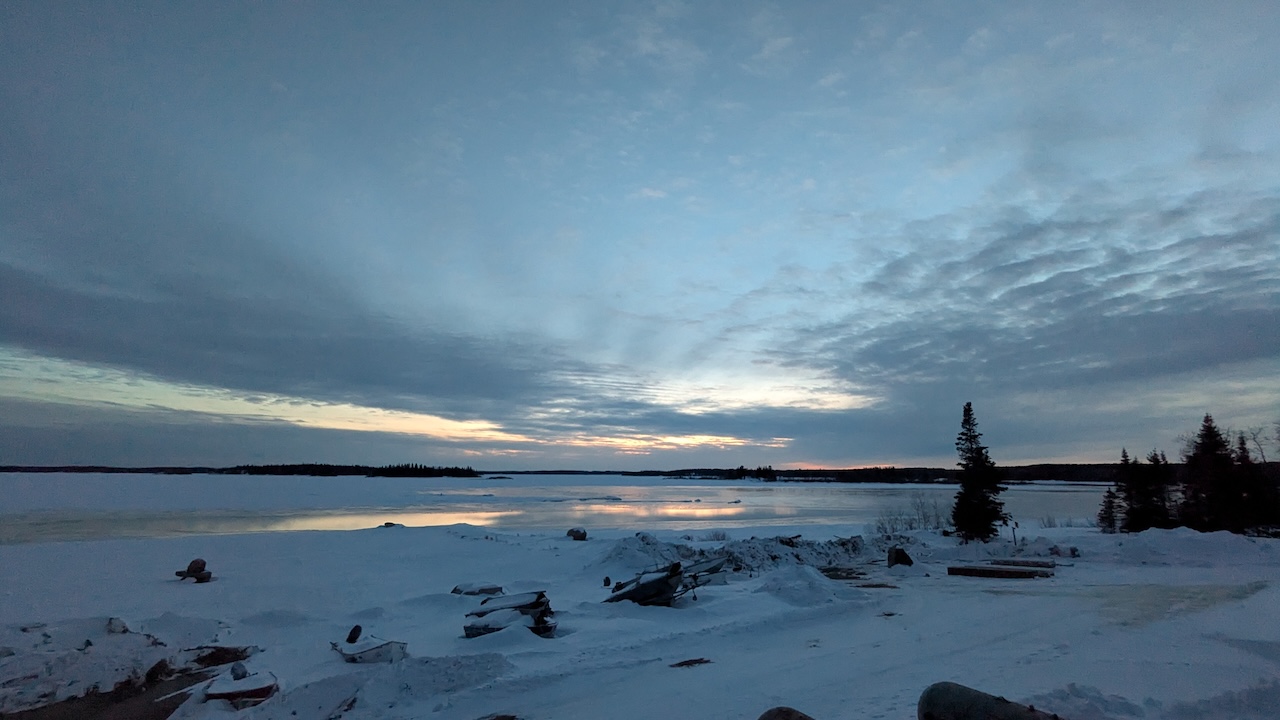
There aren’t many places in the world, I think, where people’s mode of transportation for a good part of the year is driving on a frozen lake. Anticipating the lake to freeze over for the winter to be able to come and go, rather than boating twenty-odd kilometers to a neighboring community where there is an airstrip to fly down to the city, like how it has to happen in summer, is something unique to some of these northern communities. Surrounded by rock, lakes, bush and wildlife, the reserve is a world of its own.

2. Care
Depending on the reserve, the communities can vary widely in size and numbers. Yet one can expect for residents to be well connected and familiar with each other. In some communities, every member of the family will be known by name by others and be a registered member of the band. (In others, like in Mennonite circles, a last name and a family connection will be needed to place an individual.) Nevertheless, everyone is cared for by others in the community. Even visitors like me are well looked after. But it was amazing to witness how neighbors knew when someone had been taken to the city for treatment or medical emergencies and therefore was not at home.
3. Faith
If you were to ask folks if they are religious, the majority of people on the reserve would say no. Yet, many of them do pray or admit believing in something. Some of them even go to church and read the Bible. However, defining what they believe in and self-identifying as something, even as a Christian, is just not a priority. There just isn’t anything to prove, or anyone to prove it to. If they believe or pray, it’s their relationship with Jesus that matters, one person told me. Another family told me that they read the Bible to guide their decisions. The husband and father of two has been sober for over three years. As I sat in their lovely home full of family pictures, two of their children randomly came and hugged each of their parents as I interviewed them. It seemed to me that their faith and love shone through their relationship with their children.
4. Rootedness
First Nations communities have been in Canada (also known as Turtle Island, although this is a term that would translate better as North America) for millennia. Some communities have lived in the same land as their primitive ancestors. Others, however, were displaced during the colonization period and over the following centuries.
Even as recently as a few decades ago, communities have been displaced owing to government projects, gentrification and racist policies, among other reasons. Nonetheless, this doesn’t impede First Nations peoples from maintaining a connection to the land and a lively oral history of their relationship to it. Folks on the reserve will talk about whose house it was before it became the current owner’s, and remember several generations back and when their families first arrived at the reserve.
5. Beauty
I drove to the end of the road one day. It wasn’t hard to do, because there aren’t that many miles to drive before the unpaved, snow covered road ends. On many reserves, the end of the road is at the dump, which is an odd place to find beauty. Yet, here there was a huge gathering of crows and ravens. Ravens in the North can easily rival the size of hawks or even eagles; both of which can also be spotted at the dump. In the summer, I am told, the dump is also visited by black bears who hibernate during winter. Snow is still falling in these parts of the world. The sight of it makes even sites like the dump look magical. Of course, there is more beauty than that in these places, but I thought that if I could help you picture the beauty of even the community dump, the rest of it would not be hard to picture as beautiful!


Have a comment on this story? Write to the editors. Include your full name, city and state. Selected comments will be edited for publication in print or online.