


The president of Germany praised Anabaptist values at a Baptist and Mennonite worship service commemorating 500 years of the Anabaptist movement. Mennonite representatives used the opportunity to stress the importance of welcoming refugees and resisting militarism.
“Today, 500 years later, we celebrate this small, diverse community that brought great ideas into the world,” Frank-Walter Steinmeier said in his address Sept. 21, the International Day of Peace, at Baptist Christ Church in Hamburg-Altona.
The president is Germany’s head of state, a ceremonial figure. The chancellor, Friedrich Merz, is the elected head of the federal government.
Steinmeier emphasized that Anabaptists are part of Europe’s history of freedom and that democracy thrives on citizens who take responsibility for their community and work to shape it.
“Those who believe and act with maturity do not only think of themselves but always assume responsibility — for themselves, for others and for the common good,” he said. “. . . Dear representatives of the Anabaptist community, you carry on a precious legacy. Your tradition of nonviolence, civic maturity and freedom is a gift to our society. And I am experiencing here in Hamburg-Altona today just how seriously you take this responsibility. Where others look away, you open the doors. This is neighborly love in action — but also practical democracy.
“For this, I thank you from the bottom of my heart and say: Our democratic constitutional state needs your voice, your values, your example, your connection to our country and its people.”

Steinmeier highlighted Anabaptism’s witness for peace. Though modern democracies protect their freedom with militaries, the ideal of nonviolence remains indispensable.
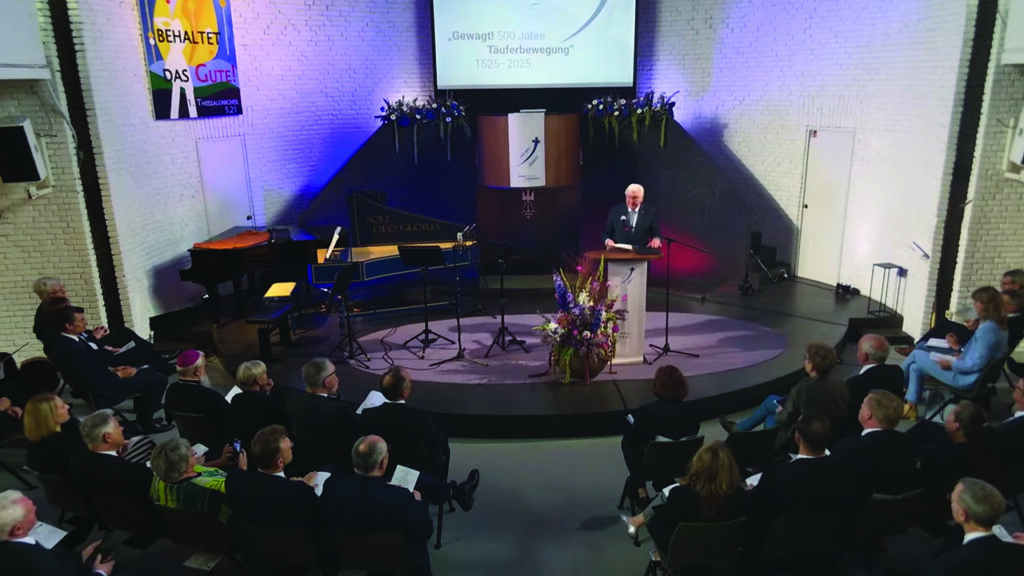
“It is right to stand up for one’s convictions, but peacefully,” he said, citing the example of courageous nonviolence in the Peaceful Revolution that marked the end of the communist regime in East Germany, leading to German reunification in 1990.
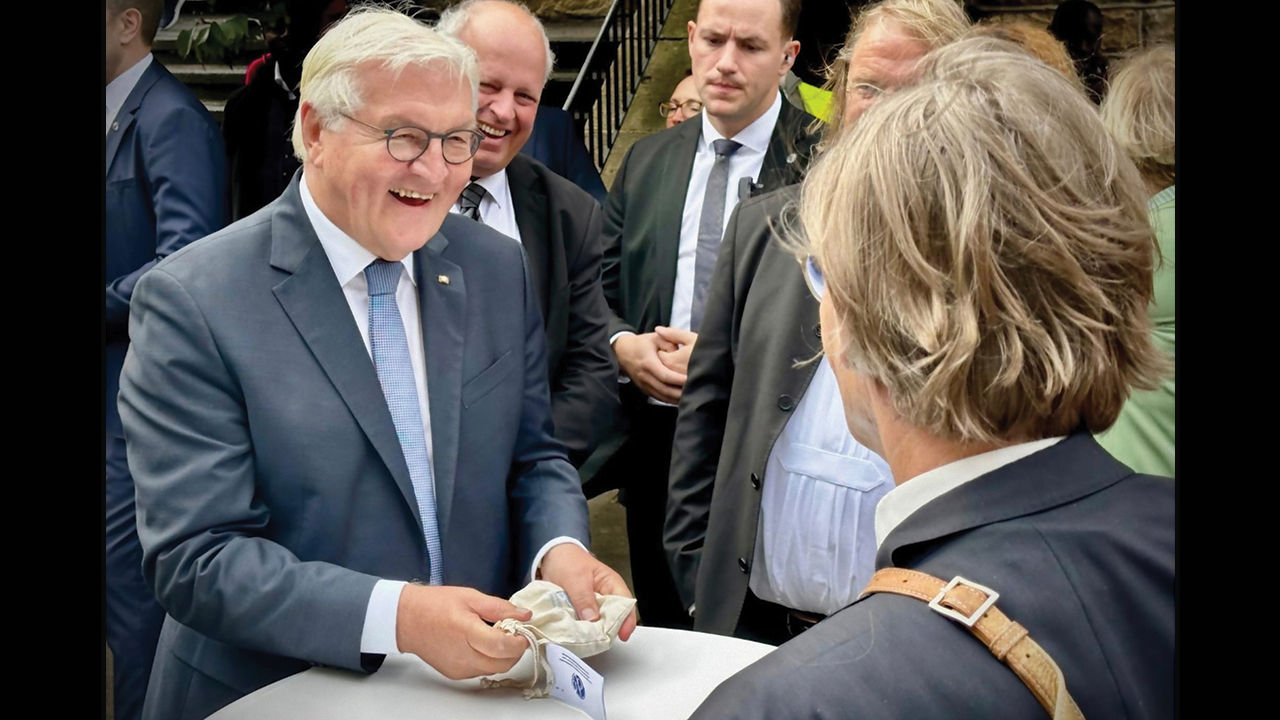
After the service, Steinmeier exited the church for an informal chat with four people representing Baptist and Mennonite congregations.
Sigrid Wiebe of Hamburg shared her experience of fleeing from West Prussia in present-day Poland to Germany’s Schleswig-Holstein region as a 5-year-old. Her father died in a prisoner-of-war camp.
Jule Quiring and Walter Jakobeit introduced themselves as residents of Neuwied, which is home to about 10 Mennonite and Mennonite Brethren congregations and is characterized by tolerance and diversity. Jakobeit is a retired MB leader, and Quiring is a girl from an AMG congregation (Association of Mennonite Congregations in Germany).
Mennonite pastor and historian Bernhard Thiessen presented the president with a small sack of Turkey Red wheat and said its significance spans multiple continents.
“When the Prussian authorities introduced conscription for all male inhabitants in the second half of the 18th century, many Mennonites answered the call of Empress Catherine II and settled in the territory of present-day Ukraine,” he said. “There they found this winter-hardy wheat.
“A hundred years later, when the then-reigning Russian czar also decreed conscription, Mennonites took this nutritious wheat, hid it in their hems and clothing and fled to North America, where they were accepted as refugees. Thus, for us today, it stands as a warning against militarization and a call to accept refugees.”
In the Netherlands, farmer Menno de Vries worked to identify a strain of wheat similar to that brought to North America by Mennonite immigrants. In 2018 he sowed the seed in Witmarsum, the birthplace of Menno Simons. He gave part of the harvest to the German Mennonite Historical Society, which made it available for a project at the Kohlhof farm in Germany’s Palatinate region.
Farmers Dieter Backes and Daniel Hege offered the 2025 harvest to be processed into bread by Lulu and Willi Blickensdörfer at the Kohlhof farm’s bakery. Thus, a centuries-old grain returned as a sign of the perseverance of Mennonite communities in their search for a peaceful existence.
Thiessen concluded his comments with the president by stressing the need to accept refugees, a sentiment that is not as popular as it used to be with the rise of anti-immigrant right-wing political groups.
“We can do this!” he said, bravely quoting a phrase well known to Germans after Chancellor Angela Merkel coined it in 2015 when Germany opened its doors to hundreds of thousands of refugees.
The president is skeptical that this is still possible, but Steinmeier noted that he was part of the government in 2015 when asylum seekers came to Europe fleeing Syria’s civil war and instability in Iraq and Afghanistan. A majority flocked to Germany because of its immigrant-friendly Willkommenskultur (welcome culture). But a series of assaults blamed on migrants from Muslim-majority countries the following year gave rise to anti-immigrant polarization.
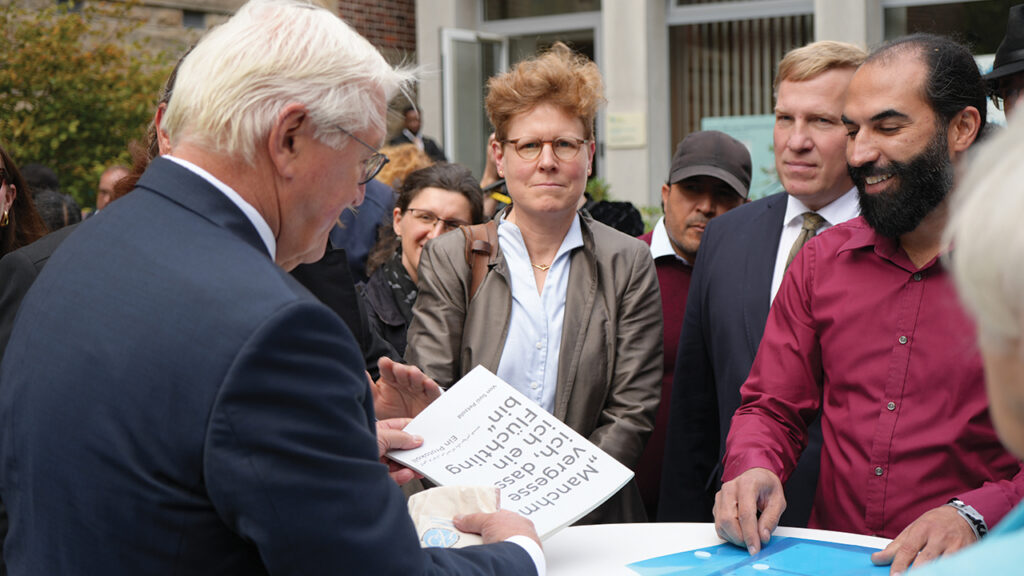
Thiessen then pointed to the person to next to him — Victor Pejman Banakar, who came to Germany from Iran as a Persian refugee in 2014 — and said: “This brother from the Baptist church is wonderfully integrated!”
Banakar told Steinmeier of the positive experiences he had upon arrival and how grateful he is that the German people and the German state have welcomed him.
He presented the president with an account of his refugee experiences written in German under the title Sometimes I Forget I Am a Refugee.
This article was based on reporting by Bernhard Thiessen in Die Brücke, the denominational magazine of AMG, the Association of Mennonite Congregations in Germany.


Have a comment on this story? Write to the editors. Include your full name, city and state. Selected comments will be edited for publication in print or online.