


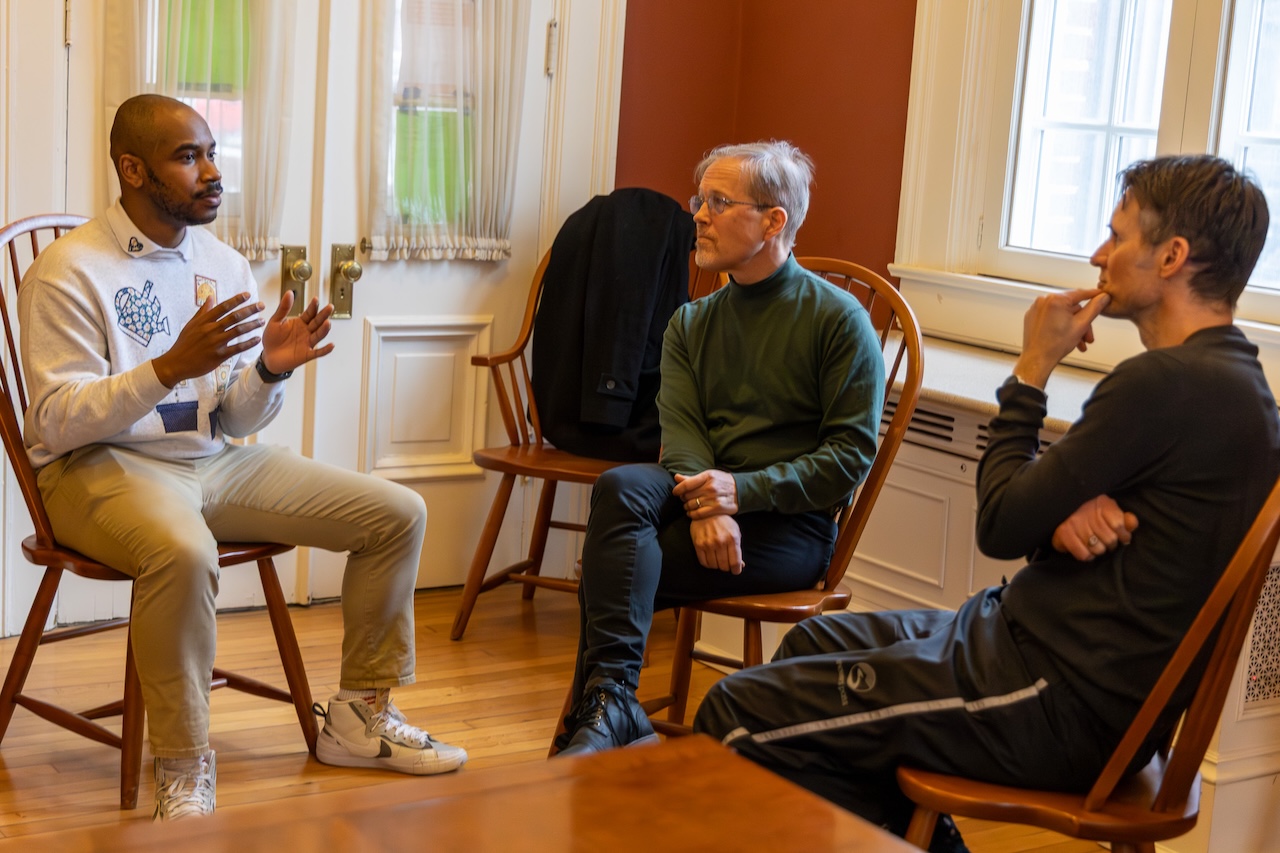
In 2025, we started working as facilitators for a series of discussions on healthy masculinity for the Lancaster (Pa.) YWCA. We approached this topic not as experts with ready answers, but rather as explorers grounded in our own personal journeys and facilitators to create the conditions for others to discover with us.
We spoke to pastors, therapists, teachers, feminists and, of course, men in our circles about what healthy masculinity means for them, followed social media content and reviewed curricula. Two of the more challenging opinions that we heard were, “Why are you only inviting men’s opinions about healthy masculinity? Don’t women have something to say about that too?” and “I gave up on defining myself in relation to masculinity.”
Starting late in 2025, we host monthly public groups with topics that the participants identify as priorities. It’s important to us that we use welcoming language that doesn’t turn off potential participants with a more traditional understanding, but we are still working on building those bridges. We also aim to talk about masculinity in a way that doesn’t assume that masculine and feminine identity fits for all, but neither denies that these identities are tangible and important for many.
Healthy masculinity is a growing movement. For example, in our community of Lancaster, Pa., there are numerous community men’s groups. It’s important that proponents of healthy masculinity groups, including us, aren’t denying the reality of toxic masculinity or patriarchy. Rather these are efforts to define, assert, understand, practice and find allies working on a positive masculine identity. Fully feeling and not suppressing emotions and vulnerability are key beginning points.
Collectively as a society, we are in a moment where men are behaving badly, and masculinity as a shallow performance of strength, bravado and domination is widely present. For some, this is a desirable return to the way things were and should be again. We think rather that these are signs of insecurity in the face of feminism and a loss of male privilege, and an opportunity for more intentional articulation of very different understandings of masculinity.
In many discussions, participants in our groups identify practicing healthy masculinity in families (as parents, as children, and as partners), at work and in friend groups as their top priorities. New approaches are particularly challenging for those that didn’t have positive role models. We’ve been asked how helpful a distinct healthy masculinity is, versus more a universal view of simply people with a healthy understanding of themselves and their identities.
It is helpful for Anabaptists pursuing healthy masculinity to start with an acknowledgment of the history of male-dominated leadership, denial and suppression of sexual abuse and exclusion of those that experience masculinity and gender differently. A key resource is the reading of the gospel as a call to nonviolence and liberation.
Without accepting violence as a key element of masculinity or accepting making war as a key ritual of male initiation and bonding, Anabaptists can be more easily free to create a new healthier masculinity. Finally, the fundamental unit of Anabaptist faith life — a congregation of believers with a common understanding of the gospel — means there is a potential for congregations to be cells of liberation, including healthy masculinity.
What can congregations do to be part of this movement? The many existing men’s groups are a natural space to open questions such as “What is healthy masculinity?” and “What are we grappling with about male identity?” Yet, we have persistently heard that some find it difficult to openly address sensitive and personal topics in church groups and yearn for something deeper.
Richard Rohr points to a current general lack of initiation rituals that enable developing maturity and a male spirituality that embraces intimacy, surrender, patience and trust. Congregations can strengthen the ritualistic aspects of baptism, offer blessings for new periods of education and service and provide mentorship with attention to gender identities for young men, young women, and non-binary youth. Congregations should stay aware of what is happening in their communities that aims to address this moment and ask about the undergirding spirituality and theology. In some cases, these spiritualities and theologies are either very secular or traditional and are not aligned with Anabaptist understandings.
We think that the growing use of the term healthy masculinity should be seen as a sign of increasing awareness and intention on the part of those who use it. Raising the question of what healthy masculinity means and how to foster more of it in ourselves, our families, our congregations and our communities is itself part of a process of creating a healthier masculinity.
You can financially support this work of the YWCA Lancaster at https://ywcalancaster.org/. The authors can be reached at [email protected].


Have a comment on this story? Write to the editors. Include your full name, city and state. Selected comments will be edited for publication in print or online.