


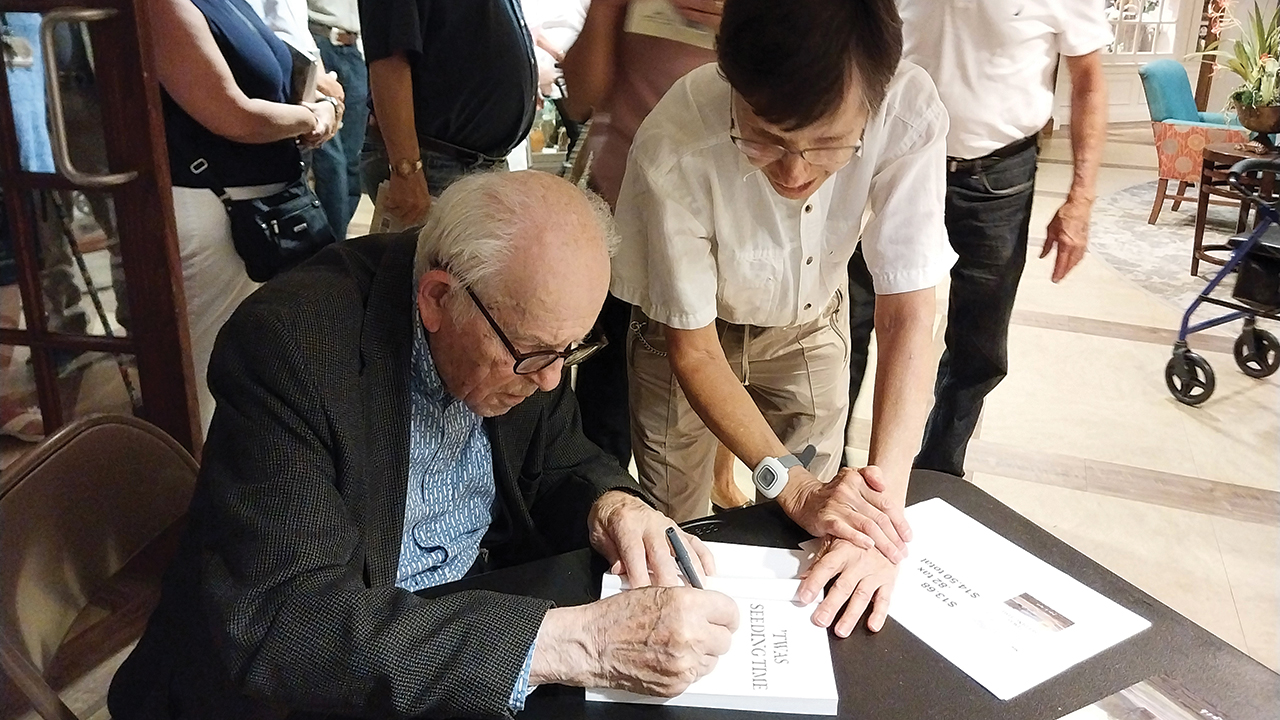
John L. Ruth wrote ’Twas Seeding Time: A Mennonite View of the American Revolution because he couldn’t find stories about his eastern Pennsylvania Mennonite community and the American Revolution in history books.
Originally published by Herald Press to coincide with the U.S. Bicentennial in 1976, the book describes challenges the oldest community of Mennonites in North America faced as defenseless Christians during a time of polarization and war.
Forty-nine years later, as the nation’s 250th birthday draws near, ’Twas Seeding Time has been republished by Sermon on the Mount Publishing. Andrew Ste. Marie, owner of the press, said one of his friends assumed Mennonites had supported the Revolutionary cause and was surprised to learn most had not.
At a book launch on July 18, Ruth addressed an audience of more than 110 people at Souderton Mennonite Homes in Pennsylvania. He said Mennonites faced fines and property seizures for refusal to participate in the war. But Mennonites also experienced internal division because of the war.
Mennonites had promised their loyalty to the British king when they came to the colonies. Some thought going back on their word would be disobedient to God. Others, like Christian Funk, noticed the new Pennsylvania Constitution allowed freedom of worship and saw possible good in the new government. Most Mennonites felt Funk was too concerned about political matters.
The disagreement caused division among the Mennonites, and Christian Funk and others formed their own group.

“We split, and so did the country,” Ruth said.
The new edition includes illustrations and a recent meditation by Ruth. He reflects on the significance of how an ex-Hessian soldier who married a Mennonite became a Fraktur artist.
“It was not Henrich Brachtheiser’s . . . bayonet that would be his adopted people’s testimony, but words he feathered on fragile paper,” Ruth wrote.
The Fraktur, reproduced in the new edition, illustrates John 13:35: “Thereby will everyone know you are my disciples, if you have love for each other.”
— Eileen Kinch/Anabaptist World
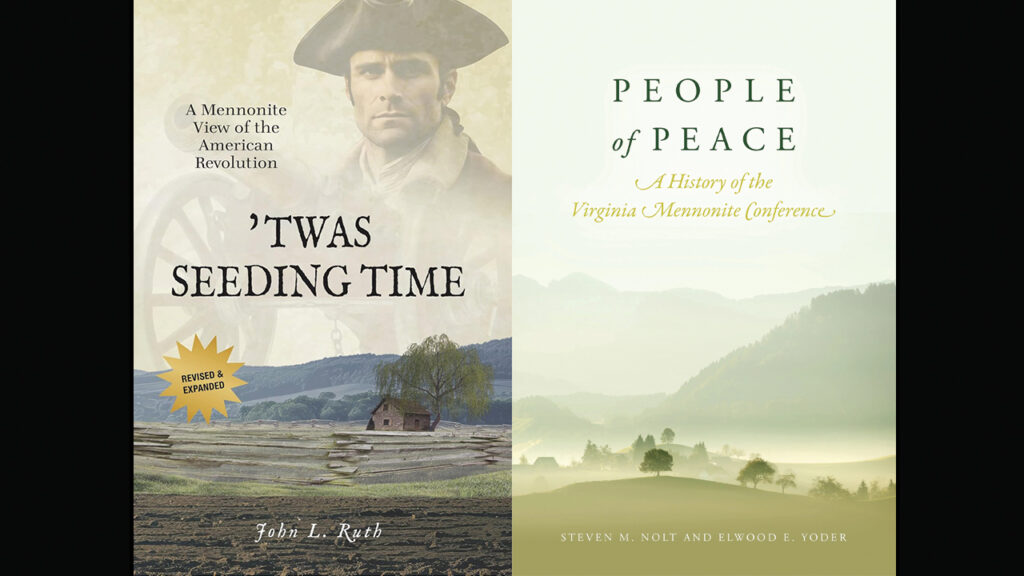
If you want to know when Weavers Mennonite Church of Harrisonburg, Va., purchased a piano, this is the book for you. Which is not to say that this fact is trivial, but simply that some of the details within People of Peace: A History of the Virginia Mennonite Conference (Masthof Press) will be of greater interest to certain Virginians than to others.
Authors Steven M. Nolt and Elwood E. Yoder cite Weavers’ 1980 piano purchase for a good reason: It illustrates the persistence of unaccompanied four-part singing even after the conference lifted its ban on musical instruments. Virginia Conference’s impact on the singing heritage of the broader Mennonite Church is just one of many points of interest within this comprehensive history, which extends from the arrival of Mennonite settlers from Pennsylvania in the 1720s to the present.
As the only Anabaptist community in the antebellum South and the wartime Confederacy, Virginia Mennonites barred slaveholders from church membership. In the mid-20th century, the evangelistic campaigns of revival preacher George R. Brunk II made a nationwide impact. In the 1990s, the question of whether military people could become church members sparked debate. The experience of Glen Guyton, current executive director of Mennonite Church USA, who left the Air Force as a conscientious objector and joined a Virginia congregation in 1993, is a part of this story. The end of spiritual oversight by bishops and a move toward congregational polity contributed to a trend of fragmentation that has extended into the 2020s.
— Paul Schrag/Anabaptist World


Have a comment on this story? Write to the editors. Include your full name, city and state. Selected comments will be edited for publication in print or online.