


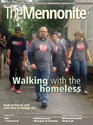
Hugh Hollowell has traded worldly wealth for the riches of homeless ministry.
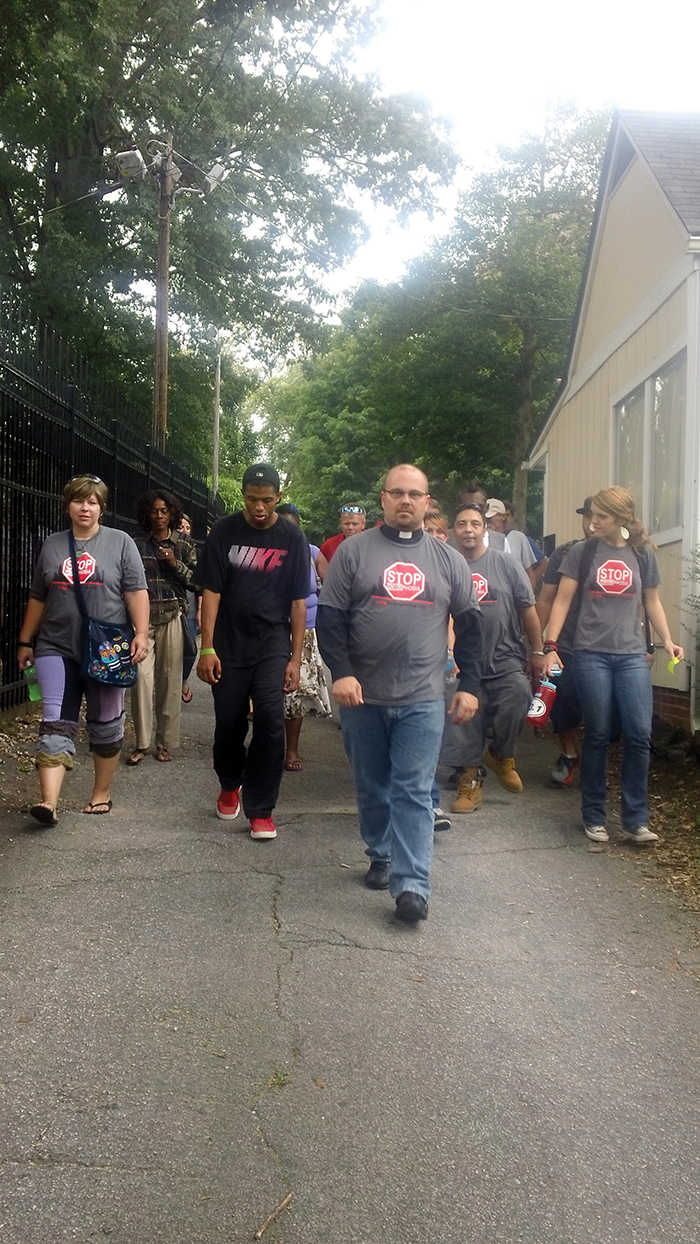
In his late 20s, says Hugh Hollowell, a driven and restless stockbroker, he began reading about the Anabaptists and their Jesus-centered approach to gospel living. As he devoured such books as The Politics of Jesus, The Anabaptist Vision and Engaging Anabaptism, he was shaken to his core.
He grew up poor in the tiny backwoods Mississippi town of Byhalia and joined the Marines to better himself, which eventually led to seeking his fortune in Memphis. As the stack of finished books grew higher, he realized how unhappy and unhealthy he had become in chasing the American dream. And though he was raised in an evangelical-oriented Methodist church, his reading uncovered how deeply he resonated with the Anabaptist faith perspective on caring for the poor and seeking to address injustice.
“The Marines paid for my college, after which I got involved in sales in the financial industry,” he said in a mid-June telephone interview. “I was a poor kid who was making a lot of money, but I was miserable. I was throwing up blood and had ulcers and was drinking way too much. I was forcing myself to be something I was not in a field rife with ethical issues.”
After a year of reading, he was troubled by the huge disconnect between his beliefs and his deeds. “I abruptly quit without knowing what I was going to do next,” he said. “I was climbing the wrong ladder and leaning against the wrong wall. The Anabaptists helped me see that Christianity is not so much about life after death but about following Jesus in this life. At 30, I decided to start over.”
His first step in starting over was buying a used book store in Memphis, where he read books from the store’s shelves on homelessness. He also volunteered with ministries that served people experiencing poverty and homelessness.
After four years, he sold the bookstore and moved to Raleigh, N.C. That’s where in 2007 he founded Love Wins Ministries in order to become a pastoral presence of unconditional love for those experiencing homelessness and housing insecurity. About a year later, he became part of Raleigh Mennonite Church (RMC), where he was licensed and ordained for special ministry to the homeless through Virginia Mennonite Conference in Mennonite Church USA.

Forging hospitality of the heart
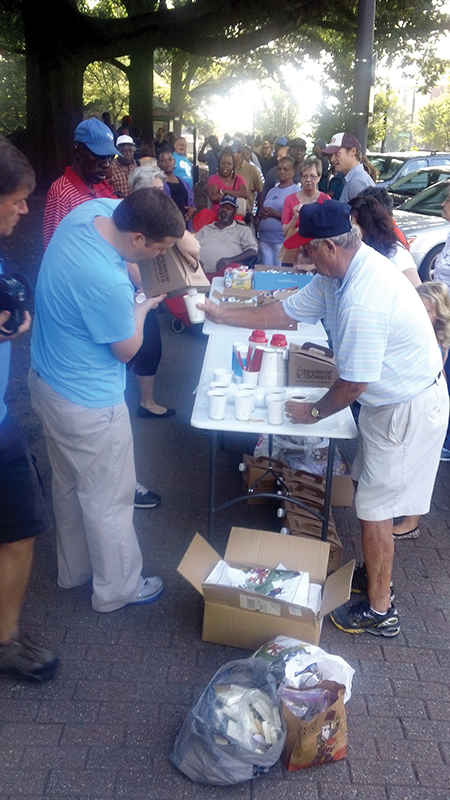
The more he worked with people and read about homelessness, the more he realized that the only thing keeping any of us from homelessness is our relationships, he said. So he shaped Love Wins around the building of relationships and community and only those programs that are entries into relationships. The ministry runs a Hospitality House, shares a biscuits-and-coffee breakfast every Saturday and Sunday morning, provides advocacy and community education and holds a Sunday afternoon worship service.
Hollowell, also a writer and a blogger, is executive director of this fast-growing ministry. What began as no-budget, goodwill visits to soup kitchens and parks has morphed into a yearly budget of $250,000. It’s informed through blogs and other social media and fueled by a wide net of individual and group donors. It supports several staff members and engages volunteers from many area congregations.
The staff strives to befriend those without homes and educate those with homes about the need to heal the lonely heart. It’s only by planting seeds of belonging and connection that the fruits of financial, emotional and social stability and skills can eventually grow, he said. Homelessness is a relationship problem, and its symptoms are hunger and lack of housing, education and jobs.
“Studies show that those who are involved in church or have other strong social networks almost never become homeless,” he said. “And those who have been homeless for more than a year never leave homelessness without developing a social network. For example, homelessness is nearly nonexistent among Mennonites and the Amish. And if my wife threw me out, I already know three people I could call who would let me sleep on their couch. I would not need to find a shelter.”
Hollowell illustrates this by telling the story of his homeless friend Peggy. She is a crack addict and does not have any money. She trades sex for drugs, and transactions can get violent. She ends up in the hospital three or four times a year as an assault victim. He recalls, “One morning three or four months after we first met, I got a phone call at 6 a.m. from Peggy, who tells me she is in the emergency room. I lived only 10 minutes away, so I offered to throw on some clothes and come sit with her.”
Peggy said not to come because she would be released soon. When he asked why she had called him then, she said, “The nurses say to me, ‘Peggy, honey, is there anyone you could call?’ Before I knew you, I could not come up with a name. But tonight in the ambulance, when they asked me that question, I said, ‘Hugh. You can call Hugh.'”
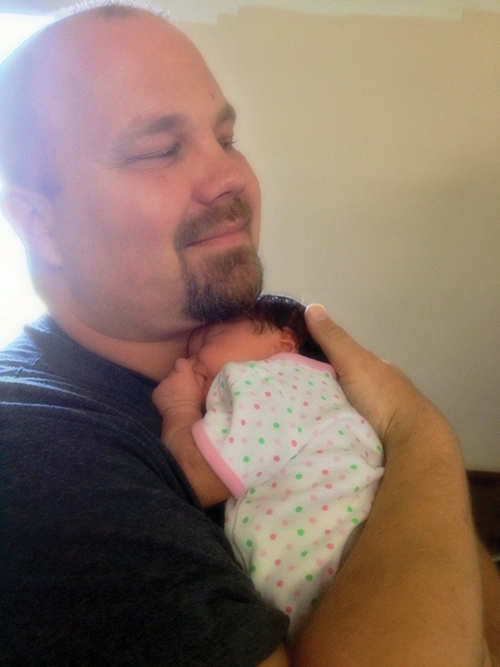
Hollowell believes Peggy felt safe to call because she sensed he had no agenda to fix her. “To this day, Peggy is still trading sex for drugs,” he said. “She has not miraculously become a paragon of virtue. She is still Peggy, with all her warts and frustrations and problems. I wish I could tell you that because of my work she is going to change. I hope she will someday respect herself and want to be sober, and I pray for that to happen. But one thing I do know is that at least one time when she was scared and alone, she had someone to call. I do not know if that is success or not, but it will have to do until other things come along. At Love Wins, we are giving people a place to call when there is no one else to call.”
Counting people, not numbers
Despite the humble hiddenness of much of the ministry, Love Wins was thrust into the national public eye last summer. That’s when Raleigh police on Aug. 24 stopped staff members and volunteers from serving Saturday biscuits and coffee on sidewalks outside Moore Square, a downtown park—something they had done for six years. “Biscuit Gate” spread like wildfire through news channels and social media around the world. Public outrage forced the Raleigh City Council to give up its opposition. As a follow up, the city paid for renovations to an empty warehouse that now serves as a downtown gathering space for the homeless.
“We could have spent all our resources in dealing with the buzz, but we still had 100 people coming through our Hospitality House doors every day to do laundry and make a sandwich and look for socks,” said Sara Acosta, director of communications for Love Wins, during a mid-June telephone interview. “At the end of the day, we are not politicos. At the same time, we are now being taken more seriously and are no longer seen as a baby, grassroots nonprofit.”
As a result of the incident, new eyes are watching for how many homes and jobs are gained each year, Hollowell said. But he and the staff resist quantification. Their mission is that of loving people, one person at a time, in order to sow seeds of potential stability in the soil of relationship.
“In a church, when someone gets sick and dies, casseroles are brought to the home,” he said. “But congregations don’t focus on the numbers of casseroles shared, because casseroles are the side effect of being in community. Similarly, Love Wins is not about projects and numbers but about people. We have baptized three people this year. And in the last 12 months 14 people have moved into stable homes and 25 people have gotten jobs. But those are the casseroles and are not what we are measuring.”
Nevertheless, the ministry’s relational fruitfulness is undeniable. Up to 100 people each on Saturday and Sunday enjoy the breakfast giveaway. And up to 100 people each weekday come through the Hospitality House on West Jones Street to fix a sandwich, do laundry, get a haircut, chat with friends, receive pastoral care, use the telephone, connect with free WiFi and replenish hygiene items.
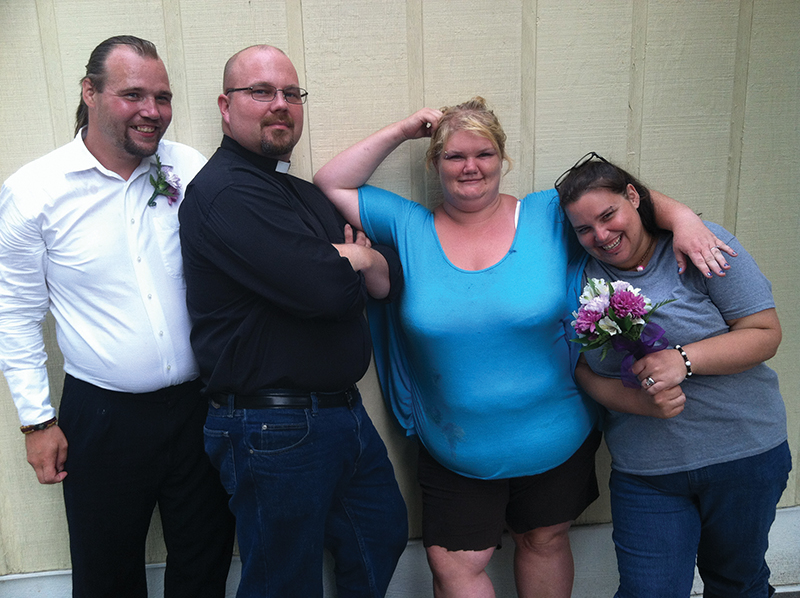
Several dozen people come to the house chapel for a 3 p.m. Sunday worship service to experience the hope and love of God in a nonjudgmental environment. Hollowell even officiated a wedding for Darius and Sonya, who at one time lived in a condemned house. Now they have their own home and have bought a second car. They both work. Darius is pursuing his CDL license. Sonya is getting ready to go back to school.
The ministry’s advocacy and community education also isn’t quantified but casts a wide net of influence. Staff members on behalf of their homeless friends talk with doctors, intercede with families, mediate broken relationships and speak in court. And staff members educate people at schools, churches and other community groups about how to best serve their neighbors who are suffering.
Local Mennonite church home for Hollowell
In the ministry whirlwind, Hollowell said he seeks rest at his spiritual home in RMC. It’s where he and Pastor Duane Beck have forged a supportive friendship. RMC is also where Hollowell meets with a support group that includes Beck and Al Reberg, who is also tackling economic justice issues. Even though no one at RMC currently volunteers for Love Wins, the congregation provides yearly financial support and serves as a theological touchstone that grounds Hollowell’s passion for ministry.
“Hugh is a real gift to us,” Beck said during a mid-June telephone interview. “He sees himself as a pastor to people who are homeless and as a missionary to congregations to help convert people’s attitudes about homelessness.
“Hugh is helping all of us middle-class folks feel more comfortable connecting with people on the street. Now when someone asks for a handout, I first greet them with my name and ask their name and shake their hand. Hugh’s relational emphasis is shaping how we deal with this issue.”
Beck said he is blessed that Hollowell and many others at RMC are engaged with ministries that don’t require formal programming on the part of the church. Rather, they are responding to an organic unfolding of personal call. Beck said he inherited this culture when in 2005 he came to serve where many in the church family were working for or volunteering at nonprofit ministries beyond the church.
“Hugh says it is really nice to be involved in a church where he is not seen as a Christian hero because he is working in a homeless ministry,” Beck said. “For example, one woman in our church is a midwife and volunteers in Africa to train other midwifes. He is grateful not to be put on a pedestal and feels like he doesn’t have to be somebody other than himself.”
Reberg said he considers Hugh to be a friend and a role model. “One of my favorite stories about Hugh is [about] when a woman came to ask him for money to pay the light bill,” he said. “She finally had a little place of her own but still was short on resources to pay that bill. At that time, Hugh did not have extra funds to help her financially and told her so. But she kept pestering him, until he finally told her that if they came to turn off the lights, he would come to sit with her in the dark.
“This story is at the heart of what Love Wins is trying to do—have genuine, loving relationships with folks without trying to fix them. So often we think we have to do things that are going to help, and then we want to measure our success in metrics. You can’t do that, and I’m glad Hugh doesn’t try.”
If Hollowell tries hard at anything, it is following hard after Jesus, depicted in the dozens of Anabaptist books he read as one who was not successful in the eyes of the world or his followers.
“I spent most of my 20s chasing success, and I was miserable until I realized that the Scriptures taught me that God does not call us to be successful but to be faithful. Was Jesus successful? He got killed. John the Baptist was beheaded. None of the prophets died well. None of the disciples died well.
Hollowell said the things that matter most to him are whether his friend Curtis has someone to call when he is drinking again or that when his friend Ramon gets evicted, he has someone to call to help him move. It’s when he can cheer on his friend Cassie, who decides to forgive the person she most hates.
“If what the Anabaptists have taught me is true, then I agree to open myself up to pain when I love like Jesus loved. Peggy is still trading drugs for sex. She is beautiful and smart and could be so much more than that, but she’s not. But if I love Peggy only when she does what I want her to do, then that is not the love that Jesus modeled—and the kind of love he calls me to share.”
Laurie Oswald Robinson is a free-lance writer in Newton, Kan., and the author of Forever Family.


Have a comment on this story? Write to the editors. Include your full name, city and state. Selected comments will be edited for publication in print or online.