


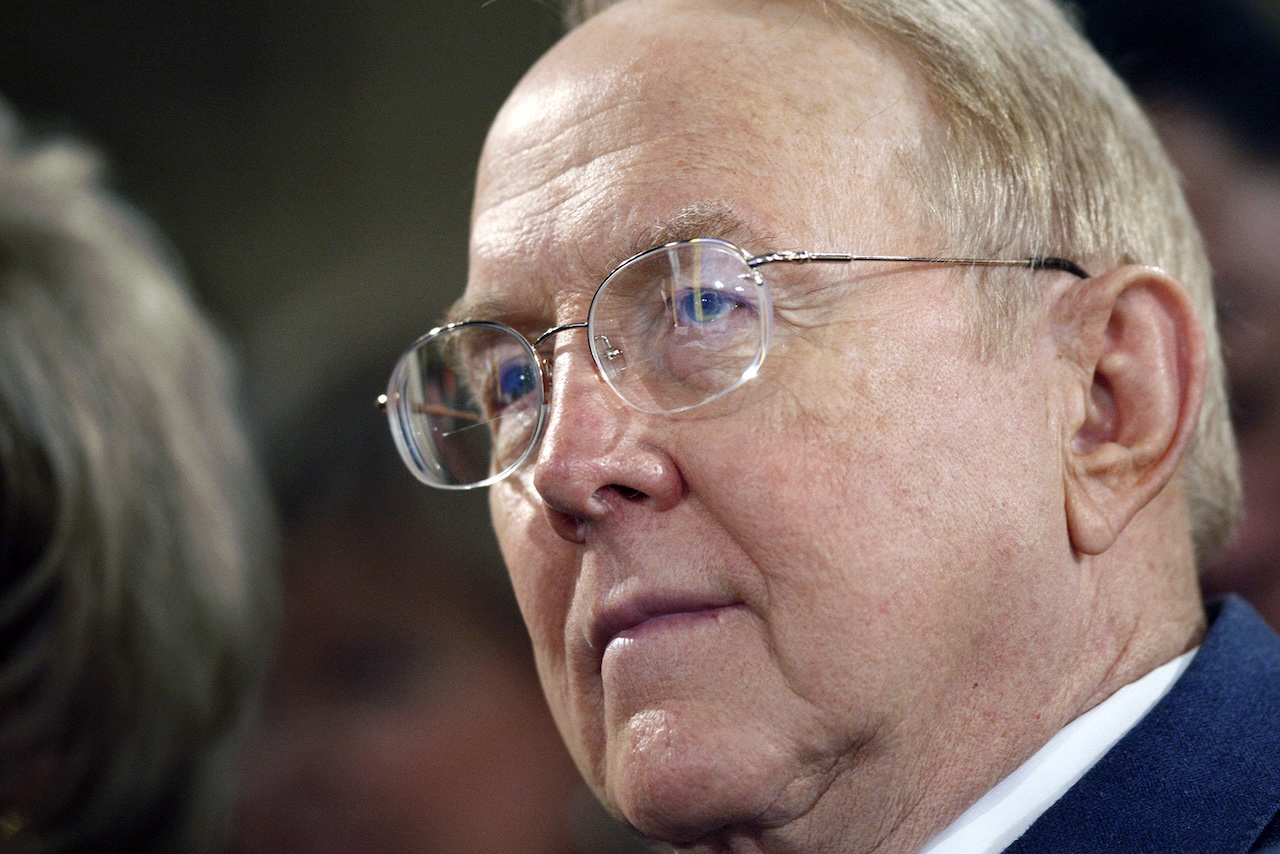
James C. Dobson, a psychologist who advocated a “family values” brand of conservative Christian morality on his popular radio shows and in his bestselling books, died Thursday (Aug. 21). He was 89.
A child psychologist by training, Dobson founded Focus on the Family in 1977 to promote conservative views on parenting, defending spanking of children as a means of discipline. The nonprofit, based in Colorado Springs, Colorado, became hugely influential, first among evangelical Christians and then among a broader public thanks to his internationally syndicated radio programs.
Dobson was heard on more than 4,000 North American radio stations and his show was translated into 27 languages in more than 160 countries, according to the website of the institute. His parenting precepts were further outlined in Dare to Discipline, a book published in 1992, and its many sequels. Dobson ultimately wrote more than 70 books, including The New Strong-Willed Child; Bringing Up Boys; Bringing Up Girls; and When God Doesn’t Make Sense.
As Dobson’s popularity with cultural conservatives grew, political leaders sought him out. In the 1980s Dobson was regularly invited to the White House to consult with President Ronald Reagan and his staff. In 1985, Dobson was appointed to Attorney General Edwin Meese’s Commission on Pornography.
In 1983, Dobson and Gary Bauer started the Family Research Council in Washington to advocate for pro-family policies.
Franklin Graham, who said Dobson died after a brief illness, hailed Dobson’s almost five decades of ministry. “Dr. Dobson was a staunch defender of the family and stood for morality and Biblical values as much as any person in our country’s history,” Graham, a son of evangelist Billy Graham, wrote in a Facebook post. “His legacy and impact for Jesus Christ will continue on for generations.”

Dobson’s unflinching conservativism rankled some Republican leaders at the height of his influence. During the 1996 presidential campaign, for instance, Dobson warned that any attempt to water down the anti-abortion plank in the GOP platform would result in widespread defection from Republican ranks by evangelical voters. He also objected to suggestions that the party’s presidential nominee, Bob Dole, choose a running mate who backed abortion rights.
But Dobson’s mark on conservative thought and evangelical Christian politics continues to this day. In 1994, he was one of the co-founders, along with evangelical luminaries such as Bill Bright and D. James Kennedy, of the Alliance Defense Fund, a legal organization now known as Alliance Defending Freedom. The ADF at one point employed Mike Johnson, who has since become U.S. House speaker, and it was a key proponent of the Dobbs v. Jackson Women’s Health Organization case, which resulted in the overturning of Roe v. Wade in 2022.
A Shreveport, Louisiana, native, Dobson grew up in Texas and Oklahoma, the son of an evangelist and pastor in the Church of the Nazarene. After graduating from a Nazarene college in California, Dobson earned a doctorate in child development from the University of Southern California. He then joined the pediatric faculty of USC’s medical school, where he taught for 14 years.
Dobson left academia in 1976, and the next year he launched Focus on the Family, beginning from a two-room suite in Arcadia, California. As Dobson’s radio show and the organization swelled in popularity, he increasingly became a force among conservative opinion-makers.
Yet, unlike prominent televangelists such as Pat Robertson, who ran unsuccessfully for president, and Jerry Falwell, a longtime conservative activist, Dobson initially focused on the power of persuasion and his listening audience, which at one time swelled to an estimated 200 million in 95 countries.
Unlike religious conservative activists such as Bauer, who would run for president as a Republican, and onetime Christian Coalition leader Ralph Reed, Dobson spoke less often to the secular media, an institution he blamed in part for what he deemed society’s moral decay.
But on his radio shows, Dobson easily switched from political topics to cultural and religious-based ones, always centering his concern on how Americans were raising their children.
“There is nothing more important to most Christian parents than the salvation of their children,” he once said. “Every other goal and achievement in life is anemic and insignificant compared to this transmission of faith to their offspring.”
Many of Dobson’s teachings about child rearing, on spanking in particular, were questioned at the time, and even younger evangelicals have pushed back on his thinking in recent decades.
The Freedom From Religion Foundation, which countered Dobson’s statements and actions for decades, criticized his stance on spanking when he was appointed in the 1990s to a federal child welfare commission: “James Dobson deserves a ‘Time Out,’ not political favors.”
In reaction to his death, FFRF said in a posting on X: “James Dobson’s legacy isn’t ‘family values’ — it’s intolerance. He blamed mass shootings on LGBTQ rights & abortion and reduced marriage to a sexist bargain. FFRF will keep fighting the Christian nationalism he championed.”
Dobson left Focus on the Family in 2009 — some reports at the time said he was pushed out — and launched the Dr. James Dobson Family Institute and “Family Talk,” a new nationally syndicated radio broadcast.
Dobson last recorded a broadcast in March and it aired in April, according to the public relations agency representing his family and the institute.
He is survived by his wife of 64 years, Shirley Dobson, two children and two grandchildren.


Have a comment on this story? Write to the editors. Include your full name, city and state. Selected comments will be edited for publication in print or online.