


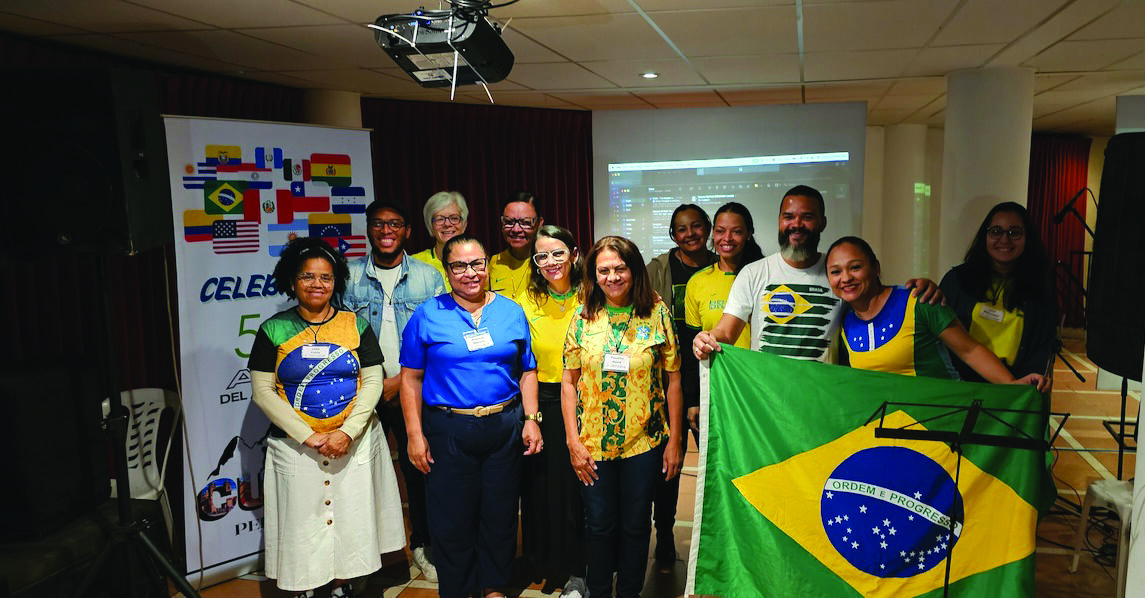
About 200 people gathered Jan. 18-22 in Cusco, Peru, to celebrate 500 years of Anabaptism. The event featured speakers from Latin America and music indigenous to the region. It was hosted by the predominantly Quechua-speaking Iglesia Evangélica Menonita del Perú (Evangelical Mennonite Conference of Peru).
In addition to Peru, attendees came from Argentina, Bolivia, Brazil, Chile, Colombia, Ecuador, Paraguay, Uruguay, Venezuela, Puerto Rico, Mexico, Costa Rica, Guatemala and Honduras, as well as the United States and Canada.
“It was lively,” said Elizabeth Soto Albrecht of Puerto Rico and Lancaster, Pa., referring to dancing as part of worship. She said there was a beautiful feeling of coming together to celebrate Anabaptism in a way unique to Latin America, including Andean-style music on flute and guitar.
Tomas Guiterrez-Sanchez, a professor of history, situated attendees to Peru and its history. The Inca empire, of which Peru was a part, stretched from south of Peru to southern Colombia in 1500. When conquistador Francisco Pizarro arrived, he encountered resistance and not a people willing to assimilate.
Guiterrez-Sanchez drew a parallel between the Inca and the European Anabaptists: Both resisted power structures.
“We can see this testimony of Anabaptist resistance in Indigenous communities,” he said. Just as early Anabaptist faith did not disappear, despite persecution, some Indigenous communities maintained their religious worldview and ancestral practices.

Other presentations focused on understanding the life and work of Jesus. Jaime Prieto spoke about “resistance Christologies” in the Gospel of John. Alix Lozano, a founder of the Movement of Anabaptist Women Doing Theology from Latin America, focused on understandings of Christ that have emerged from 1980 to 2025.
Lozano reflected on the question Jesus asked his disciples: “Who do you say that I am?” The question invites every community to understand Jesus in light of its experiences and contexts.
Marginalized people “can create new interpretations and understandings based on the realities and contexts in which they find themselves,” she said. In these encounters, discovering Christ is creative and not impositional.
Each regional speaker and presentation were examples of seeking Jesus in local circumstances. Mirian Leal of Brazil said it had been important since 2020 to “embrace hope and sustainability” as part of following Jesus.
While most presenters spoke in Spanish, some spoke in other languages, such as Portuguese. Interpreters then translated into Spanish. This practice honored all local expressions.
Discussion moved from theological to practical in a Peace Summit that took place after Cusco 500 on Jan. 22-24. The discussion was grounded by messages from David Morales of SEMILLA on shalom as described in the Bible and from Ramón Guevara, who talked about peace from a pastoral perspective.
The summit focused on Ecuador as a case study. Francisco Carrion Mena, a political science professor, analyzed why a once peaceful country now experiences street violence, drug trafficking and drug wars.
In a panel on confronting violence and its outcomes, speakers offered stories of putting peace and justice into action. The three Ecuadorian Anabaptist conferences are studying peacebuilding with Mennonite Mission Network and seeking to develop a plan to teach conflict resolution among students. The director of a public school shared how she intervened nonviolently in a case of extortion.
Participants said Anabaptism is a movement of the Holy Spirit, and the Spirit continues to move among Anabaptists in Central and South America, who consider early Anabaptists to be their spiritual ancestors.
“We are fruits of this movement” that began in Europe, Soto Albrecht said. “We have something to offer.”



Have a comment on this story? Write to the editors. Include your full name, city and state. Selected comments will be edited for publication in print or online.