


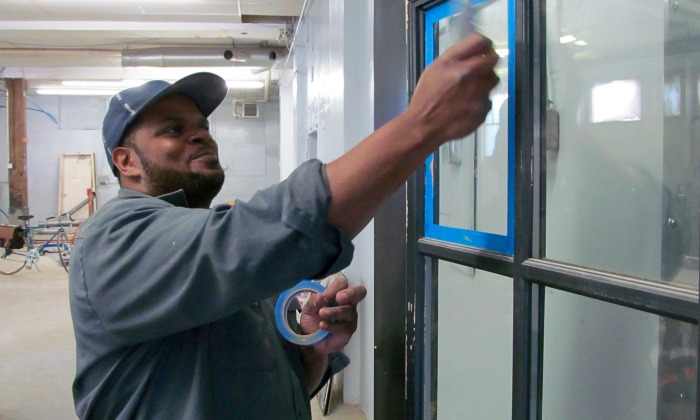
Photo: Ed Jackson prepares a door to be painted as part of Kingdom Builders Construction’s (KBC) renovation of a North Philadelphia auto repair shop. Jackson is the construction manager for KBC, an MCC East Coast partner that offers a chance for former prisoners to learn vocational skills while providing construction services to congregations, businesses and individuals in the greater Philadelphia area. (MCC Photo/Rachel Sommer).
In the U.S., African-American men have a one in three chance of going to prison at some point during their lives. For Latino men, this chance is one in six. For white men, it’s one in 17.
In some communities, these statistics from The Sentencing Project–a report on racial disparities in the United States criminal justice system – can seem low.
Ed Jackson lives in the Fairhill neighborhood of North Philadelphia. “Growing up in this neighborhood, it felt like you had a 90 percent chance of going to prison,” he said.
Many members of Jackson’s community, a predominantly Hispanic and African-American neighborhood, struggle with poverty and access to food. The neighborhood’s crime rate is among the highest in the city.
Drug laws disproportionately targeting ethnic minorities – and the racially biased way in which these laws are enforced – impact many families in Fairhill. Although drug-use rates are comparable across racial lines, people of color are significantly more likely than whites to be arrested for and convicted of drug-related crimes, according to a report from the Center for American Progress.
These criminal convictions can have lifelong consequences. “It’s hard to get hired with a conviction on your record,” Jackson said. “It feels like there’s not much to come home to when you come out of prison, so people go back to crime.”
But Jackson is helping to break this cycle. He knows from firsthand experience there’s another way.
When Jackson returned home to Fairhill after serving a five-year prison term, he found work driving trucks. Then, he started a small, home-repair business. After a few years, he reconnected with Crossroads Community Center, an Anabaptist ministry in the neighborhood. He had fond memories of attending Bible studies and evening activities at Crossroads as a child.
Crossroads executive director Juan Marrero hired Jackson to do maintenance work at the center. Soon, Marrero approached him with another job prospect.
In 2008, Anabaptist congregations in Philadelphia partnered with Mennonite Central Committee (MCC) East Coast to launch Kingdom Builders Construction (KBC), a Christian, non-profit construction company. The organization offers a chance for former prisoners to hone vocational skills while providing construction services to congregations, businesses and individuals in the greater Philadelphia area.
Jackson joined KBC’s staff, and the fit was a natural one. “Ed was as much of a blessing to KBC as KBC was to Ed,” said Marrero, who serves on KBC’s board. Today, Jackson is KBC’s construction manager.
KBC’s sliding-scale fee system enables low- and moderate-income community members to afford its services. Jackson appreciates the chance to serve those who might not otherwise be able to repair their homes or church buildings. Sometimes he donates his time, working for free to help fix the homes of community members who can’t afford to pay.
With the skills he’s acquired over the last several years, Jackson knows he could leave Fairhill and build a life in a different community. But he’s not going anywhere.
“I choose to stay because I want people to know that God can change you right where you are,” Jackson said. “You don’t have to leave to be transformed.”


Have a comment on this story? Write to the editors. Include your full name, city and state. Selected comments will be edited for publication in print or online.