


No revolutionary movement is complete without its poetical expression.
— James Connolly
I’d never sung so much in community-organizing spaces. I’d had lots of experience with music in church, school and sometimes at political rallies.
I valued singing in these contexts. I appreciated how music connected people across geographies, languages and cultures.
Now, more than just thinking that artistic expressions are nice things to have, I understand them as strategic necessities in organizing for liberation.
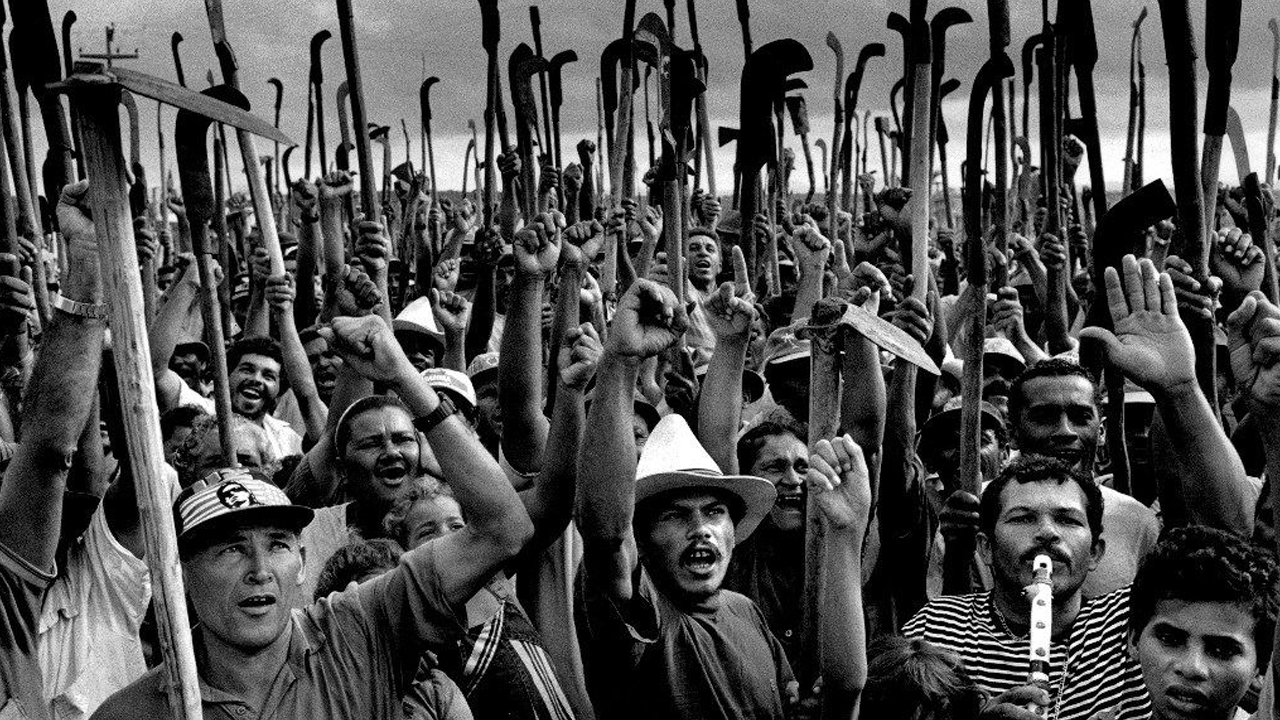
In my organizing, we draw lessons from Brazil’s Movimento dos Trabalhadores Rurais Sem Terra — the MST, or Landless Workers’ Movement. The MST is the largest organization of the poor in the Western Hemisphere, claiming around 1.5 million members.

Brazil has similarities to the United States — a colonial society, ongoing oppression of Indigenous peoples, chattel slavery and gross inequality. In this context, the MST has built collectives throughout the country over 40 years. They develop leaders of the poor through political education, land occupations and a practice called mistica, which we translate as “spirit of the struggle.”
People come from around the world to study with the MST, and they experience mistica. Mornings begin with song and symbolic expression. Meetings begin with music or dancing. Land occupations and actions are accompanied by displays of art and theater.
While mistica is how we might open our gatherings, it is more than that. It’s a cultural glue that binds our people together, connects us to histories of struggle and engages our emotions in ways that agendas and events don’t. It compels us to reflect and study, to sing and to act together in resistance against injustice. It is a collective experience where everyone contributes.
Spirit of the struggle isn’t a show. Often it isn’t polished, and it doesn’t require professionals. Yes, presentation matters. But, ultimately, experiencing spirit of the struggle together — either in church or in social-change organizing — should bring us together in commitment to transforming the world.
Consider the disciples: When Jesus was crucified, they scattered. They knew the religious and political leaders would be looking for them next. However, after Jesus’ ascension, they stayed together, and even grew their numbers. They were still in danger, but they committed to one another to build the Jesus Movement.
Then the Holy Spirit showed up.
Empowered by the Holy Spirit of Struggle, the disciples began connecting with people across ethnicities and languages. This first church then set about a radical transformation of society by sharing all their possessions and making sure there were none in need among them. They didn’t do this in new and remote places. They set about this revolution in the middle of the Empire. Their radical community defied the dominant practices of exchange and wealth accumulation.
Oppressors throughout history use isolation and individualism to keep us divided. To have any chance of ending the oppressions we’re up against, we need to learn how to counter these tactics with practices of solidarity and community. To do that, we need leaders who can bring people together in a way that breaks isolation and forms new kinds of people and communities. Communities like the early church not only challenged the oppressive logic of the Empire but practiced an alternative and grew with the aim of ending all oppression.
Mistica connects us to histories of struggle and unlocks our creativity. One recent example is the struggle for justice in Palestine. Organizations rooted in faith traditions — Muslim, Jewish, Christian — bring their rituals, liturgies and spiritual practices to bear in creative and context-specific ways.
In this context, Mennonite Action was born. Mennonite Action draws on our roots in visual presentation, using a quilt for its logo, and through music, by featuring hymns in four-part harmony at rallies and protests.
These cultural elements remind us that Mennonites have a centuries-old pro-peace commitment that obligates us to confront genocide and war today.
Mistica connects the present struggle with our histories of struggle. It gives us strength by invoking our ancestors’ commitments to justice and peace.
Mistica is humanizing. It builds solidarity around shared experiences of oppression and resistance. Grounding ourselves in this way fortifies us for the struggles ahead. Things didn’t get easier for the disciples after Pentecost, but the Holy Spirit of Struggle sustained their commitment against impossible odds.


Have a comment on this story? Write to the editors. Include your full name, city and state. Selected comments will be edited for publication in print or online.