


What would you grab if a tornado or hurricane was coming? The photo albums, probably, if you’re the kind of Anabaptist who takes photos. You can’t put a price tag on the charm of seeing how people used to look and the preservation of memories that might have slipped away.
Pictures in a family album define our place in a larger story. Yet we might ask: Is the remote past relevant? How far does the story extend? Do our distant relatives matter?
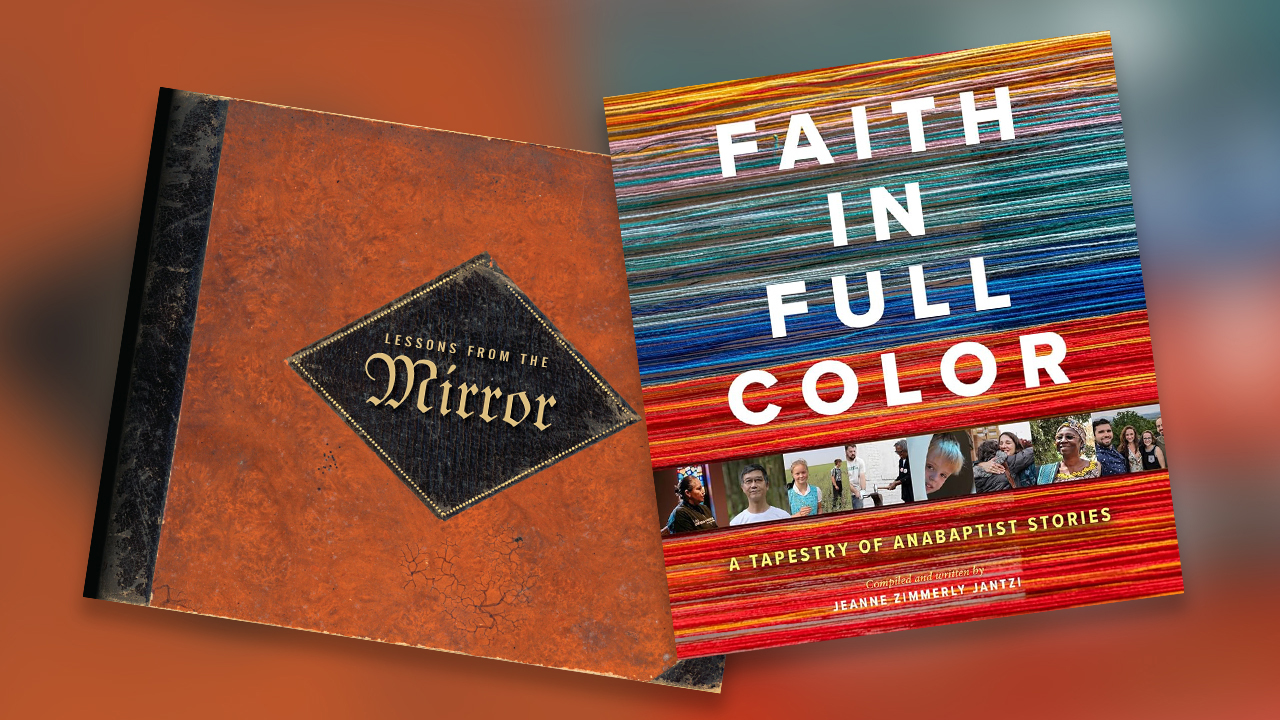
All of these questions apply to families of faith as well. In Anabaptism’s 500th anniversary year, two new albums remind us how deep our family tree’s roots have grown and how far its branches extend.
The first is Faith in Full Color: A Tapestry of Anabaptist Stories (Herald Press) by Jeanne Zimmerly Jantzi. This striking hardcover belongs in places where people will notice it. Seventy-seven richly illustrated stories present a wide-ranging portrait of Anabaptism at the five-century mark.
Mennonite Church USA is well-represented but doesn’t dominate. Stories from the Amish, Hutterites, Church of the Brethren, Brethren in Christ and other groups portray diverse expressions of faith: a Pennsylvanian’s campaign for Congress, an Ethiopian’s baptism in a barrel, a camp that teaches children four-part unaccompanied singing.
International stories range from a small group’s peaceful witness in the face of government control in Hong Kong to the perseverance of the million-member Church of the Brethren in Nigeria amid attacks by Islamic jihadists that claimed the lives of over 3,000 members.

Success stories stand alongside tough topics: sexual abuse among the Amish, Mennonite complicity in the Holocaust, racism in the North American church. Views of Anabaptist identity include those of a pastor in the LMC denomination who believes there is no future in his town for a Mennonite church but a hopeful outlook for one that’s “informed by Anabaptist values.”
Faith in Full Color celebrates but doesn’t idealize the Anabaptist family. Along with the Anabaptist Community Bible, it’s a gem in MennoMedia’s Anabaptism at 500 project.
The second album, Lessons from the Mirror (Masthof Press), makes the artwork of Anabaptism’s most iconic book accessible by separating it from the 1,141 pages of text in Martyrs Mirror. This 250-page softcover reproduces all 104 scenes that Dutch artist Jan Luyken etched on copper plates for the 1685 edition, plus 11 not included in that historic volume. A brief description accompanies each.
The album is an important companion to the Martyrs Mirror itself, because the 1938 Herald Press edition — the one most people have seen over the past century, reprinted more than two dozen times — includes only 55 of Luyken’s 104 etchings. Why so few? No one really knows, says historian David Weaver-Zercher, author of Martyrs Mirror: A Social History (Johns Hopkins, 2016). While anyone can find all 104 on the website of Bethel College’s Mennonite Library and Archives, many will appreciate a book with the entire set.
Seeing all of Luyken’s art spotlights the fact that only about half of Martyrs Mirror illustrations depict Anabaptists. The first 50 show the torture and gruesome death of faithful Christians before 1525, beginning with Jesus himself and continuing with the apostles, early Christian saints and medieval dissenters judged as heretics.
One scene is different: a persecutor’s punishment. Honoric, king of the Vandals, writhes in agony over the loss of a hand and a foot while being consumed by worms, like Herod in Acts 12:23.
A visual timeline of Christian martyrdom, Lessons from the Mirror reminds us that our forebears had forebears — links in a 1,500-year spiritual genealogy we now claim.
In the second of two essays that introduce Luyken’s art (the first is by Mary S. Sprunger, professor of history at Eastern Mennonite University), J. Ross Baughman reflects on the power of pictures: “If the pen has proven mightier than the sword, then the edge of a single picture might cut sharper than a thousand words or a dozen soldiers. . . . Sacred accounts of sacrifice . . . can be especially powerful.”
Family albums are sacred accounts — whether of ultimate sacrifice, dramatic witness or everyday faithfulness. What does your picture look like?



Have a comment on this story? Write to the editors. Include your full name, city and state. Selected comments will be edited for publication in print or online.