


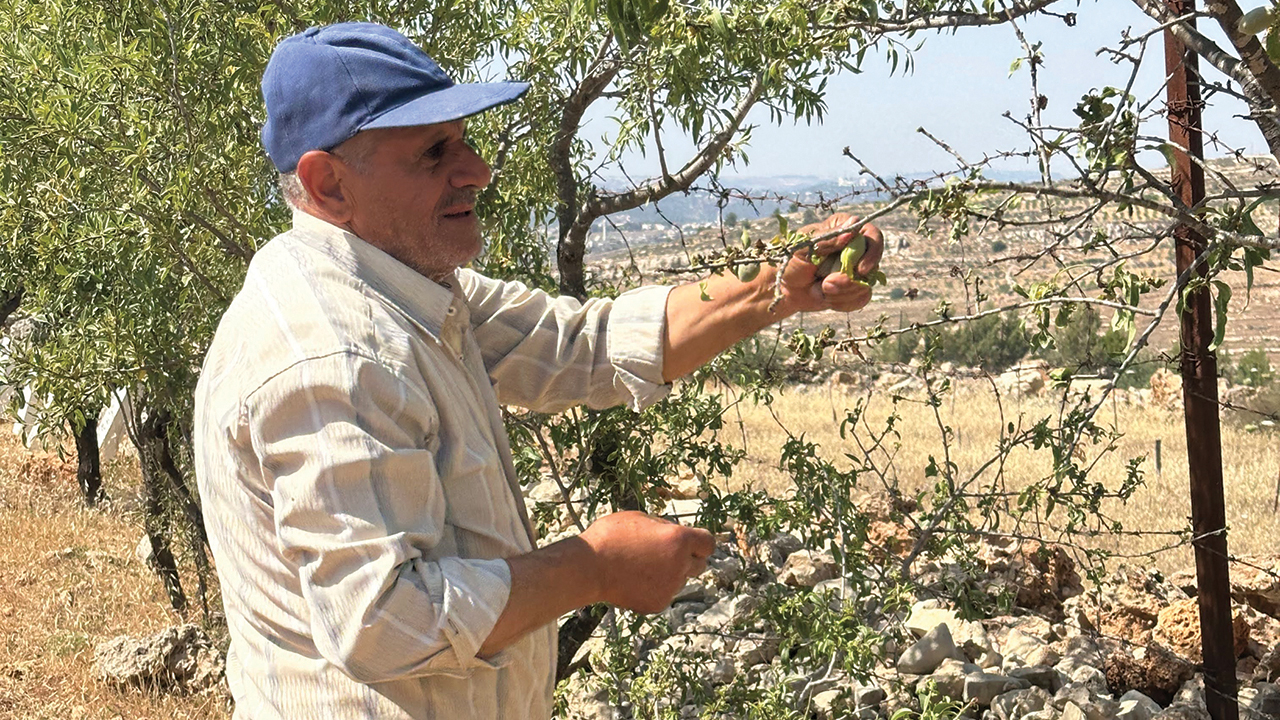
A Mennonite Action delegation visited Palestinians to offer encouragement amid Israel’s disproportionate military response to a 2023 Hamas attack and returned to the United States with encouragement to continue advocating for an end to a war that has killed over 58,000 Palestinians, according to conservative estimates.
Ten staff and regional leaders from Mennonite Action visited Palestine- Israel June 4-16 to offer solidarity and develop relationships as the conflict entered its 22nd month.
Mennonite Action developed as a movement mobilizing people to take public action calling for a cease-fire in Gaza, where deadly violence against civilians and children has become daily news as the U.S. and Canadian governments continue to support the actions of the Israeli military.
“Just being a presence and a witness is important, because groups aren’t going there right now,” said Timothy Seidel, a member of Mennonite Action’s steering committee and associate professor of peacebuilding, development and global studies at Eastern Mennonite University. “. . . We got as close as 20 to 30 miles to Gaza, but there was no way to get inside.”
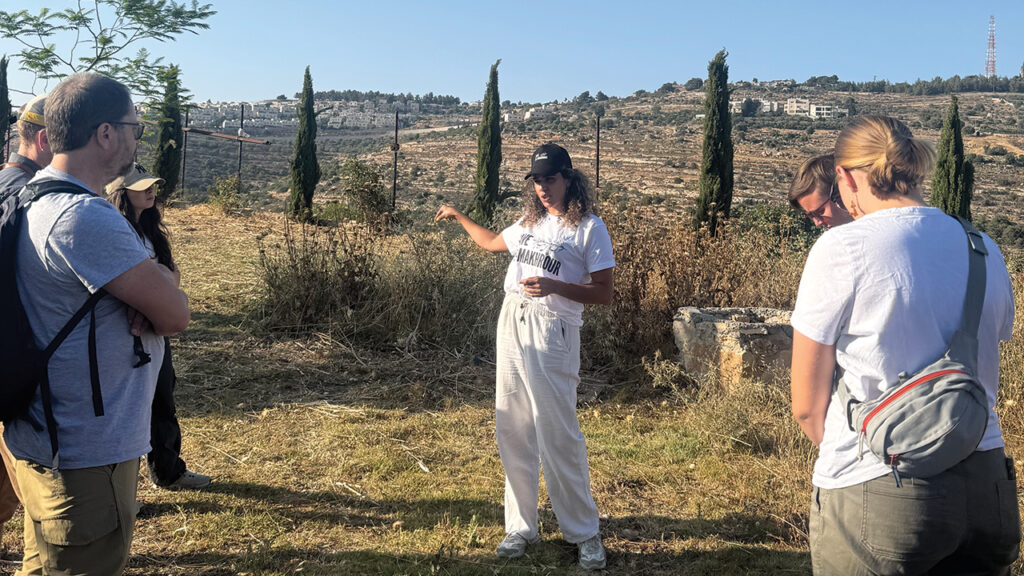
Most of the group’s time was spent visiting Palestinians and peace organizations — and a few Israelis — in places such as Bethlehem, Nazareth, Ramallah, Jaffa and Israeli-occupied East Jerusalem.
“We learned much about how Palestinian folks under repressive conditions have been organizing and continue to do mutual aid work,” Seidel said. “That can guide our own efforts to mobilize and guide our work at home.”

Delegation member Nate Pequette was inspired by the refusal to hate at Tent of Nations, a farm where the Christian Nassar family is surrounded by Israeli settlements that cut them off from other Palestinian territory.
“The settlers come in and clear out their trees and build roads through their land,” said Pequette, a pastor at Church of the Sojourners, a Mennonite congregation and intentional community in San Francisco. “It’s intense to see, and it’s amazing. One of my questions going to Palestine was how they learn not to hate and try to love their enemies.
“Daoud Nassar says Tent of Nations refuses to hate, refuses to be a victim. They put energy in constructive things, plant trees and do solar power, summer camps and work in the courts: ‘We won’t hate.’ ”
Recently ordained, Pequette said becoming Mennonite has been a “grounding experience” to join and partner with religious communities that have been working for peace as partners in the gospel for centuries. He is working with colleagues at First Mennonite Church of San Francisco to develop the San Francisco chapter of Mennonite Action.
When the group visited the Aida refugee camp, Pequette was moved deeply by generations that have lived as refugees since the 1948 Nakba (catastrophe) that took Palestinian territory and displaced more than 750,000 Palestinian Arabs to create the Israeli state. Six watchtowers and a wall surround the camp, where IDF soldiers enter and use tear gas, or use sniper rifles from distance.
“Daily life is a form of resistance. Walking kids to school is a form of resistance,” Pequette said “. . . People desperately holding on to hope and faith in all this is phenomenal and encouraging.
“This is where Jesus walked, lived, died and resisted himself. Meeting people you don’t see on the news and using these ideas of resisting and not hating was mind-blowing. We heard over and over again, from everybody we saw: Tell these stories. The United States obviously has the wrong story because of what they’re doing.”
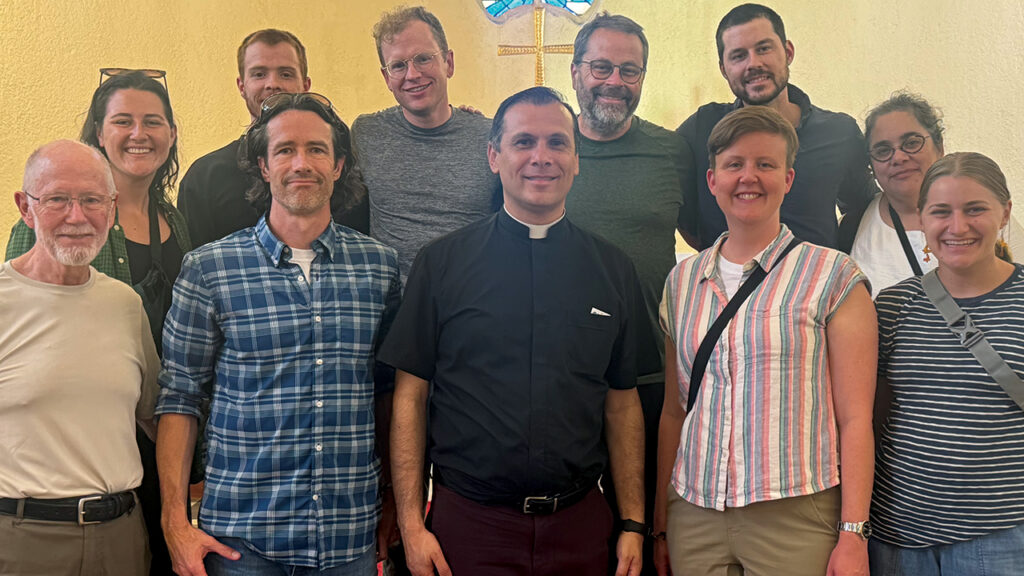
Katie Corbit of Harrisonburg, Va., a member of Mennonite Action’s coordinating team, was moved by Palestinian responses to strategies of occupation that steal land and life, but not hope.
“It felt like everywhere you turned you saw a new way the occupation found to get worse,” she said. “We were in Tel Aviv . . . and it was just a gut punch. Everybody is acting like it’s normal life, but Tel Aviv is built on the rubble of Jaffa from 1948.
“People were having a concert on the beach and enjoying the beautiful sea while the government is killing the people of Gaza just down the beach. . . . The tear-gas canisters on the ground say made in Pennsylvania in the U.S. of A. My tax money funds that violence.”
The group met people from Zochrot, an Israeli organization that educates about how the Nakba forcibly removed Palestinians from homes they and their ancestors lived in for centuries.
“They expelled people from their land in Jaffa. Our guide told us about this cliff by the sea. When Israel came in, they had to jump off the cliff to boats, but they didn’t know where the boats were going,” Corbit said. “That was their best option, and many of those people ended up in Gaza. The connection of that to now, with the horrifying things happening now in Gaza, was horrible as people were sitting on their beach chairs so close to Gaza.”
Corbit grew up Southern Baptist, came to work at EMU and got her master’s degree at the university’s Center for Justice and Peacebuilding. She has been inspired by the way people connected to Mennonite Action use their faith for action in a political way and was part of the organization’s march to Washington a year ago.
She came away from Palestine inspired to share stories of resistance like Alice Kisiyeh’s. Her family has documents proving her family’s land ownership, but United Nations approval is not the same as Israeli settler approval.
“We were there in the first week that they got the news they got their land back without — supposedly — the threat of settlers taking it,” Corbit said. “This was desolate. They tore down 100-year-old fruit trees.
‘But we remember we are Christians’
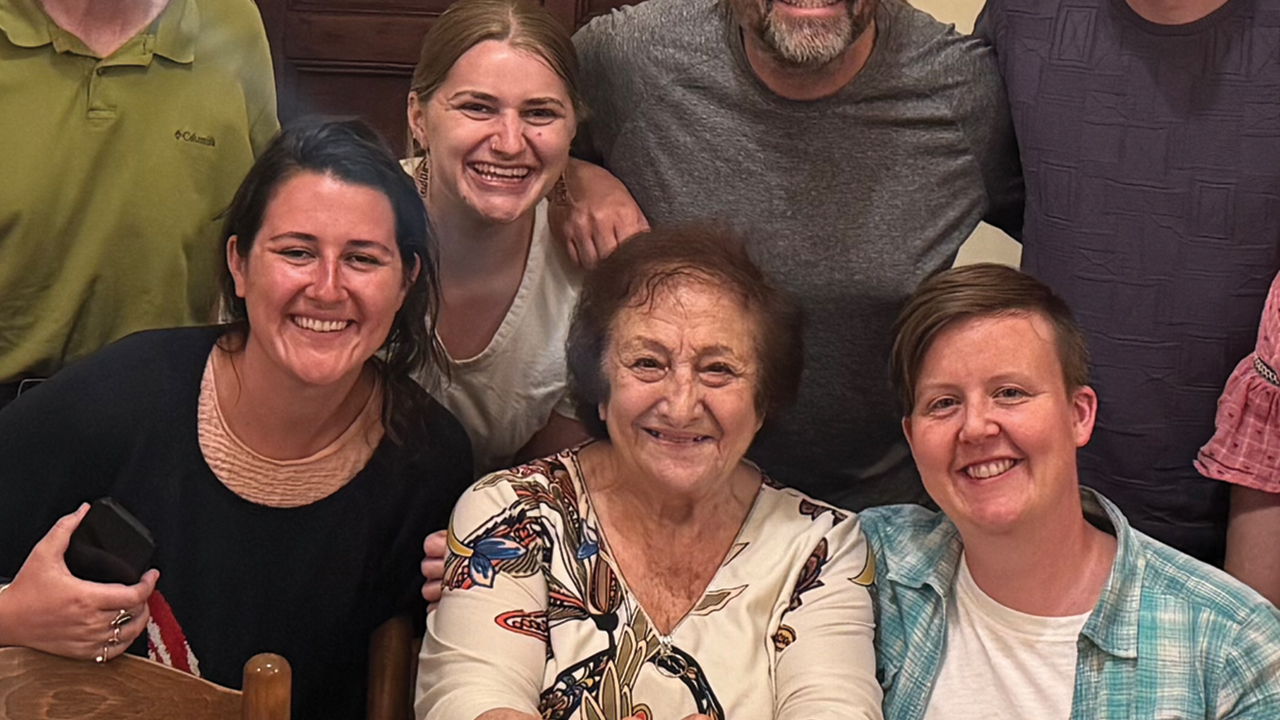
Violette Khoury is an 87-year-old Palestinian Christian woman who started the Nasijona Center to produce and market products made by women in Nazareth and a general assembly member at the Sabeel Ecumenical Liberation Theology Center in Jerusalem.
“I don’t know what to tell you,” she said to the Mennonite Action delegation. “I am perplexed. Is this real? Is it a nightmare? Our minds are very confused if I use only human logic. But we remember we are Christians, and we have our faith and renew our hope.”
She described the wars Palestinians have endured since the 1948 Nakba (catastrophe) expelled over 80% of the Palestinian population, with Zionist forces committing dozens of massacres and destroying over 500 Palestinian towns and villages.
“But since 2023? I want to keep hope because I’m a Christian. But I don’t know how,” she said. “After Gaza they will come for the West Bank, and then they will come for us [the Palestinian citizens of Israel]. . . . “What I would ask you to do is to pray for us.” — As recalled by Timothy Seidel of Mennonite Action
“As we left to go to a restaurant across the valley, we could see Israeli settlers in their cars watching. Just after we left, we got a call from her parents that settlers were climbing the fence to get in. People from our delegation quickly drove back, and there were three teen boys with semiautomatic weapons telling Alice’s parents they were going to take back the land.
“Since we could be there to film what was happening, we could be there with presence to watch. Within a matter of 30 minutes of them celebrating that they got their land back, these armed teens were there to upset that. Knowing people who are there reminds me every day why I do this and remain steadfast, both in Palestinian solidarity and with the authoritarianism happening in the United States.”
Changes in recent years made an impact on Seidel, who is no stranger to Palestine. He did peacebuilding work based in Bethlehem with Mennonite Central Committee and more recently led a six-week summer cross-cultural trip with EMU students in 2023, just a few months before violence escalated.
“In Jerusalem, the presence of Israeli settlers seems more pronounced,” he said. “The settler violence is more visible. They are armed and walking around the old city of Jerusalem with new boldness. The settler project and settler violence are not new, but there’s something about this genocide that emboldens settlers. . . . This is a project of eliminating Palestinians.”
One group of Israeli extremists set fires in an arson attack July 7 at the 5th century Church of St. George in Taybeh, seven miles from Ramallah. Other groups have even attacked their own Israeli Defense Forces for not doing more against Palestinians. Sayfollah Musallet, a 20-year-old born in Florida with U.S. citizenship, was beaten to death July 11 near Ramallah by Israeli settlers who also attacked medical workers attempting to aid him. He was protesting theft of his family’s land.
The delegation met Munther Isaac, who gained international attention in 2023 as pastor of Evangelical Lutheran Christmas Church in Bethlehem, where the Christmas nativity was a Christ child wrapped in a keffiyeh and surrounded by pieces of rubble.
“We met with him in Ramallah, where he was just installed in the Lutheran church there,” Seidel said. “He says to Christians around the world: It’s clear what needs to happen. He says you need to call and condemn what Israel is doing as genocide. You need to call for international investigations into Israel’s war crimes. And you need to call for boycotts, divestment and sanctions against Israel until it complies with international laws. At the end of the day, it’s not controversial to call this genocide. Our Palestinian brothers and sisters are saying, ‘Where are you?’
“At a minimum, I would say wherever Mennonite Action goes, it’s going to be impacted and informed by this experience and these relationships and the solidarity and mutuality we’ve experienced.”


Have a comment on this story? Write to the editors. Include your full name, city and state. Selected comments will be edited for publication in print or online.