



Comparisons between early Anabaptism and global Anabaptist (and even non-Anabaptist) expressions of faith abounded at a conference hosted by the Young Center for Anabaptist and Pietist Studies in Elizabethtown, Pa., July 22-24.
“Comparing and drawing connections between different places and people brings into relief new perspectives and possibilities,” said Elizabeth Miller, director of the Institute for the Study of Global Anabaptism and assistant professor of history at Goshen College.
“Early Anabaptism in Global Perspective: Past, Present and Future at 500 Years” featured presentations and panels by scholars and historians from Ethiopia, Asia, Latin America, Europe and North America. About 130 people attended.
Henok Mekonin, global leadership collaborative specialist at AMBS, drew parallels between early Anabaptists in 16th-century Europe and the Ethiopian Anabaptist experience in the 20th century. Both groups were born into Christendom and emerged as smaller movements within a dominant culture.
For early Anabaptists in Europe, this was Roman Catholicism and Protestantism; in Ethiopia, it was the Ethiopian Orthodox Church. Today the Meserete Kristos Church is the largest Mennonite body in the world.
In Japan, a sectarian group developed with no known connections to early European Anabaptists. This group of clandestine Christians emerged in the 1600s.

Tomoji Odori, a professor from Tokyo, said the formerly Roman Catholic Japanese group and European Anabaptists had similar experiences: They met in caves and hidden places; their faith and practice were banned by the state; and they preserved martyr stories and prayers. Today, descendants of these Japanese clandestine Christians now practice believers baptism.
Contemporary Anabaptists are aware of how their forebears’ beliefs were different from and threatening to others. Nicholas Terpstra, professor of history at the University of Toronto, pointed out in his plenary address that early Anabaptists did have some understandings in common with their neighbors. “When we focus on space, there are similarities,” Terpstra said. In this period, western European architectural spaces were both protective and purifying. As the Catholic Church enclosed nuns, restricting them to cloisters, the Hutterites, fleeing persecution, lived separately from the rest of society. Hutterites used the space to practice communalism.
“A rich community developed within enclosures and [was] preserved across time,” he said. By the time Anabaptists came to North America, they wanted to maintain the separation that was once forced upon them.
Presentations explored historical Anabaptist connections to Pietists, Quakers and Baptists; the role migration played in the formation of the Bruderhof Communities; and how languages spoken by Anabaptists, including Pennsylvania Dutch and Plautdietsch, have stayed the same and shifted over time.
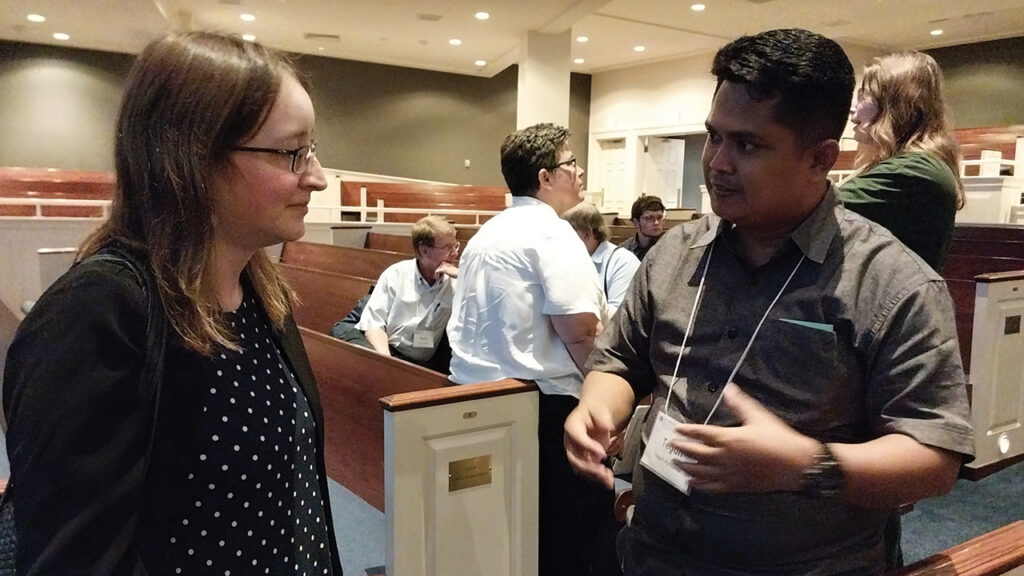
Pastors from Indonesia shared their experiences as Anabaptists in a Muslim-majority nation. Teguh Karyanto, from the GITJ Synod (Javanese Mennonite Conference), said the gospel initially was considered incompatible with Javanese culture. But over time, people came to integrate Anabaptist values of yieldedness, nonviolence and peacemaking with Javanese values of respect for others, harmony and peace for the world.
This formed “a hybrid spirituality that fosters interfaith reconciliation,” Karyanto said. These values help Javanese Anabaptists pursue peace and dialogue with their Muslim neighbors.
Danang Kristiawan, also a pastor in the GITJ Synod, offered an approach to Anabaptist theology that attempts to address the tension between local uniqueness and global Anabaptist unity. From his Indonesian context, he shared a Trinitarian Christo-cosmic and mystical liberative idea, which implies that God embraces the world and all are in Christ. Therefore, the church is called to participate in God’s work of liberation and reconciliation, which is carried out together in an inter-religious manner.
Attendees represented at least 20 denominations, including Amish (Old Order and New Order), Baptists, Bruderhof Communities, Charity Fellowship, Church of the Brethren, Friends, Hutterites (Schmiedeleut branch), LMC, Mennonite Church Canada, Mennonite Church USA, Missionary Church, Old Order River Brethren, Pilgrim Mennonite Conference, Rosedale Network, Washington-Franklin Mennonite Conference and Weaverland Old Order Mennonite Conference. International denominations were GITJ, Meserete Kristos Church, Church of the Brethren in Rwanda and the Baptist church in Japan.
“I don’t think it’s . . . common to have that kind of mix in a three-day event,” Young Center director Steven Nolt said in email.
He saw an Ethiopian Mennonite talking with an Older Order Mennonite and a Church of the Brethren couple in conversation with two Hutterites.
“Those kinds of informal interactions were something I was delighted to see and support,” he said.
Breanna Nickel, associate professor of Bible and religion at Goshen College, was glad for the different perspectives and appreciated that the conference was not only about the past. “It’s a 500th anniversary event, and we’re talking about the future,” she said.
The mosaic of Anabaptist faith and history is fragmented, Miller said in her plenary address, but it is also a “fragmented whole.” She hoped the conference would cultivate new life for others in the future.
“In so doing,” she said, “we may come to find the mosaic we thought we knew is . . . more expansive and surprising than we had thought.”



Have a comment on this story? Write to the editors. Include your full name, city and state. Selected comments will be edited for publication in print or online.