


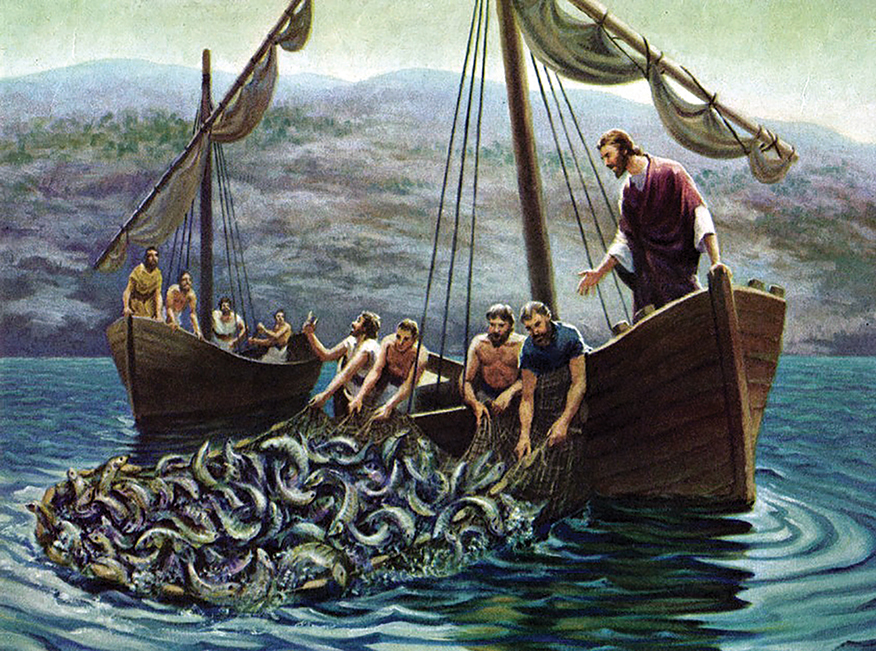
A reflection on Luke 5:1-11
William Willimon claims Jesus was thrown out of Nazareth because of his success in preaching. In Luke 5:1-11, Peter wants Jesus out of the boat because of his success at fishing. Luke 5 is a strange passage. In John this story does not come until after the Resurrection, in Chapter 21. So, what is the meaning of this story? Is it a story of the miracle of Jesus creating fish? Or is it rather instruction for how believers must learn to see after the resurrection?
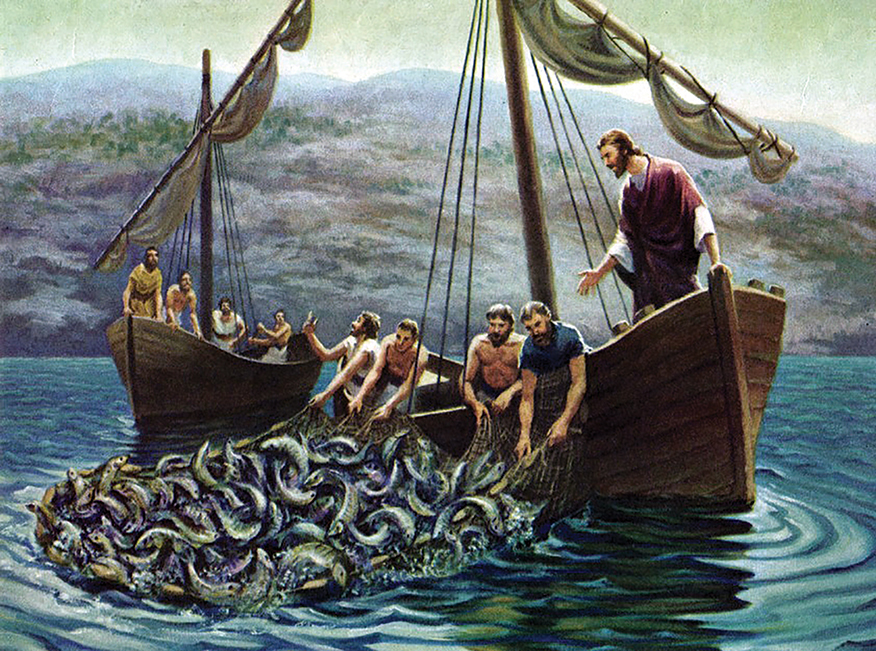
Fish in the Sea of Galilee traveled in groupings or shoals. A shoal of fish could spread as wide as an acre. Imagine a solid acre of fish. Jesus may have been teaching Peter to search more carefully, to pay attention to what moves in the depths below the surface.
The Gospel of Luke, addressed to Theophilus, was the Gospel for the Gentiles. The Book of Acts, Luke’s second book, records the opening of the church to the Gentiles; in other words, the kingdom must be available to the entire Gentile world.
In this fishing scene in Luke 5, Luke reminds us that believers must resee and rethink who is considered “in” and who is “out.” At that time, the Jewish people segregated themselves from Gentiles in the same way we segregate ourselves in modern society. In modern society, we, too, select and label our own lesser groups of “Gentiles.” We separate ourselves, certain our “Gentiles” are fodder for hell.
As the understanding of God emerged in human history, the God of the Hebrews uniquely made universal moral demands. This universal God by his very nature calls us to accept all people as fellow travelers. The stories leading up to chapter 5 in Luke foreshadow how Jesus of Nazareth was rejected by his own people, forcing him to seek followers outside his circle.

Now, in chapter 5, Simon Peter recognizes that larger spirit moving inside the words and actions of Jesus, like Moses and Isaiah also understood God’s call. Both Moses and Isaiah were overwhelmed with a feeling of unworthiness in God’s immediate presence. Here, Simon Peter also falls to his knees and says to Jesus, “Go away from me, for I am a sinner.” A new moment in history emerges here, a new truth, if Peter and the rest are able to receive it. This bounty of fish is a call to seek deeply below the surface and a call to see in new ways.
What does this mean for us?
How we understand God and what we view as ultimately true affects how we see the world. This view shapes our understanding of issues of ecology and warfare and what we believe must be done to preserve the world for future generations. If I truly believe God cares for the entire world and not just my corner of it, I understand and live differently. Through his call, my corner relates to every corner of the world. Through his call, my family relates to all future generations, and I must use resources with all these people in mind.
But life also means I must make judgments and choices about these issues. I can act in one of at least three ways. First, I can be the agnostic and claim I really don’t know anything and make choices that best fit my personal interests. Or, second, I can be the dogmatist and insist I do know everything, and no one needs to question my choice. Or third, like Simon Peter, Moses and Isaiah, I can act in faith with the clues that do exist when I am able to see them. For example, I can’t prove I should love my wife. But with faith I take small steps toward intimate human loving, and in the process I discover the rich reward of a loving relationship. This relationship in turn teaches me to seek and understand the call to live in an equally loving relationship with my environment and to seek and respond to clues about caring for these resources. Love for my children and grandchildren teach me by extension to pay attention to and be personally invested in the world’s future generations and to seek further what is going on beneath the surface.
This paying attention, this deeper search, is Jesus’ message of radical mercy, radical forgiveness, radical self-sacrifice and radical love for one’s enemies. In that first century, this new way of seeing was thought foolish by many. In Jesus’ day, many thought that to act through love was weak. But the clues made visible in the Resurrection radically changed that perception, teaching the early church to live with, relate lovingly to and sacrifice for its sick neighbors. This new way of seeing gradually extended into the wider world, bringing his vision of love as the highest good and value
Madeleine L’Engle states wonderfully, “Size makes no never mind; a grain of sand is as important as a galaxy.” I don’t believe she (or we) would be saying that if it were not for Jesus’ example. L’Engle says this because she has paid attention to what lies below the surface. Thus, this fruitful fishing trip in Luke 5 calls us to a new way of seeing, one the church and its subsequent history confirm.
In the United States, of course, our society at large does not choose to look below the surface of events and therefore characteristically sees through eyes of self- interest. We have seen a closed military response to all problems in the last decades. But there are clues to what lies deeper for those who are willing to see.
The United Nations has pleaded that the United States be less dependent on military force. Of course the UN can also be petty and selfish, but other countries can teach us if we are willing to see. South Africa, Uganda, East and West Germany have found less violent ways to resolve vast differences.
Can we learn from clues in our world such as these? Thomas Merton, wrote this about the Vietnam War in the 1960s: “the Asian whose future we are about to decide is either a bad guy or a good guy. If he is a good guy, he is on our side and ought to be ready to die for freedom. We will provide an opportunity for him to do so: we will kill him to prevent him falling under the tyranny of a demonic enemy. Thus we not only defend his interests together with our own but we protect his virtue along with our own. Think what might happen if he fell under Communist rule and he liked it.”

He goes on: “This destructive kind of logic is not in the exclusive possession of the United States. This is purely and simply the logic of power shared by all warmakers.
Possibly American generals are naïve enough to push this logic, without realizing, to absurd conclusions. But all who love power tend to think in some such way. Remember Hitler weeping over the ruins of Warsaw after the Luftwaffe had demolished it? ‘How wicked these people must have been, he sobbed, to make me do this to them'” (Thomas Merton, Echoing Silence). War talk has one purpose: to mask unreason and permit the game to go on. This is the ultimate form of an unwillingness to see.
We who have seen below the surface must insist that we as a society and we as a church look into the waters and see what is really going on. We must advocate for the clues of God’s universal love, point to the waters and say: “There are fish down there. Come and see.” We are often amazed when God and his love wins by less violent means, as if we are scared to death that clues offered through the Resurrection we celebrate every Easter might after all be true.
We must be courageous enough to see the fish in our sea. We must be willing and courageous enough to perceive and respond to the clues God provides to understand how to shape our world.


Have a comment on this story? Write to the editors. Include your full name, city and state. Selected comments will be edited for publication in print or online.