


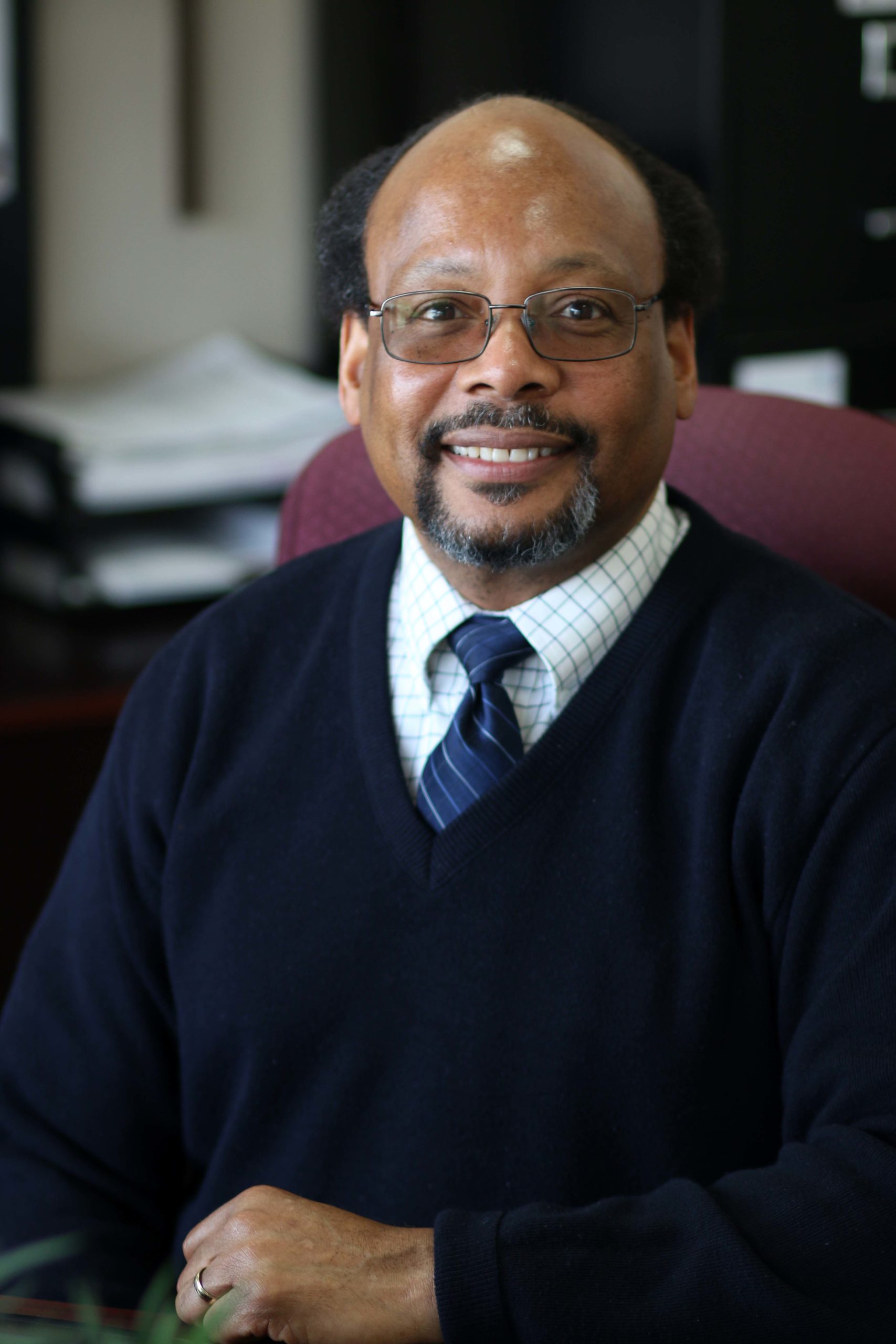
Name: Daniel Grimes
Occupation: Director of Enrollment and Financial Aid at AMBS
Church: Berkey Avenue Mennonite Fellowship, Goshen, Indiana
1. How many years did you serve on the Goshen City Council?
I served from 2000 to 2007 as a councilman.
2. How did you first get involved in city politics?
I was asked to consider running. It was through shoulder tapping, and it was basically because I had shown an interest in civic affairs. I was somebody who had already rolled up my sleeves and gotten involved in local issues. The school board was making changes to the ways school were configured that I didn’t agree with.
I was willing to accept the change, but I couldn’t find one person in the city who actually agreed with what the school board was proposing. I asked co-workers and neighbors and everyone thought it was a bad idea, but they also thought that the school board would do whatever they wanted. At the time, I had just moved from Pennsylvania to Indiana, but I thought, “I’m still in America and in America the people decide.”
3. What changes was the school board considering and how did you respond?
The school board was planning to move to a K through 4 structure for elementary schools. This meant there would be more transitions for students and it was a move away from the neighborhood school concept. I didn’t think it was educationally the best solution.
I created a petition and went around the neighborhood to collect signatures. I presented the petition at a school board meeting. Usually no one goes to these public meetings, so it was front page news the next day!
I started getting calls from TV stations and I was on the 6:00 news. Community people started calling me to say thank you, and ask how they can help; it seemed like everyone was waiting for someone to question what the school board was doing.
To make a long story short, because there was community involvement, we formed a group called A Better Way and we went through negotiations with the school board. The school board put a hold on plans and hired a consultant to do a series of community listening sessions. There were meetings at the Goshen Middle School where the auditorium was packed full of people and the meetings would go until midnight.
We ended up with a reconfigured plan that kept the K through 5 structure and ended up with the creation of a new elementary school. At the end of it all, we kept with the current structure and the superintendent, who we had butted heads with at one point, thanked me for showing them a better way. So the name of our group ended up winning the day!
4. Were there other ways that you were involved in local politics, too?
Around the time of these school board meetings, the local KKK [Klu Klux Klan] had a series of rallies in Goshen. They would hold rallies at the courthouse and then they wanted to hold a rally at the high school. I felt like this would be desecration!
I called the Southern Poverty Law Center and said, “We have these Klan rallies in our community. What can we do to mitigate this?” They sent me anti-mask ordinance info and I sent that to the mayor. Basically this legislation would prohibit the use of masks in town, so you’d have to reveal yourself unless it was for religious purposes. It was a way to unmask the clan.
The city council did pass the anti-mask ordinance and Goshen became the first community in Indiana to pass such an ordinance. So that was also part of my activism prior to council.
5. What made you take the final step to run for office?
The next year I was asked by the local Democratic Party to consider running for council. I ran for council in the first district, where there had not been a democrat elected in over 50 years. What I didn’t realize was that I was asked to run because they wanted to run someone so the race was contested, but there was never an expectation that you would win. I didn’t realize that!
Campaigning was more of the same of what I had been doing already. I was used to walking and talking to neighbors and going to community meetings, so it wasn’t a radical shift from behavior I was already used to.
I enjoyed the campaigning process. It sort of forced you to get out on Saturday morning and knock on doors. Not everyone would think that was fun, but I did. People were generally very gracious.
6. And you won! What were some of your highlights during your time on city council?
My highlights on council were just really feeling like I was in the know. You have the back story about what’s going on, and you try to find ways to work on controversial issues that are acceptable to people.
It’s all about how you communicate with people. If you’re discussing anything of significance, there will always be people of different viewpoints. There’s always opposition, but it’s how you go about creating that dialogue that matters. Really, to some extent, it’s about your own skills of persuasion and your own conviction about what is right and what is wrong.
This is public service. So it’s not just about what we do today, but it’s thinking about what they going to say about us in 10, 15, or 20 years. We’re leaving our fingerprints all over our community. For me it wasn’t how to avoid making someone upset so they continue to vote for me; it was asking is this in the best interests of my community. There were times when I was told, “You know that’s going to cost you votes.” But I voted my conscience.
7. How did you reconcile your faith with government service? How do you think about the intersections with Christian identity and politics?
The hardest part for me was deciding to even run, but it was never about whether or not to engage in government. Hard parts were wondering, How can I be perceived as respectful for things people hold dear but that I don’t agree with? For instance, the flag. It was not my habit to pledge allegiance to the flag. As an elected official, I didn’t want to offend people. Although I didn’t always feel comfortable saying the pledge of allegiance, I felt like not to say the pledge was so offensive to people that anything else that would come afterwards from me would be dismissed.
I didn’t have a religious conviction against the pledge, but I didn’t think it was preferable. I remember talking to other church people and they pointed out that the pledge does say “under God.” And so I felt that gave me permission. It’s not ultimate allegiance to the flag. I felt like it was the respectful thing to do that didn’t go against my conscience.
At the local level, you have the ability to impact more immediate change. We determine tax rates, road projects, building projects, and tax abatements for new industries. These things impact your daily life. Do we pay for our trash to be picked up? What kind of recycling program do we have? Do we have sidewalks and bike paths? Should we have more park space?
Living in a free society and a democracy where people have the right to vote, I don’t take that lightly. I stand on the shoulders of those who have gone before me. I take that as a personal responsibility. Whether or not I vote or don’t vote, I’m giving the government permission to do certain things that are going to impact my neighbors. Why wouldn’t I want to influence their decisions?
I have a hard time saying that somehow my faith doesn’t allow me to be connected to community. I think it’s a privilege to be able to live in a democratic society. A lot of people wish they had that privilege. I don’t take it lightly.
I may have a different perspective then some because I’m aware of the impact of government in opening doors for me that my parents never had. Those things even intersect in the church. I went to Eastern Mennonite College [Harrisonburg, Virginia]. My mother, who grew up in rural Lancaster County, Pennsylvania, was a conservative Mennonite and wanted to go to EMC, but at that point, they did not admit African-Americans, so she went to Goshen College, which still wasn’t all rosy for her. She was not allowed to go to EMC because our church reflected society in Virginia.
I went to EMC and my mother didn’t have that opportunity. Was there a government push that motivated the church to make that change? If government hadn’t intervened and changed, would EMC have changed independently from that?

Read previous Seven Question interviews.
For more reflections on engaging politics as a Christian, see the October issue of The Mennonite magazine.


Have a comment on this story? Write to the editors. Include your full name, city and state. Selected comments will be edited for publication in print or online.