


Rose Bender
Location: Whitehall, Pennsylvania
Congregation: Whitehall Mennonite Church
Occupation: Part-time pastor, adjunct professor and researcher
1. What is your earliest or most interesting memory of church?
I have a couple memories. I grew up at Lower Deer Creek Mennonite Church in Kalona, Iowa. We had two pastors and both would have been called by the lot. One of them only preached once a month and I liked him best because he always had a children’s time. When he preached we got to come down to the front and I felt important.
I also remember my mom and dad’s Bible study group. I have five older brothers and sisters, and my mom and dad were older when they had me. My mom and dad were in a Bible study group and there were no other kids that were part of the group at that time. So I went to this Bible study group and was always playing somewhere and overhearing the group. I would hear them sing and pray and share and care for one another. So I just remember having that as a constant in my life, and that group was church, too.
2. When did you first know that you were called to pastoral ministry?
I had a teacher in high school—I went to Iowa Mennonite School (IMS)–who told me that I was going to be a pastor. I didn’t have any time of day for that. I didn’t even believe women could be pastors at that point!
I grew up at Lower Deer Creek and that wasn’t an option. But it was interesting because they totally used my gifts. I flourished and was well-equipped there and was able to do all sorts of things. I had a fantastic youth group and was allowed to be a leader. I taught Bible school and Sunday school and planned Sunday evening worship. And I went to IMS and was on chapel committee. But still, in the back of my head, women weren’t supposed to be pastors.
Also, my mom growing up always told me that God had something special for me. She wouldn’t have necessarily said it was a call for ministry, but she continued to say that throughout my life.
And then, when I was teaching history in New Jersey at a Christian school, I was coordinating the chapel services and really just loved it.
I was also part of a Mennonite church plant from Franconia conference. There were literally five people who were raised Anabaptist in the church, so it was my first experience with lots of people who hadn’t been raised Christian or weren’t Mennonite. I was asked to do a lot of things in leadership at that church, and that’s when I decided that I would go to seminary. But I still didn’t say I was going to seminary to be a pastor.
During Service Adventure [a service program of Mennonite Mission Network where participants, age 17-20 live in a house with an adult leader of family], our unit, the Johnstown, Pennsylvania, unit, had eight churches we were connected to. A lot of those churches didn’t have pastors. So when we would visit, often the kids would do some things in worship and I would preach. I got a lot of confirmation from folks in those churches, even from some who didn’t think women should be pastors. So that was the process until I finally said yes to God about this ministry business.
3. I hear that your congregation, Whitehall, has a unique story. Can you tell me a little bit about how your church started and how it’s evolved?
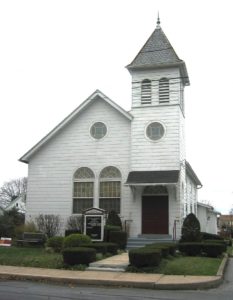
Bob Walters was a retired leader. He was a part of Franconia Conference and he felt called by God to start a church in the area of the Lehigh Valley in Pennsylvania. That was 25 years ago or so.
There were a lot of different people that came from churches in the conference to help plant the church. They started by meeting in a motel and even met in a diner for awhile. When I go back and look at their records, at that point, church members were doing a lot of transportation: taking people to doctor’s appointments and other errands and doing Bible studies at another local hotel. Bob had a sailboat and he would take people out in the sailboat. Lots of things like that.
So that’s in our DNA. It’s a very hands on church. It’s very small congregation, but doing big things for God and very connected to the community. Right now our work is more focused on refugees and folks who would be on the margins of society. We transport almost half of our congregation to church on Sunday from around the area.
4. What is one thing that might surprise people about being a pastor?
When I came into this particular church, I had very little experience with people with mental illness and there are several folks in our congregation that struggle with mental illness.
There’s one woman in particular who talks freely about her illness. When I first came to the church, she was going into the hospital probably every three or four months. I started walking with her once a week, sort of a prayer walk. I didn’t really know how I thought it was going to help her, but now she hasn’t been in the hospital for probably four years.
But the most surprising thing is that she prays for me three times a day. And I can call her at any time and she will pray for me over the phone. She will pray for me, and when she prays, she prays about things that she shouldn’t even know or be aware of. I have come to rely on her as a prayer partner and a friend.
In this congregation there can be a lot of “us and them” language. We have people who have a little more money and education and who are perhaps more spiritually mature, and then there are people who need more support.
I’ve been working at getting people to be mutual and appreciate what the other can offer. We need each other. I say a lot in church that we’re a group of very unusual people that wouldn’t be together except for Jesus. And this church member has helped me live into that. We are interdependent. I rely on her. That is a very wonderful, surprising thing. It’s helping me live into what I tell the congregation we need to be.
5. You’re a bi-vocational pastor. What are some of the gifts and challenges of that?
Well, it teaches you to depend on God more!
I live in an intentional community. I ended up buying a house in Allentown that was way too big for me. Together, with others living in the neighborhood, I started dreaming about what it could become.
So for awhile we had four bi-vocational Mennonite pastors living here, and now there’s three of us living here. We call it the Zumé House. Zumé means yeast in Greek, and the name comes from Luke 13:21, where it says that the kingdom of God is like when the woman takes a little yeast and mixes it in with the flour until the whole loaf is leavened.
The idea of the house is for it to be yeast in the community. We use the lower floor for the public: ESL classes, a drop-in center for refugees, after school stuff with kids, and to house some computers that were donated. More people have keys to our house than I know what to do with.
That helps me financially because I live in community. I can live more cheaply because we share finances. We all can live and do ministry and the advantage to that is that when you’re a pastor full time, you’re really just working for the church and you kind of lose sight of the community and the rest of the world and people that don’t follow Jesus.
When you’re bi-vocational and live in a house like mine, you’re always interacting with other people. It keeps you fresh and helps model things for the people who go to your church.
6. Do you have a story you tell over and over from your time as a leader of the Johnstown Service Adventure unit?
So at that time when I was there, the church that was right across the street from the house met at four or five in the afternoon. It had a lot of attendees from the community, many of them folks with disabilities or struggling with mental illness. One of the kids at my house who was from Germany really just could not fathom that this was what the church was. She just couldn’t accept it. It was so out of the box for her. But one day we had this one breakthrough service where we served communion. She just began to see the people we were ministering to and with. She realized that it’s not us and them, but she saw how God could use them to teach her. She basically had this incredible experience of God’s grace.
And I had a similar experience in that same church with one of the women. She was a bit bizarre. She often wore 12 hats during the summer and her conversation didn’t always make sense. At the church, we washed hands instead of feet. As I was washing her hands and she was washing mine, I just had an experience of Jesus’ presence and an incredible understanding of the dignity of this other person that was also created in the image of God. It really changed me and set me up to do this ministry here.
Service Adventure made it so I can probably never be in a traditional Mennonite church again. I just have to be with people that are kind of on the edge or at the margins of society. All the years I was a teacher, I was history teacher and I was very liberal-minded and I taught in a more conservative school so I was always on the edge. I was teaching about poverty, but I realized that I didn’t really know anyone who was experiencing those things. In SA, living in the community and making friends with everyone around me really changed me. These things stopped being theories and sank into my bones. It was a natural progression to come here and live in a neighborhood and work at a church like Whitehall.
7. What book would you recommend if you could only choose one?
I like books. It’s so hard to choose. But the book Left Neglected by Lisa Genova comes to mind. It’s one of those books I’ve bought three times because I keep loaning it out and not getting back. It was written by a neurosurgeon. It’s fiction, but it’s the story of a woman who is an accident and she ends up not being able to see anything on her left. She was someone that felt good about herself because of how productive she was. When that was taken away and she couldn’t be productive in the way that society says you have to be, she had to figure out what to do. I guess I resonate with that.


Have a comment on this story? Write to the editors. Include your full name, city and state. Selected comments will be edited for publication in print or online.