


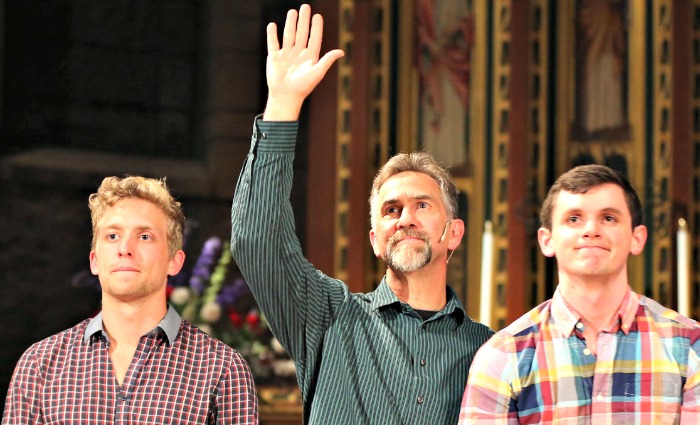
Ted Swartz is an actor and writer who has been performing in Mennonite (and other) circles for the past 20 years. He is the current owner of Ted & Co. TheaterWorks. Prior to 2007, he was part of a traveling theater duo, Ted & Lee, with Lee Eshleman. In 2007, Eshleman committed suicide after a long struggle with mental illness. Ted is re-launching an updated version of his play, Laughter is Sacred Space, which explores mental illness and faith. Hannah Heinzekehr talked with Ted about comedy, faith, his journey as a Mennonite artist and the new production. Check out upcoming tour dates.
Photo: Ted Swartz (center) with Listening for Grace co-stars, Philip Martin and Justin Yoder. Photo by Abby Graber, Mennonite Church USA.
Name: Ted Swartz
Hometown: Harrisonburg, Virginia
Occupation: Owner, actor and writer at Ted & Company TheaterWorks
1. Tell me about being an artist and a Mennonite. What has that journey been like?
This particular art form—community theater—influences how we understand faith in ways that I didn’t even understand when I started. I just wanted to do something funny and do it in a way that was rewarding and that I could make a living with. But I’m discovering that the way that humor actually works became more important.
I think when Lee and I started this work, it was at a point where much of the denomination was ready to laugh at familiar stories. Biblical stories were where Lee and I started writing. For many people it might have felt like “lightweight theology.” It’s simply taking a familiar story putting the humanity in the story by finding it funny. When you find something funny, you connect to a person’s humanity very quickly. When you look at characters like the disciples who are questioning things and confused, and when we recognize ourselves in someone who doesn’t know what’s going on, that’s where comedy finds itself many times. I think the church on the whole accepted that because it didn’t feel threatening. When you laugh, you’re not as threatened. You’re able to open up to something new.

Other thing that I’m bemused by is that I’ve never been invited to any Mennonite writers associations or gatherings. As a playwright and a sketch writer, I think some people don’t even know that there’s an actual script. They think that we’re maybe just making this up as we go along or our theater is just improvisational.
I think most playwrights would say that comedy is the hardest thing to write, because you are asking people to connect at a level where they can produce laughter. A drama allows you to come to a piece at whatever level you bring to it. But when you write a comedy, you’re expecting people to laugh. That’s why laughter’s so critical, because when you laugh you show understanding. I can do a serious piece, and I don’t have any way to know if you have understood it. But if you laugh, I know you’ve understood.
2. Where do you draw your writing inspiration from?
Well, some of the shows I’ve written were ideas that had been percolating before Lee died. Right afterwards, as we were trying to keep the business moving, I followed a pattern which was to try and get a bid based on a show that hadn’t been written yet and then I would be forced to write. So basically I would write a show to get a gig. That’s never the best way to do things. Sometimes someone would call from a Catholic church and ask, “Do you have a show about St. Paul?” And the answer’s always yes!
But at the same time, I was doing some of my best work. During those years after Lee’s death, I wrote a show called, What would Lloyd do? It was reflective again of where I was in that period of depression, but it’s some of the best work I’ve ever written.
I discovered that Lee as much more inclined to write from a personal place than I was, but I realized a few years after Lee died that I had been writing more from personal experience. My work was much more tied into exploring what was going on, what is grief doing, and what is depression doing to you as a person? Is it sealing you off or opening you up?
For me, grief was opening me up in ways I’d never done before. When I wrote WWLD, I was playing an age appropriate pastor whose wife has left him. He’s burned out and he’s angry, and so he follows her when she goes back home to Cincinnati. He follows to be with their kids, and he takes a job at a depressed area mainline church. Nobody goes to the church, but it’s propped up by endowment. In order to keep the endowment, they have to broadcast a Sunday morning sermon, but it ends up being a sermon for nobody.
He also has to hire a music director, and he ends up hiring a guy he sees at a bar down the street. In the play, that’s Trent [Wagler, of The Steel Wheels band]. This new relationship starts pushing Lloyd and he wonders, what are we doing here? What is church for? What is God? And there’s this rant monologue he has that accidentally gets broadcast.
I realize this was me asking, Where’s God? It seems like when I need him the most I can’t find him. Is it because he hears and won’t do anything? And that monologue is the end of first act.
And at the end of the piece, his wife doesn’t want to reconcile and he’s lost that hope, but he comes back to the church and he says, “I don’t come this morning healed of anything. I don’t come with answers. But I ended up here, here where the unhealed gather, and in this world there is peace, but never enough. Grace, but never enough. Love, but never enough. But we take what we have, and we break it and we pass it out.” And then one of Wagler’s wonderful songs picked up. When he [Lloyd] was finally honest, of course people listen and show up.
In the show he has this quandary of stay or go. For me, it was finally just saying that I’m going to write the real stuff and put it into the most entertaining play I can.
3. Your memoir and this play that you are beginning to take on tour both hold the title, Laughter is Sacred Space. Say more about what that means to you.
I have a couple of projects that I’m thinking about. One is perhaps writing a book called Faith is a Comedy. I’m interested in pushing father on the question of, what does happen to us when we laugh? There’s physiology involved: it changes how we breathe, how we open, all those good things like endorphins which I know enough to be intrigued by.
But it also does something to us spiritually when we laugh. When we laugh together with a group of people, it forms a commonality that I don’t think we have trusted very well over the years. I think that laughter is one of the least appreciated and most important elements of how we build commonality and faith communities together.
The reason it’s unappreciated so often is that it can feel frivolous. We laugh for many reasons. But that deep laughter that happens when we come to a common understandings or recognize ourselves within a faith community, it’s amazingly important. When I reflect on a life in the arts with the Mennonite church, it’s parallel with that growing understanding.
I feel alternately appreciated and bemused by this nonunderstanding of what happens in comedy and laughter. Steve Kaplan is a writer who travels around the world doing writing about how to do comedy. One of the things he says is that if your characters know too much and have too many skills, your movie or show becomes a drama. For example, James Bond has all the skills to get out of a situation, so the movie becomes a drama.
When Lee and I started writing, we focused on characters like Peter and the disciples who didn’t have the skills at all. Has this wonderful equation. Steve Kaplan says, “Comedy is about an ordinary guy or gal struggling against insurmountable odds without much of the required skills and tools to win yet never giving up hope.” To me that is what faith is and that’s why I say faith is a comedy. There are insurmountable odds, you don’t’ have the tools to win, but you never stop giving up hope. There’s a forward-looking outlook. There’s an expectation that we are going to be co-creators with God in this expanding universe and comedy helps us make sense of that.
That’s why I react so violently against Calvinism or this idea that we need pure belief and there are things we need to retain to meet a goal. We don’t know the goal. Faith is about reflecting on the immediacy of what’s around us and following the Jesus narrative of the way we should live and we don’t know where that will take us.
4. You have been open about the ways that grief has shaped you and work, especially after the Lee’s death. Can you say more about the role of grief in your creative process?
I call grief a shape shifter. You don’t know how and what it’s going to form. It becomes part of who you are. If I reflect on my life and what this loss did for me personally and what it did to the company, I had probably two years of depression. I had anger. I didn’t just lose my best friend, but I lost the company. It’s one thing to deal with the grief of losing someone close to you, but to deal with the fact that he also killed your company at the same time, that’s a whole different level.
I would say anger was really high. I turned all of Lee’s pictures around. I said, “You don’t get to face the front until I can see some way through this.” I didn’t wear any Ted & Lee shirts. I removed him from the visual, public life of what I was doing. I was angry at him, but I was also resentful toward people who felt as if that was my whole identity. I feel much more comfortable at this point now that I’ve had eight or nine years to tell people who I am, in opposition to just one half of a brand.
But what I didn’t lose was the fact that I was still an actor and still a writer.
Now it’s become much easier for me to celebrate our lives – Lee and me together –and to celebrate what we did. I saw a wonderful piece on ESPN last night and it featured a cop who was just 24 years old when his partner was killed. He said that you die several times: once when you die a physical death and once when people stop saying your name.
I’ve actually been accused of using Lee’s name as a way to ensure my career. I would understand why people might think that, but I would much rather say that this is a way for him to stay alive and hold some of his memory. Not everybody who sees this show that we’re taking on tour now will have known Lee at all. This show is introducing them to him and also exploring what kind of a relationship two men can have that is complicated and isn’t romantic. It’s complicated, but it’s deep and maybe it’s an example of showing people of how love can prevail.
5. Yes, talk more about this particular play. What is the purpose of it and what are you hopes as you take this show on tour again?
It’s not a brand new play, but it’s new in part because I’m new. It shows where I’m moving from anger and desperation to reflection and celebration. The original show was in conjunction with the book that came out, but I’ve changed it a great deal since I wrote it.
I think the rawness of this show the first time around was helpful for people to see honest reflections of a suicide survivor in a church and faith context. And we’re now moving into the question of, so how do we live with this? How do we move not past—because this is now part of my story and part of how people know me and I know myself—but how do we understand this is how life was then and this is how life is now. There’s new growth and new ways to embrace laughter as a sacred space.
The show is way different than what I thought it was when I was first asked to write the book and using this title. When you lose laughter through tragedy or trauma or grief, it becomes even more precious when you get it back. In the midst of writing material that I think was really good and that made people laugh, I didn’t find laughter in myself very well.
I think the show was a combination of this gradual work and study and a growing understanding that, just from a theatrical level, this is a pretty compelling story. Two people get together through a love of comedy and a love of theater and making people laugh and they are talented enough to make a living out of it.
Lee and I started by telling the arc of God’s story. We were finding comedy and getting known in the Mennonite church and the Brethren church and eventually beyond that [according to Swartz, in the last five years, roughly 10 percent of Ted & Co. shows have been in Mennonite-connected spaces]
But in the midst of laughter and this faith journey was this depression that ultimately killed Lee. And then what? You work with comedy and the biblical story and then suicide happens.
The irony of all those things hit me on a couple of different levels. On a theatrical level, that’s interesting. This show also gave me permission to be Lee; permission to just be brutally honest about some of these faith things that we’ve taken for granted.
And also to destigmatize the conversation about mental illness and suicide. That’s a huge part of what we’re trying to do. I’m here to maintain a business if I can and here to be a conduit for the writing that I think is important as an artist. Lee and I never used the word ministry, and I still don’t. If people want to call it that, that’s fine. But my first impulse is still that I’m an actor. I need to do this work, and the best way for me to do this and say the things I want to say is to be my own writer. I sometimes tell people that I’m a missionary for theater more than anything else. And laughter.
6. Alison Brookins, your intern this summer, recently wrote about the ways you deal with very deep-seeded issues in humorous ways. What is it about comedy that allows you to say something that might hard? For instance, your show Listening for Grace talked about a father and a faith community engaging understandings of same-sex relationships, a topic and a conversation that is very live right now in Mennonite churches and other Christian denominations as well.
I think art in general and theater specifically gives people permission to empathize and to feel something around a particular issue that they may not feel comfortable having a conversation about initially.
Theater can be a great tool to open up conversation about many things. It also has a role of allowing you to feel things. Theater is the art of human beings. People on stage are saying things and interacting and it’s a sort of heightened humanity. In theater you get to say things that you don’t get to say ordinarily in conversation. In theater, no one wants small talk, so theater allows you to jump right through that.
I like to say that St. John Cleese of the Holy Church of Monty Python says that laughter takes us from the closed state to the open state quicker than anything. That open state is partly physical, but it’s mostly psychological and emotional. We’re open to something else when we laugh. You can feel it. Laughter helps the audience relax and helps them like you. And what’s even larger than that is that, after laughter, the audience is now ready to learn. The empathy is greater. Your vulnerability is greater.
It also does something to you. If I use Listening for Grace as an example, some of the greatest laughter in that story is in a scene with the preacher when he talks about St. Augustine and masturbation and oral sex. With a scene like that, sometimes you’re laughing despite yourselves. What happens to you is that you say, “You know what, I think it’s really ok to talk about that.”
I do a piece about Jeremiah called the shorts story. Afterwards, there was a woman who came up to me and asked what that story was a metaphor for. And I said, “Oh honey, that’s just the Scripture. The whole thing’s a metaphor.” But hopefully what she’s going to have in my opinion is a warm feeling about Jeremiah and that biblical story.
7. A lot has changed in the ways that stories are told and the ways that word spreads over the course of the last 20 years. How has the rise in social media or digital communication changed your work and the ways you focus on storytelling, if at all?
The thing is that theater in the form in which I still love it the most is never going to change. It has been the same for generations. There’s a contract: We’re going to go see these people, they’re going to tell us a story and if they do it well, we’ll be part of the story. It’s happened since campfires: You know, the next time caveman Zaag has a close call with a saber tooth tiger, he’s going to tell us that story again and again and it gets bigger and bigger.
That’s one thing that strikes me: theater actually has a power that can’t be replicated any other way. Music feels much the same way.
But social media and video and the need for immediacy has changed marketing. If you would talk to people in a band 20 years ago, they were making a big chunk of their record off of CD sales. That just disappears now because there is an expectation that you’ll be able to get it free.
But the strength of theater that can travel is that you can’t get this experience any other way. It takes an effort to go to theater because there’s an expectation that you will need to be involved. Sometimes we’re scared that the person won’t know what they are doing and you will be embarrassed for them. So in any show, the first x number of minutes that I’m on stage is assuring people that I know what I’m doing and they don’t need to be embarrassed.
With theater, the possibility of high reward is comparable to the effort you’re going to put out. If you think about going to a bad movie, you haven’t given anything to it. With theater, you give something to it, so the rewards can be higher, but the loss can be higher. Wouldn’t we rather have that level of possible excitement to our lives?


Have a comment on this story? Write to the editors. Include your full name, city and state. Selected comments will be edited for publication in print or online.