


A bed pan, a soccer ball, a bicycle pump. For the MAMA Project, these items are simple tools that save the lives of mothers in South Sudan.
A hemorrhage after childbirth is a leading cause of death for women in sub-Saharan Africa, says Priscilla Benner, founder of the MAMA Project and a member of Methacton Mennonite Church in Norristown, Pa. But these deaths are preventable.
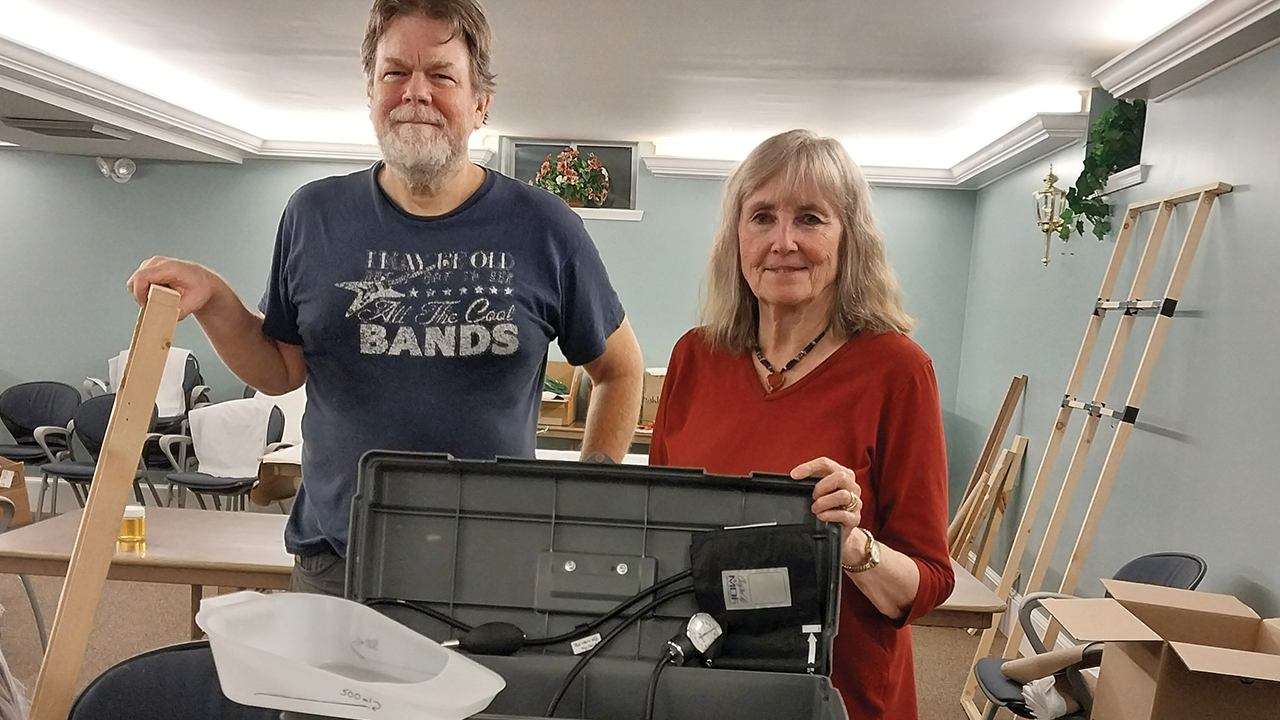
In October, Benner enlisted the help of people from Methacton to assemble Mother and Baby Toolkits. The church basement resembled a factory, with volunteers cutting strips of nylon cloth at one table and hemming the cloths on sewing machines at another. Others drew a 500-cubic centimeter-line on the bed pans or cut strips of paper for the anemia-detection kits.
Mary Roding, who hemmed cloths for the toolkits, recognized many women in South Sudan don’t live near a well-stocked hospital, so they give birth in less-than-ideal settings.
Ron Kolb-Wyckoff, who marked lines on bed pans, said: “Who would imagine that bed pans and soccer balls could be used to save lives? . . . These can be creatively used in childbirth to save women’s lives when no proper medical facilities are available.”
The congregation worked throughout the fall. The Mother and Baby Toolkits were expected to be shipped in November.
MAMA Project has worked in South Sudan since 2023. Paul Lueth, a pastor who works for a nonprofit in South Sudan, reached out to MAMA to request a partnership to help people displaced by South Sudan’s brutal conflicts. MAMA responded with a nutrition program and medical outposts.
Regina Lueth, Paul’s wife, told Benner that many women were dying in childbirth. That got Benner, a medical doctor, thinking about what the women might need to survive.
She asked what equipment the traditional birth attendants already had. The answer was none. She asked if hospitals already in South Sudan could provide such items. Benner learned that the hospitals had old and broken obstetric equipment and were often out of medical supplies. Patients needed to buy their own needles to get an injection.
With the help of medical school classmates, Benner created a toolkit with supplies that both trained and traditional birth attendants can use.
A bed pan with a 500-cubic centimeter line measures blood after a woman delivers a baby. If the blood exceeds the 500-cc line in 15 minutes, the birth attendants will know that a hemorrhage is occurring and can begin the next intervention.
Attendants wrap a long nylon cloth tightly around the woman’s abdomen and secure it with Velcro strips. The cloth acts as giant tourniquet. Then attendants place the deflated soccer ball into a pocket sewn on the long cloth and use the bicycle pump to inflate the ball, which provides pressure on the uterus to stop the bleeding.
In addition to the bedpans and body tourniquet, the kits contain obstetric equipment, a suture kit and a cookie sheet, which, along with a cloth, functions as a work tray to keep instruments clean. Also included are blankets so a mother can give birth on a clean surface, a suction ball and infant resuscitator, a blood-pressure cuff, stethoscope and an anemia-detection kit, which includes a finger-stick, strips of paper to collect a drop of blood and a color card to interpret the results.
Another important part of the kit is a thumb drive with training videos and PowerPoint presentations to educate birth attendants. The “MAMA academy,” as Benner calls it, has been translated into Dinka, the local language in South Sudan. MAMA Project provides laptop computers to the six tent clinics it has helped to establish.
MAMA Project is a nonprofit started by Benner and her sisters in southeastern Pennsylvania in 1987. It works with partners to promote health and wholeness in communities that are vulnerable and hard to reach. It trains health workers, sets up water-filtration systems, offers micronutrients and provides deworming medicines.
The “MAMA” name — an acronym for “Mujeres Amigas (Women Friends) Miles Apart” — reflects the organization’s origin as a partnership between English-speaking Mennonite women in Pennsylvania and Spanish-speaking Mennonite women in Honduras.
The work in Honduras has been taken up by Healthy Niños Honduras, a conference-related ministry of Mosaic Mennonite Conference. MAMA has projects in Tanzania, India, Kenya, Haiti and South Sudan.


Have a comment on this story? Write to the editors. Include your full name, city and state. Selected comments will be edited for publication in print or online.